
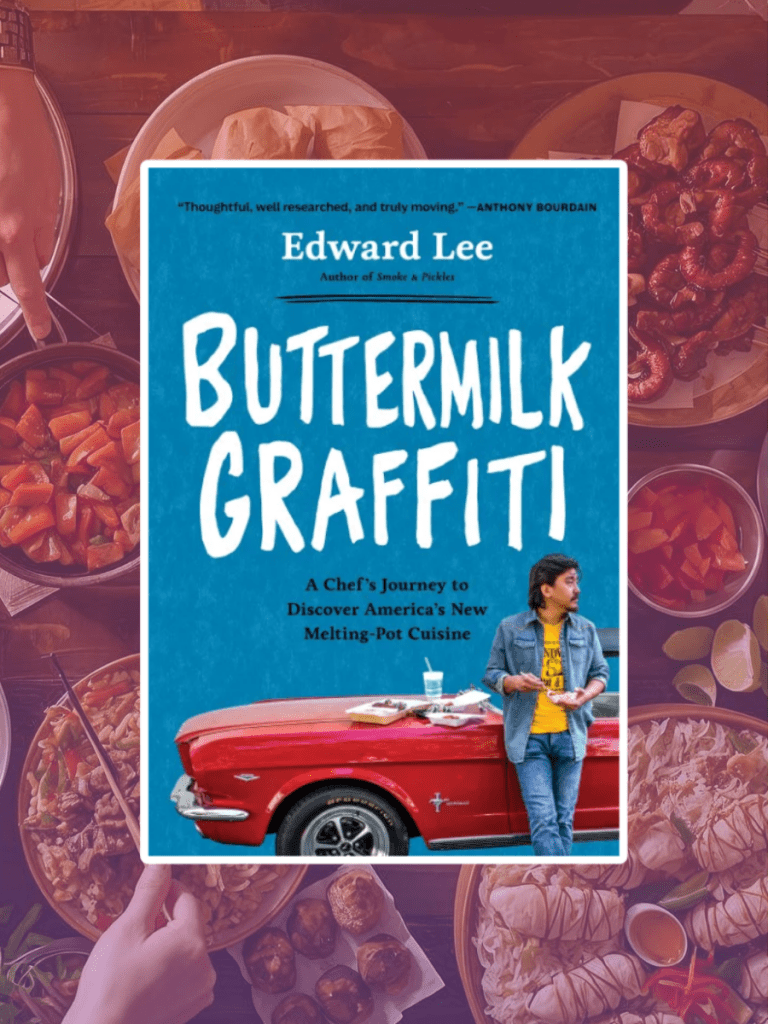
The intersection of food and culture happens in strange and beautiful ways.
Edward Lee, Buttermilk Graffiti
There are books that feed your mind. Some feed your soul. And once in a while, you stumble across one that does both—while making you hungry. Buttermilk Graffiti by Chef Edward Lee is one of those rare reads.
I’ll be honest, I picked up this book because I saw Edward Lee on that chaotic and wonderful Netflix series Culinary Class Wars. He was sharp, quietly intense, and clearly knew what he was doing. His perspective stood out to me. He is not just a chef but someone who understands that food is personal. It is also political and layered with meaning. At present enjoying watching him go around South Korea learning recipes from and cooking for grandmothers in Edward Lee’s Country Cook. Still, I wanted to know more. So, I picked up Buttermilk Graffiti, thinking it would give me a deeper perspective of the man himself. What I got instead was something much deeper. It is a memoir that maps out America not through geography or history. Instead, it is mapped through flavor, family, and the people who’ve left their imprint on both.
This isn’t a cookbook. Let’s get that out of the way. Sure, there are recipes. They’re wonderful. They arrive like little love notes at the end of each chapter. These are bonus souvenirs after an emotional journey. This is a book about culture, identity, and what it means to belong. It is told through the lens of food and migration. Edward Lee sets out to understand the immigrant experience across the U.S., and he does it the only way he knows how—by showing up, asking questions, and sharing a meal.
The Soul Behind the Stove
What makes this book special isn’t just the food. It’s how Lee approaches it. He doesn’t arrive as a celebrity chef expecting reverence or recipes. He comes as a guest, sometimes uninvited—and listens. Really listens. And if people don’t open up right away? He waits. Eats. Tries again. It’s a kind of journalistic patience. You rarely see this level of patience anymore. It is paired with the humility of someone who knows he’s on sacred ground.
In New Haven, Connecticut, he learns about smen – an aromatic, fermented Moroccan butter and the layers of tradition behind it. (Side note: I was both fascinated and lowkey terrified of it. I want to try making one of the recipes in this book, but maybe not smen. It feels like a lot of pressure… and bacteria.) It’s about memory. It’s about ritual. It’s about the people who made it for you and how their hands shaped more than just the food.
There’s something deeply respectful about the way Lee writes. His narrative voice toggles between curious outsider and reflective observer, and he never pretends to have all the answers. He invites you to sit with the questions. He encourages you to feel the complexity of identity. He wants you to understand that America’s culinary identity is immigrant identity.
Reading with a Fork in One Hand and Feelings in the Other
As someone who reads a lot of memoirs and has a complicated relationship with both food and belonging, this hit me hard in the best way. I didn’t expect to get teary over, but here we are. This book made me nostalgic for dishes I didn’t even grow up eating like the Cambodian steamed fish curry, amok trey. It made me think of family recipes written in fading ink and guarded like state secrets. It reminded me that food is often the last thing we hold on to when everything else has changed.
There’s something cathartic about observing a Korean-American chef navigate spaces where language and culture intersect with cuisine. These connections are inextricable and not always easy to access. His presence is, at times, questioned. His intentions are sometimes misunderstood. But he keeps showing up, breaking bread, asking to learn. That persistence, that willingness to not be the center of the story, is rare and incredibly moving.
And then there are the recipes, unfussy and generous. They aren’t exact replicas of what he’s tasted. Some are reinterpretations. Others are tributes. But all of them carry the spirit of what was shared and the people who shared it. I found myself bookmarking several pages, hoping to try one or two eventually.
Who Should Read This?
If you’re someone who loves Anthony Bourdain’s Parts Unknown or cries over episodes of Chef’s Table, this one’s for you. If you’ve ever bitten into something and felt a wave of emotion so intense it knocked you off your feet, you’ll find your people in these pages.
This is a book for immigrants and children of immigrants, for third-culture kids, for anyone who’s ever tried to recreate a dish from memory because the person who used to make it is no longer around. It’s for home cooks, professional chefs, foodies, and the food-curious. It’s also for readers who are tired of sanitized narratives and crave something more nuanced—something that acknowledges the complexity of identity without trying to simplify it into a digestible soundbite.
But maybe most of all, it’s for those of us who believe that food can be a bridge. That the act of sharing a meal is one of the most human things we can do. And that sometimes, the most powerful stories are the quiet ones told over a steaming bowl of something homemade.
Final Thoughts: A Book That Nourishes
I closed Buttermilk Graffiti feeling full in every sense of the word. Full of stories. Full of questions. Full of hope. Edward Lee doesn’t just chronicle a journey across America—he gives voice to the people and flavors that often go unnoticed. He reminds us that the kitchen is a sacred place, that food is both survival and celebration, and that behind every dish is a person, a place, and a story worth remembering.
This isn’t a flashy book. It’s not meant to be devoured in one sitting. It’s one you savor. One you return to. One you dog-ear and annotate. It made me want to write down my family’s recipes. It made me want to listen more. To ask better questions. To be a little braver about sharing the stories that live in my own kitchen.
So if you’re looking for a book that feeds more than your appetite—one that honors the messiness and magic of being human – put Buttermilk Graffiti on your list. Just maybe don’t read it hungry.
Food is trust, and trust is intimacy. The hardest part of trying something unfamiliar is not the fear of the unknown, but rather the mistrust of the person cooking the food.
Edward Lee, Buttermilk Graffiti

 jujucation.com