
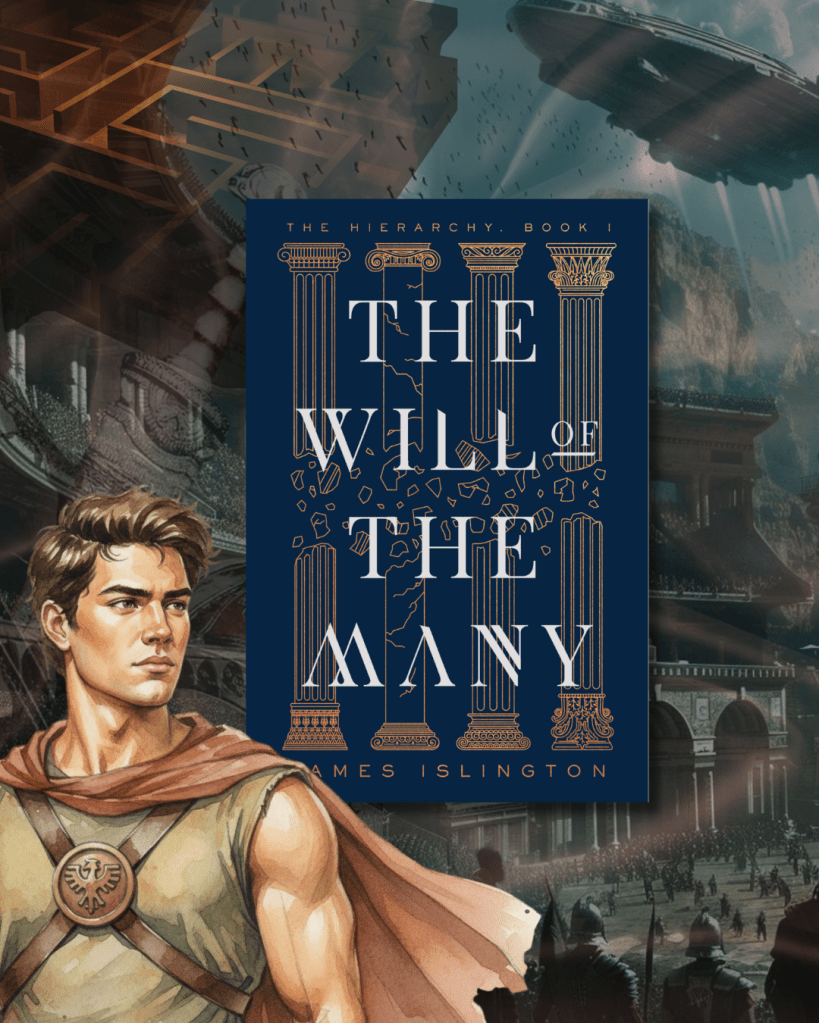
A Pyramid Scheme I’d Actually Join: James Islington’s The Will of the Many
Rating: ⭐⭐⭐⭐.75
There’s something deeply timely about a magic system built on extraction. The poor give their life force to the rich. Not as a metaphor. As a policy. James Islington calls it “ceding Will” in The Will of the Many, which sounds like something you’d hear at a corporate retreat right before they cut your benefits. The reality is simpler: it’s an empire that runs on human batteries, wrapped in togas and the language of civic duty.
We tell ourselves stories about power. Islington tells us a story about a boy trying to survive power’s machinery.
Vis Telimus is an orphaned nobility from a conquered kingdom, hiding in plain sight at the Catenan Academy, the empire’s training ground for its future elite. He’s brilliant because he has to be. Strategic because the alternative is death. He’s one of those people who would solve the crisis while you were still understanding there was a crisis. This should be insufferable, but Islington makes it work because Vis isn’t pursuing excellence. He’s pursuing survival. There’s a difference.
The first third of this book is a test. Islington spends pages—many pages—building the empire’s bones. How the hierarchy functions. Who takes from whom. Why this particular flavor of oppression feels inevitable to those living inside it. I nearly stopped reading around page 150. I thought: I understand. I see what you’re doing. Can we move on now?
But Islington isn’t showing off. He’s building a case. Every detail is evidence. Every seemingly tedious explanation matters because the book isn’t about magic—it’s about systems. How they sustain themselves. How they make collaboration feel like survival and survival feel like complicity.
The magic itself is elegant in its brutality. “Will” is autonomy made literal. The ability to control your own body, your own choices, your own future. The empire has turned it into currency. The poor give it up in exchange for nothing much. The rich accumulate it and call this civilization. If you’ve ever wondered why the exhausted subsidize the comfortable, here’s your answer rendered in speculative fiction.
The questions the book raises sit heavy: Is surviving within a corrupt system the same as supporting it? If you don’t resist, are you complicit? Vis spends 600 pages wrestling with whether to burn down the academy or simply graduate from it. The book doesn’t answer this for him. Or for us.
The supporting characters are surprisingly complete. Even minor players have agendas, histories, reasons for their choices. No one is decoration. Everyone wants something, usually at someone else’s expense. The academy is less a school than an ecosystem of competing interests, which is probably what all elite institutions are once you strip away the Latin mottos.
By the time the political maneuvering accelerates and the secrets compound, I was turning pages fast enough to get a paper cut (thankfully I was on my Kindle). The setup pays off. The world-building justifies itself. The slow burn becomes a wildfire.
7 Reasons The Will of the Many Should Be Your Next Fantasy Read (And 2 Reasons It Might Not Be)
Why You’ll Love It:
1. The Magic System Functions as Social Critique In a genre oversaturated with elemental powers and prophesied heroes, Islington’s “Will” system, where the disenfranchised literally cede their life force to the powerful, is both innovative and uncomfortably familiar. It’s fantasy that holds up a mirror to extraction economies.
2. It’s Academia Meets Political Thriller The Catenan Academy isn’t just a backdrop for magical education. It’s where the empire trains its future oppressors, and every friendship is shadowed by the question of who will betray whom first. Think less magical school, more pressure cooker of ambition and survival.
3. The Protagonist’s Flaws Are Structural, Not Superficial Vis isn’t flawed because he’s impulsive or arrogant. He’s flawed because he’s complicit by necessity, brilliant by survival instinct, and morally compromised in ways that feel uncomfortably real. His struggle isn’t whether he can win, it’s whether winning means anything.
4. Every Detail of World-building Earns Its Keep The beginning is dense with political structures and historical context. But Islington doesn’t waste exposition. That bureaucratic detail? It matters. That hierarchy you had to memorize? That’s the entire point. The world-building is the story.
5. The Pacing Transforms Completely Once the academy politics ignite, the book shifts from deliberate setup to relentless momentum. The final 300 pages move like a thriller—betrayals compounding, secrets spilling, consequences accelerating.
6. It Explores Big Ideas Without Preaching The book examines colonialism, complicity, and utilitarian ethics without feeling like a lecture. The philosophy is structural, not decorative. You’re thinking about power while racing through the plot.
7. The Sequel Arrives This November You can binge the first book and jump straight into the second without years of waiting. Perfect timing for total immersion.
Why You Might Not:
1. The Opening Third Demands Patience If you need immediate action and constant momentum, the extensive world-building may test your commitment. Islington takes his time establishing the system before showing you why it matters.
2. Vis Can Feel Almost Too Competent While his struggles are genuine, Vis rarely fails catastrophically. If you prefer protagonists who regularly crash and burn before succeeding, his measured competence might feel too controlled.
The Verdict: If you want epic fantasy with intellectual heft, moral complexity, and a magic system that doubles as sociology, The Will of the Many is essential. Just bring patience for the setup and prepare to lose sleep over the payoff.
“There comes a point in every man’s life where he can rail against the unfairness of the world until he loses, or he can do his best in it. Remain a victim, or become a survivor.”
Will this book change your life? Probably not. Will it make you think about power while keeping you thoroughly entertained? Yes. Will you want the sequel the moment you finish? I’ve already marked November on my calendar.
The Will of the Many is for readers who want their fantasy to mean something beyond the plot, who can tolerate dense world-building for substantial payoff, who prefer moral complexity to moral certainty. If you loved The Name of the Wind but wished for higher stakes, or if you’re drawn to stories that examine how systems perpetuate themselves, this will satisfy.
You just have to get through those first 150 pages. I promise it’s worth it.

 jujucation.com