
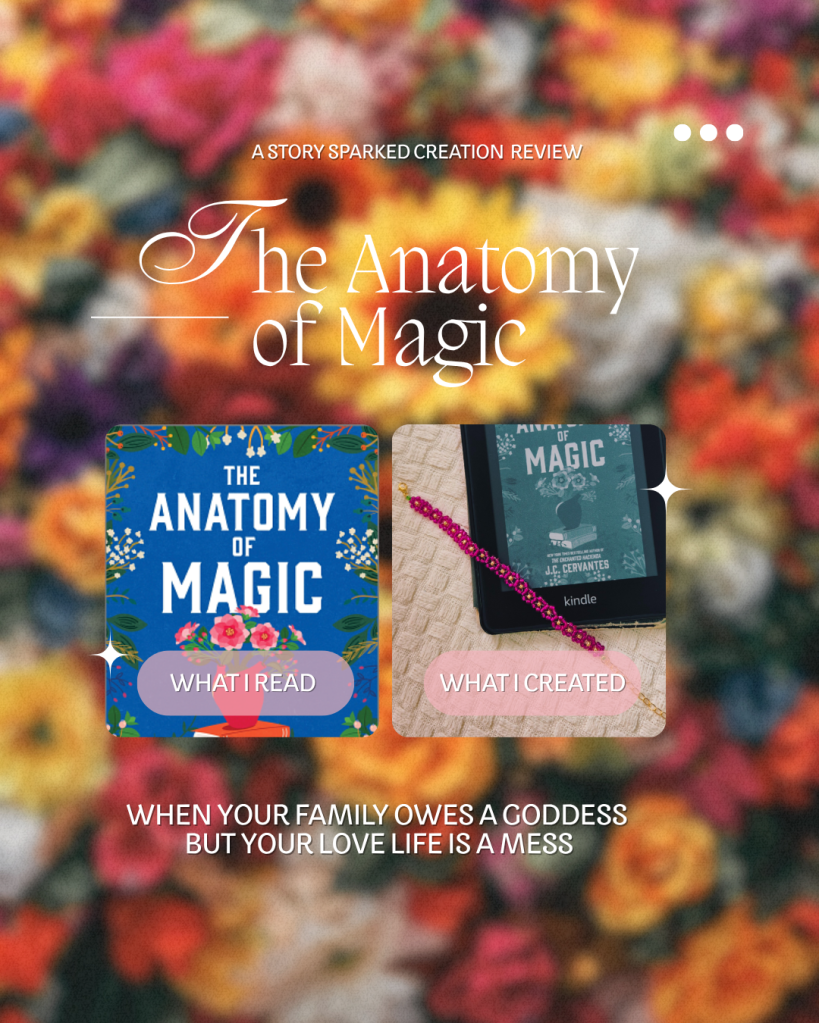
Here’s what I do: Sometimes, I make things from the books I read. Sometimes inspired by. Sometimes vaguely themed around. Sometimes I make crafts that come directly from the stories themselves, little tangible proof that fiction can become something you can hold. Go on dear reader to find out what book inspired me to craft.
This is what nobody tells you about magical realism: sometimes the family pact with a deity makes more sense than the relationship drama. J.C. Cervantes’ The Anatomy of Magic is Practical Magic meets Encanto—a family bound by divine contract to protect love, passion, and beauty, each woman wielding her own supernatural gift. Add a second-chance romance that’ll make you simultaneously swoon and roll your eyes.
What’s It Actually About?
Lilian Estrada, Lily, is an OB-GYN who literally cast a spell on herself to stop feeling things (relatable, honestly). After a traumatic event, she retreats to her family’s magical home in Mexico, where generations of Estrada women have honored their deal with a goddess: in exchange for flower magic, they protect love, passion, and beauty in the world. There, she runs smack into Sam, her first love and the reason her life took a hard left turn years ago. Cue the family secrets, a scene-stealing dog named Bullet, and enough Mexican mythology to make Isabel Allende proud.
Each woman has her own gift. Memory magic. Healing. And yes, there’s a cousin and aunt who can communicate with flowers—though here’s my gripe: I wanted so much more of that. Tell me everything about talking to roses. Show me what bougainvillea gossips about. Give me the flower whisperers doing their thing. But maybe that’s what sequels are for, and I haven’t even read the first book (The Enchanted Hacienda), so there’s clearly more Estrada magic waiting.
Think Emily Henry meets magical realism, with all the emotional weight of family legacies bound to divine obligation, and the question: what happens when you’ve spent years refusing to feel anything at all?
The Stuff That I Still Think About
On Numbness Versus Healing
Lily’s whole deal is that she thought not feeling pain would solve her problems. Spoiler: it didn’t. Cervantes nails this idea that emotional avoidance isn’t self-care, it’s just delayed suffering. The magic system here isn’t about fixing things; it’s about forcing you to look at what you’ve been hiding from.
Memory as Currency and Sacred Duty
In this family, flowers aren’t just precious. They’re literally power. They sustain the magic, fulfill the goddess’s bargain, shape identity, and connect generations. When Lily has to decide what she’s willing to sacrifice, it’s not just metaphorical hand-wringing. There are actual stakes. The family made a deal with a goddess to protect love, passion, and beauty, and every choice ripples through that ancient contract.
The Family Magic System
Multiple generations of women, each with distinct powers, bound together by divine obligation. The house itself is practically a character. Different gifts serve the same sacred purpose.
About Those Flower Powers…
A cousin and aunt who can communicate with flowers? This is the kind of magic that deserves whole chapters. Conversations with petals. Botanical secrets. The language of blooms as actual dialogue. But we only get glimpses, and I’m left wanting an entire book about the flower whisperers. Maybe there’s a sequel coming. Maybe The Enchanted Hacienda (which I haven’t read yet) covers more. But in this book, it felt like watching someone mention they can fly and then never leaving the ground.
About That Romance…
Look, I’m a sucker for second-chance love stories. The yearning, the history, the “what if we’d chosen differently?” But here’s where I have to be honest: the reason Lily and Sam split up in the first place feels… thin. Like, you’re telling me this is why you spent years apart? The emotional reconnection is lovely, but the original obstacle doesn’t quite earn the decade of separation that follows.
Five Things You’ll Actually Remember
- Memory magic isn’t cute—it’s brutal. Forgetting the bad stuff means losing the good stuff too, and Cervantes doesn’t let anyone off easy.
- Divine contracts have generational consequences. The Estradas made a deal with a goddess to protect love, passion, and beauty, and that bargain shapes every choice.
- Scientific thinking and magical heritage aren’t opposites. Lilian being a doctor AND a witch isn’t a contradiction; it’s the whole point.
- Second chances require showing up scared. You can’t rewind. You can only choose differently right now.
- Sometimes sacrifice is the opposite of martyrdom. Giving up what you love most can be the most powerful choice you make, but ONLY when it’s actually your choice.
Who Should Read This
Pick it up if you:
- Loved Practical Magic‘s family dynamics or Encanto‘s generational gifts
- Appreciate Mexican folklore and settings that feel lived-in, not touristic
- Like your magical realism emotionally messy (Isabel Allende, Alice Hoffman fans)
- Want family drama where the stakes involve divine contracts
- Enjoy Emily Henry but wish she’d add supernatural elements and goddess bargains
Skip it if you:
- Need your fantasy plots tight and action-heavy
- Hate when the central relationship conflict feels manufactured
- Prefer romance where the obstacles make you go “oh yeah, that’s genuinely complicated”
- Want minimal feelings and maximum plot momentum
- Expect every mentioned magical power to get full screen time
Story Sparked Creation: A Beaded Flower Bracelet
After finishing The Anatomy of Magic, I made a beaded bracelet. I have made my share of beaded bracelets (the Eras tour gave me the chance to) , and honestly, the process taught me something Lily Estrada would understand: sometimes your hands remember what your brain has forgotten.
The bracelet is fuchsia—bold, unapologetic, the color of bougainvillea spilling over Mexican courtyard walls. The color that would make a goddess of love, passion, and beauty nod in approval. I could have arranged fresh flowers, sure. That would have been the obvious choice for a book about a family bound to protect beauty itself, where some members can literally talk to flowers. But here’s the thing about fresh flowers: they’re beautiful for a week, then they’re compost. A beaded bracelet? That’s wearable memory. That’s magic you can carry on your wrist for years. Flowers can be worn, not just arranged in vases waiting to wilt. This way, I get to keep them.
I tried a new beading technique, one that required the kind of fine motor control I haven’t exercised since who knows when. My fingers fumbled at first. The seed beads scattered. The thread kinked. I had that specific frustration that comes from knowing your hands used to be better at this, that muscle memory is real but also requires maintenance, like a spell you’ve let grow rusty.
Then something shifted. Maybe fifteen minutes in, maybe twenty. The fumbling became rhythm. Thread, loop, pull tight. Thread, loop, pull tight. My breathing slowed. The physical act of creation turned meditative, the way prayer probably feels or like honoring a goddess’s bargain, one bead at a time. Each tiny bead a moment, a memory, threaded onto something that would hold. This is what the Estrada women knew: that making something with your hands isn’t just craft. It’s conjuring. It’s fulfilling the contract to protect beauty by creating it yourself.
The fuchsia flowers took shape one petal at a time. Small magic. Quiet magic. The kind that doesn’t announce itself but persists anyway—exactly like the memories Lilian fought so hard to keep and release and understand. When you make something yourself, when your slightly clumsy fingers force tiny beads into bloom, you’re doing what memory magic does: taking something ephemeral and making it last. Taking something fragile and giving it structure. Choosing what to preserve and what to let scatter across the table.
Maybe this is what that cousin and aunt do when they talk to flowers. They listen to the language of lasting versus fading, of bloom versus wilt. They understand what I learned making this bracelet: that preservation is its own kind of magic.
So yes, I made a bracelet instead of an arrangement. Because sometimes the best way to honor a story about memory and a family bound to protect beauty is to create something that remembers: something that stays, something you can touch, something that proves you were here and you felt everything and you made something anyway.
That’s the real magic, I think. Not the forgetting. Not even the talking to flowers, though I desperately wanted more of that. The making.
The Bottom Line
The Anatomy of Magic is gorgeous, heartfelt, and occasionally frustrating in the way that real relationships are. Except some of that frustration comes from plot choices rather than authentic complexity. Cervantes writes beautifully about grief, numbness, and the courage it takes to feel again. The magic system rooted in divine obligation is compelling. The family dynamics ring true. The setting is transporting.
But that central romantic conflict? It’s the one spell that doesn’t quite land. And those flower whisperers? They deserved so much more page time.
Still, if you want a story about women inheriting magic and mess in equal measure, about honoring a goddess’s bargain while figuring out your own heart, about choosing to feel everything even when it hurts, this delivers. Just don’t expect the reason they were apart to make as much sense as the reason they find their way back. And maybe read The Enchanted Hacienda first—or save it for after, when you’re hungry for more Estrada magic.
And if you’re looking for a way to keep the story with you? Make something with your hands. Let it be clumsy at first. Let it become meditation. Let it teach you what your fingers remember about creation, even when you think you’ve forgotten how to feel. Let it be your own small way of protecting beauty, just like the Estradas promised a goddess they would.

 jujucation.com