
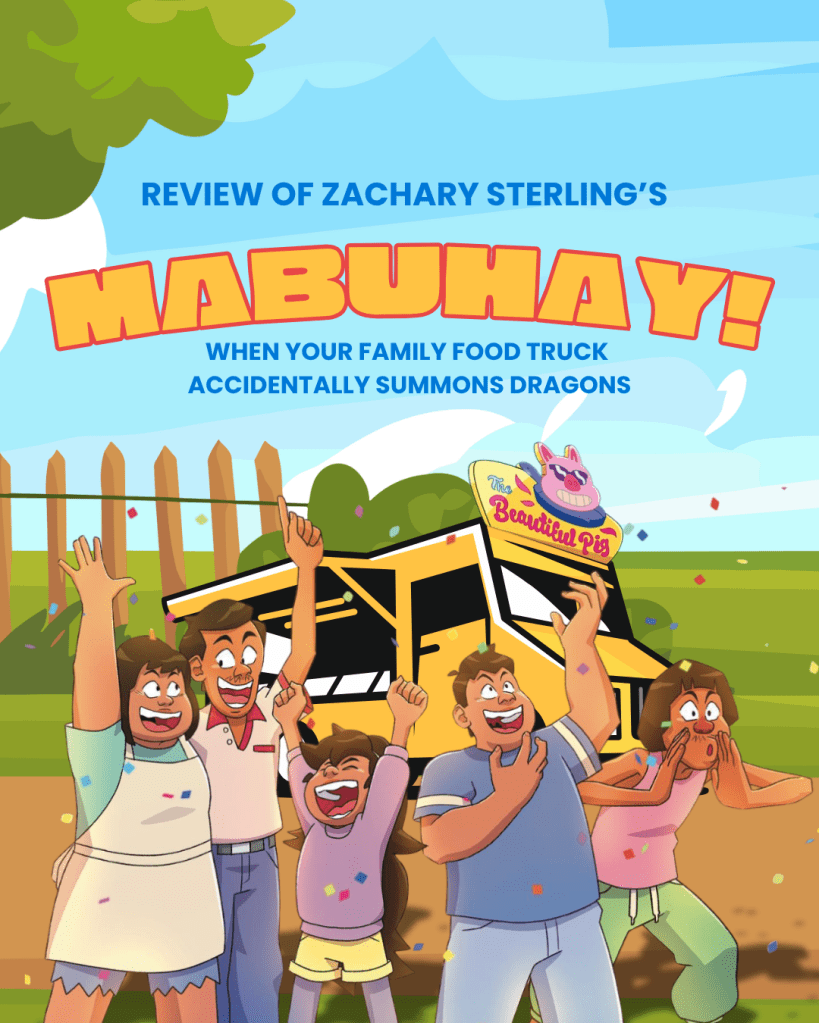
You know that friend who messages that you have to read this book? The one who texts you book-related links at midnight? Well, mine came through this time. She mentioned Mabuhay! When I lamented that the current book I was reading got Filipino food wrong, and before she could finish her sentence, I was already on Libby, one-clicking that “borrow” button like my life depended on it.
Here’s what I wasn’t expecting: to be completely charmed by a middle-grade graphic novel about Filipino siblings helping their parents run a food truck in Oregon. But Zachary Sterling knows exactly what he’s doing, and by page ten, I was hooked—laughing at the sibling banter, getting hungry (more on that later), and wondering why more books don’t come with footnotes/glossary explaining delicious food.
The Setup: Family, Food Trucks, and The Mortification of Being Seen
Meet JJ and Althea Bulan, two kids who would rather be literally anywhere than working their family’s food truck, The Beautiful Pig. If you’ve ever been a teenager forced to wear a mascot costume while your crush walks by, you’ll feel their pain in your bones. Sterling captures that specific agony of loving your culture while simultaneously wanting to disappear into the linoleum whenever your parents do something “embarrassing” in public.
The food truck isn’t just a plot device—it’s the stage where identity, shame, and pride throw down in a cage match. And those footnotes? They’re genius. Instead of making you feel stupid for not knowing what lumpia is, they make you feel like you’re in on a delicious secret. I found myself Googling Filipino restaurants at 11 PM, which leads me to my personal crisis.
I Need to Talk About the Food
Listen. I was not prepared for how much this graphic novel would make me crave Filipino food. Sterling describes dishes with the kind of casual reverence that makes your mouth water and your soul ache a little. The adobo. The kare-kare. The casual mentions of halo-halo that made me pause mid-page and stare longingly at my boring refrigerator.
I’m now on a mission to find authentic Filipino food in my neighborhood (which should not be this tough), which might be the most successful marketing campaign for Filipino cuisine I’ve ever encountered. If that was intentional, Sterling, well played.
The Folklore Surprise That Stole My Heart
But here’s where Mabuhay! went from “charming” to “I’m recommending this to everyone I know”: the Filipino folklore.
I’ll be honest—I didn’t know what to expect when the story shifted into mythological territory, but I was pleasantly surprised by how Sterling weaves manananggal, aswang, and other creatures from Filipino legend into the narrative. These aren’t white-washed, sanitized versions of folklore. They’re weird and wonderful and sometimes terrifying in the way real folklore should be.
What hits differently is how Sterling uses these myths as a survival guide rather than decoration. The “annoying tales” JJ and Althea’s mom tells them? Turns out they’re the blueprint for staying alive when supernatural trouble comes knocking. It’s a love letter to every immigrant parent who insisted on telling stories while their kids rolled their eyes, only to realize later that those stories held everything they needed to know.
7 Life Lessons From a Graphic Novel About a Food Truck (Yes, Really)
1. Your Parents’ Embarrassing Stories Are Actually Survival Manuals
Those folktales your family insisted on telling at the worst possible moments? They’re not just background noise—they’re instructions for navigating both actual monsters and the metaphorical ones (like middle school social hierarchies).
2. Food Is the Most Honest Language We Have
The Beautiful Pig food truck proves that what we eat and share tells the truth about who we are, where we’re from, and what we value. It’s vulnerability wrapped in banana leaves.
3. You Can Roll Your Eyes at Your Culture and Still Love It Fiercely
JJ and Althea show us that ambivalence isn’t betrayal. You’re allowed to find your family mortifying on Tuesday and be ready to fight dragons for them by Thursday.
4. The Magic Is Always Hiding in the Mundane
Sterling teaches us to expect the extraordinary in ordinary places. That food truck? Portal to adventure. That difficult customer? Maybe something more. Nothing is ever just one thing.
5. Heroes Don’t Want the Job—That’s How You Know They’re Real Ones
True courage looks like doing the thing anyway when you’re scared, annoyed, and would rather be literally anywhere else. Reluctance is honest. Reluctance is relatable.
6. Representation Means Getting Specific, Not Generic
Mabuhay! doesn’t try to represent all Asian experiences or all immigrant stories. It’s unapologetically, specifically, reverently Filipino—and that specificity is what makes it universal.
7. Humor Is How We Survive the Unsurvivable
Whether you’re facing down a supernatural creature or your sibling’s attitude problem, sometimes the only weapon you have is the ability to laugh at the absurdity of it all. Sterling wields humor like a shield.
Who Needs This Book in Their Life?
Read this if you:
- Have ever felt caught between two cultures (or two versions of yourself)
- Are raising kids who need mirrors, not just windows
- Appreciate when humor and heartbreak share the same panel
- Want representation that doesn’t feel like it’s trying too hard
Skip this if you:
- Demand strict realism with zero magical elements
- Have an irrational hatred of graphic novels (though, respectfully, get over it)
- Prefer your stories without cultural specificity
- Don’t believe middle schoolers can carry complex narratives
The Verdict: Read It, Then Feed Everyone
Mabuhay! does what the best middle-grade literature does: it takes young readers seriously. Sterling doesn’t talk down, dumb down, or sugarcoat. He trusts his audience to handle complexity, ambivalence, and the truth that sometimes you save the world while still being annoyed at your family.
This is a book that asks you to remember where you come from, even when (especially when) that origin story is complicated. It asks you to change how you see the ordinary—to look for magic in food trucks and folklore in your parents’ lectures. And maybe, if you’re brave enough, it asks you to act: to claim your whole, complicated identity and defend it against whatever monsters show up.
Also, it will make you extremely hungry. Consider this your warning.
My friend was right. Sometimes the midnight text-message book recommendations are worth it. Mabuhay!—long may you thrive, and long may the rest of us find books that feed us this well.
Have you read Mabuhay? What surprised you most? Drop a comment below—I need to know if anyone else immediately searched for Filipino restaurants after reading this.

 jujucation.com