
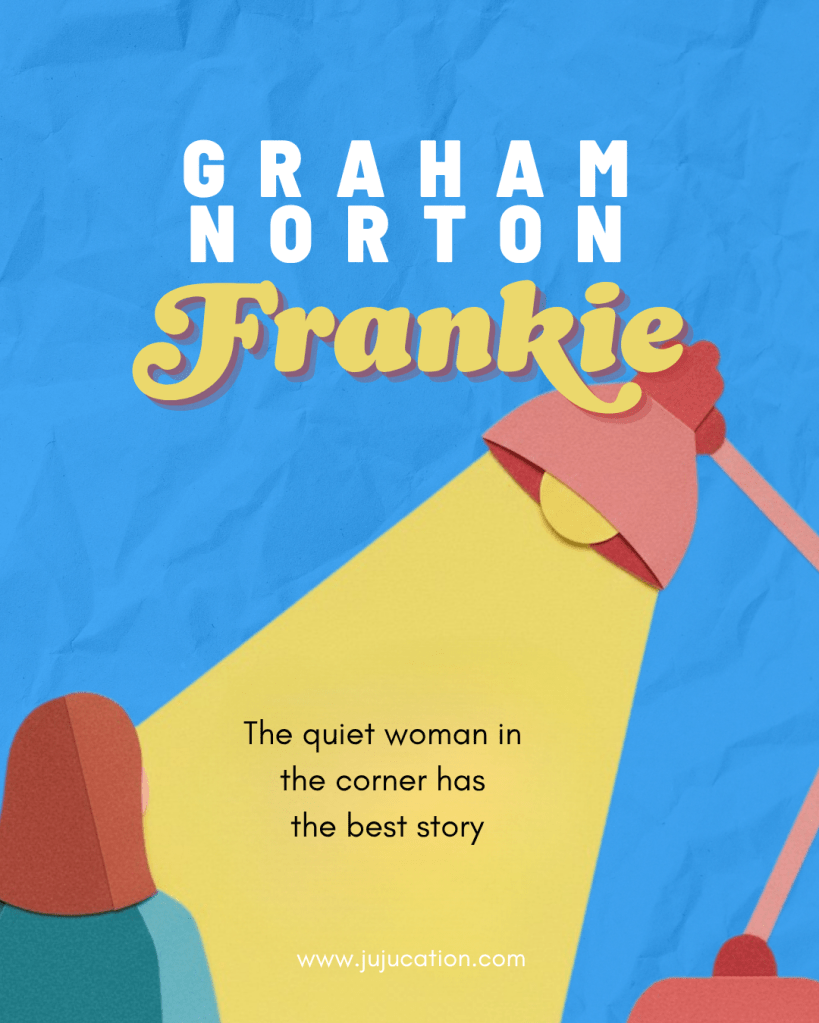
Here’s what nobody tells you about living a big life: you don’t actually have to be loud about it.
Graham Norton’s Frankie, understands this in a way that makes my heart hurt in the best possible way. It’s the story of Frances “Frankie” Howe, who at 84 insists she did not “have a fall”—a distinction that immediately tells you everything about her spirited refusal to be diminished by age or circumstance or the world’s relentless insistence that women disappear quietly.
When a young Irish caregiver named Damian arrives to help during her recovery, Frankie does something she’s never done before: she tells her story. All of it. From orphaned child in post-war Ireland to reluctant teenage bride, from London’s 1950s lesbian literary circles to New York’s vibrant art scene, through the AIDS crisis that decimated her chosen family in the 1980s.
What Makes This Book Impossible to Put Down
Let me be clear: this is not a book about a woman who sets out to conquer the world. Frankie doesn’t storm boardrooms or lead revolutions or deliver rousing speeches. She’s the woman standing slightly to the side, observing, adapting, surviving. And Norton has written her with such clear-eyed tenderness that you’ll find yourself thinking about her weeks after you’ve finished reading.
The real genius here is how Norton captures what it meant to be a woman navigating spaces that weren’t designed for you. 1950s Ireland, where a good parent was simply one who kept their child breathing. London’s literary world with its unspoken rules. New York’s restaurant scene. These aren’t backdrops—they’re living, breathing constraints that Frankie must constantly negotiate.
But here’s what grabbed me by the throat: I realized, somewhere around page 150, that I’ve spent years gravitating toward stories that span decades. There’s something about watching a life unfold across time that feels like watching someone learn to swim in increasingly complicated waters. You see the patterns. You see how one choice ripples into another, how trauma reshapes itself, how resilience isn’t one dramatic moment but a thousand small decisions to keep going.
The Friendship That Anchors Everything
If you’re tired of novels where female friendship is either uncomplicated cheerleading or toxic competition, Frankie offers something better: messy, enduring, complicated love between Frankie and her lifelong friend Norah (later “Nor”). Their relationship spans seven decades, survives jealousy and misunderstanding and completely different life trajectories, and remains the gravitational center of Frankie’s world.
This is chosen family before we had the language for it. This is what it looks like when someone sees you fully and keeps showing up anyway.
What You’ll Actually Learn From This Book
On Agency: Watching Frankie slowly claim her own life, learning to make choices rather than simply accepting what’s handed to her, is a masterclass in how agency isn’t always loud. Sometimes it’s just the quiet decision to leave, to stay, to try something new, to let yourself be happy.
On Being Surrounded by “Big” Personalities: Frankie spends her entire life around people with more money, more confidence, more everything. Norton’s stroke of genius is giving her center stage at the end, not because she finally becomes loud, but because her story finally gets told. That felt right in a way I’m still processing.
On Witness: The novel argues (persuasively) that bearing witness to others’ lives, and having your own life witnessed, is what gives meaning to existence. Damian’s role isn’t just narrative device; it’s the book’s thesis statement.
7 Reasons This Book Will Stay With You
- Life doesn’t require a spotlight to be significant – Frankie proves that peripheral vision can be a superpower, not a limitation.
- Your history deserves telling before it disappears – Every ordinary life contains extraordinary moments; the tragedy is when they’re never shared.
- Friendship can sustain you through decades – Romantic love gets all the press, but Frankie and Nor’s bond proves that platonic love can be equally transformative and complicated.
- Resilience isn’t about never breaking – It’s about continuing. Frankie faces forced marriage, betrayal, devastating loss, and the AIDS crisis, yet she perseveres without becoming bitter.
- Women’s hidden histories matter – From Ireland’s suffocating religiosity to London’s lesbian literary scene to limited opportunities everywhere, the book excavates stories that deserve remembering.
- Community creates meaning during crisis – The AIDS epidemic sections show how people build spaces of care and connection when institutions fail them entirely.
- Geography shapes who we become – Frankie’s journey from rural Ireland to cosmopolitan New York mirrors her internal transformation in ways that feel earned, not contrived.
Who Needs This Book In Their Life
Read Frankie if you’re drawn to character-driven stories about ordinary people’s extraordinary lives. If you appreciate Irish fiction with emotional depth. If you want to understand the AIDS crisis not as historical fact but as human loss. If you’ve ever felt like you were living your life from the periphery and wondered if that was enough.
(Spoiler: it’s not just enough. Sometimes it’s everything.)
Who Can Skip It
Don’t pick this up if you need constant action and tight plotting. Frankie isn’t going to satisfy your thriller cravings. This is contemplative, reflective, emotionally weighty. If you prefer protagonists who aggressively drive their own narratives rather than responding to circumstances, you’ll find Frankie frustrating. If you want pure escapism without tears, look elsewhere. Bad things simply happen here, the way they do in actual lives.
The Final Word
Here’s what I keep coming back to: Frankie’s life philosophy that emerges gradually through the novel—”To know that you’ve known happiness, to know that you’ve been loved, there is a great comfort in that.” This isn’t self-help wisdom or Instagram inspiration. It’s hard-won understanding from someone who lived through genuine suffering and chose to focus on what sustained her rather than what broke her.
In an era drowning in irony and cynicism, Frankie offers something increasingly rare: honest sentiment without manipulation. It’s a celebration of life that acknowledges pain without wallowing in it. It trusts you to appreciate a story told with integrity rather than melodrama.
That alone makes it worth your time.
But more than that, it gives you Frankie, a protagonist who’ll stay with you long after you close the book, reminding you that the quiet people observing from the sidelines often have the richest interior lives and the most interesting stories.
And sometimes, if we’re lucky, they finally get to tell them.
Rating: 4.5/5 stars
Have you read Frankie? What did you think about Norton’s handling of the AIDS crisis? Share your thoughts in the comments below.

 jujucation.com