
Or: How a Saturday workshop turned into an existential reckoning with craft addiction, directional mantras, and the radical power of choosing color
I have a problem. It’s not a serious problem, not in the grand scheme of things, but it’s persistent, and slightly embarrassing, and it’s currently threatening to consume every available surface in my apartment. The problem is this: I cannot stop signing up for craft workshops.
Pottery? Signed up. Bookbinding? Obviously. Gelli plate printing? Already own one and planning to purchase plates in different sizes. Macramé, embroidery, candle making, bookbinding, journaling —you name it, I’ve either tried it or it’s sitting in my mental queue, waiting for the right moment (read: a fleeting surge of motivation) to strike.
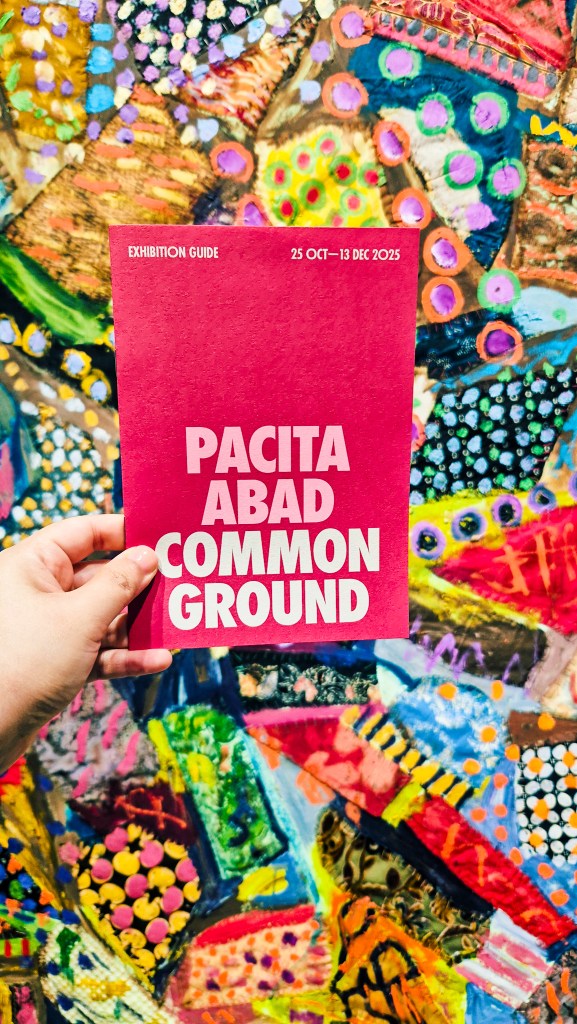
So when I saw that STPI (Singapore Tyler Print Institute) for the uninitiated, was offering a relief printing workshop tied to their Pacita Abad: Common Ground exhibition, I did what any reasonable person with an already overflowing craft supplies closet would do.
I signed up immediately.
And reader, I am so glad I did. Because what I thought would be a pleasant Saturday afternoon activity turned into something much bigger: a masterclass in fearless experimentation, a meditation on the value of trying things badly before doing them well, and an introduction to an artist whose story made me want to paint my entire life in 55 different colors.
Let me explain.
Why I Signed Up (Or: FOMO Meets Genuine Curiosity)
If I’m being honest, and I always try to be, even when it makes me look slightly unhinged, I signed up for this workshop for three reasons:
- I’d been wanting to learn relief printing for ages. There’s something deeply satisfying about the idea of carving your own stamps and pressing them onto fabric or paper. It feels ancient and modern at the same time, like you’re participating in a craft tradition that goes back centuries while also making something entirely your own.
- STPI has an incredible reputation. This isn’t just some community center hobby class (though I love those too, no shade). STPI is a serious creative workshop that has hosted some of the world’s most renowned contemporary artists. The chance to work in their space, with their facilitators, using their materials? That’s not something you pass up.
- I knew almost nothing about Pacita Abad, and that felt wrong. I’d seen the Alkaff Bridge—everyone in Singapore has—but I didn’t know the story behind it. I didn’t know about the woman who, in the final months of her life, insisted on painting a pedestrian bridge in 55 colors and 2,350 hand-painted circles because she believed art should make people smile. I didn’t know she’d traveled to over 60 countries, created thousands of artworks, pioneered a technique called trapunto painting, or that she was a political refugee who turned displacement into one of the most vibrant artistic practices of the 20th century.
I was about to learn all of this, and more.
The Workshop Setup: Cozy Chaos Meets Artistic Precision
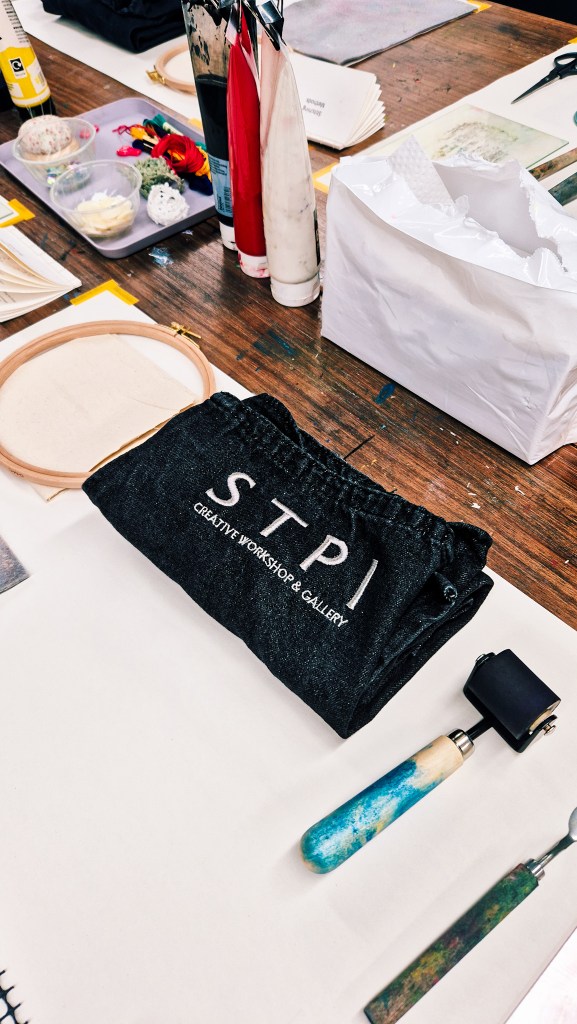
I arrived at STPI on a Saturday afternoon with the kind of adorably optimistic energy I reserve for new creative endeavors. You know the feeling: fresh notebook, new apron, the secret belief that you might discover you’re a secret genius at this particular craft.
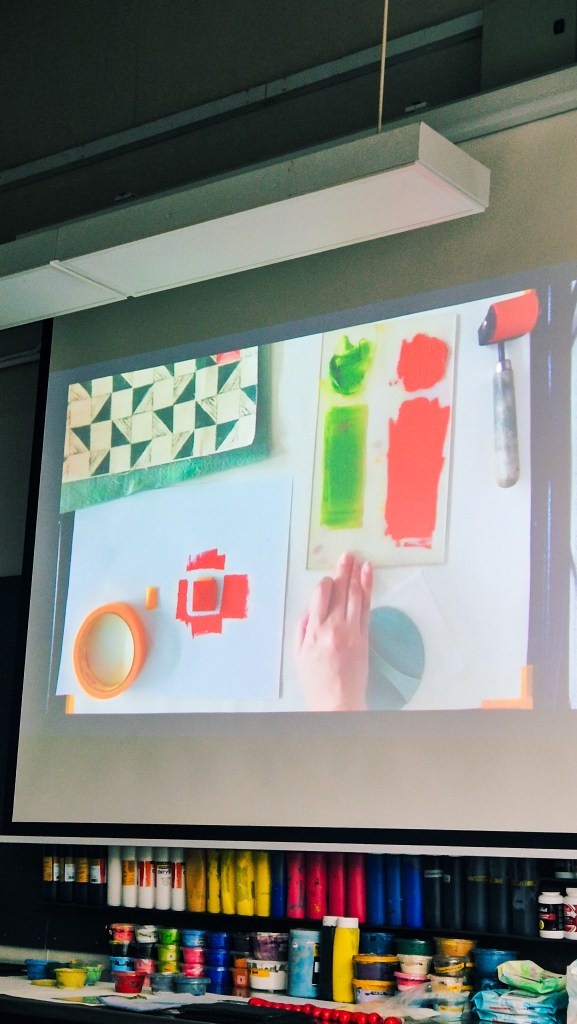
The space was everything I’d hoped for—bright, organized, smelling faintly of ink and possibility. Tables were set up with all our supplies: linoleum blocks, carving tools, fabric squares, ink, rollers, and projected on the screen is a reference image showing Pacita Abad’s bold, abstract patterns.
The facilitators gave us a quick overview of the process: we’d be carving our own relief stamps, inspired by Abad’s love of circles, abstract forms, and repeating patterns. Then we’d ink our stamps and print them onto fabric. And finally, we’d add embroidery details with colorful thread to create a finished textile piece.
Simple enough, right?
Reader, it was not simple.
The Carving Part: A Journey in Humility
Let me start by saying that I have reasonably good fine motor skills. I can thread a needle without wanting to throw it across the room. I’ve successfully completed multiple embroidery projects. I can write in very small handwriting when required.
None of this prepared me for carving linoleum.
The problem with relief printing is that you have to think in reverse. You’re carving away the parts you don’t want to print, which means your brain has to constantly flip the image in your mind. Add to this the fact that the carving tools are sharp (obviously), the linoleum has a tendency to slip (terrifying), and you’re trying to create clean, precise lines in a material that has its own ideas about how it wants to be carved.
I spent the first fifteen minutes in a state of mild panic, holding my carving tool like it was a live scorpion, making tentative little scratches on the surface while everyone around me seemed to be carving with the confidence of Renaissance sculptors. I was worried that I was making superficial cuts that wouldn’t show up in the final piece.
But here’s the thing about good facilitators: they notice when someone is about to have a small existential crisis over a craft project.
One of them came over, watched me for a moment, and then said, very gently, “You’re doing good”.
And just like that, something shifted. I stopped trying to control every millimeter and started working with the material instead of against it. My lines became cleaner. My confidence grew. I carved circles and crescents and abstract shapes inspired by the Pacita Abad reference images, and slowly, really very slowly, my relief stamp began to take shape.
It wasn’t perfect. Some of my lines were wonky. One of my circles looked more like a lumpy potato. But it was mine, and I’d made it with my own hands, and that felt like a small miracle.
Repeating Patterns: A Humbling Exercise in Spatial Awareness
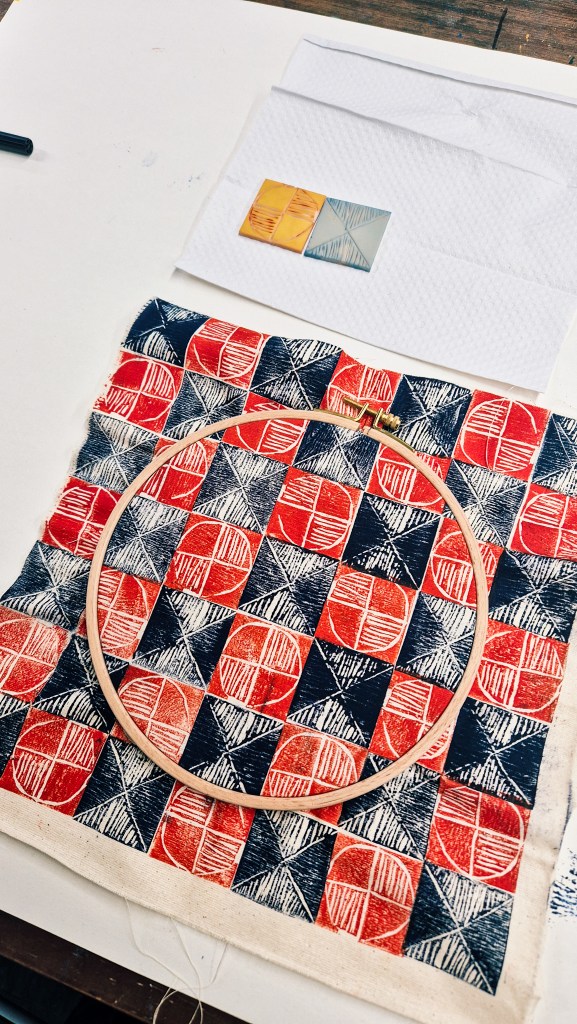
Once our stamps were carved, we moved on to the printing phase. The facilitators demonstrated how to ink the stamp using a roller (this part I was confident about, thanks to my gelli plate experience), position it on the fabric, and press down firmly to transfer the image.
They also gave us a crucial tip: mark an arrow on the back of your stamp to keep track of orientation.
“This will help you create consistent repeating patterns,” they explained.
I nodded sagely, thinking: Yes, of course, very sensible, I am a person who thinks about spatial orientation.
Reader, I did not think enough about spatial orientation.
Despite the helpful arrow, despite my best intentions, I found myself second-guessing every single placement. I’d ink my stamp, position it carefully on the fabric, and then, right before pressing down, I’d have a moment of pure panic.
Wait. Is this right? Is the arrow pointing up? Or is up actually down from this angle? If I rotate it 90 degrees, will it still line up with the previous print?
I started whispering to myself like I was navigating a particularly tricky yoga pose: “Up, right, down, left. Up, right, down, left.”
The person next to me glanced over, probably wondering if I was okay. I did not make eye contact.
I was not okay. I was having a full internal debate about cardinal directions and pattern repetition while trying to look like a calm, competent adult participating in a casual Saturday craft workshop.
But you know what? It worked. My directional mantra kept me on track. My repeating pattern slowly emerged, not perfectly aligned, not professionally executed, but undeniably mine. And there was something deeply satisfying about seeing the design multiply across the fabric, each circle and crescent building on the last, creating something larger than any individual element.
This, I realized, was what Pacita Abad must have felt when she created her massive works, this sense of accumulation, of building something complex out of simple repeated gestures, of trusting that the pattern will reveal itself if you just keep going.
The Embroidery Part (Or: Things I Took Home to “Finish Later”)
By the time we got to the embroidery phase, we were running low on time. The facilitators handed out needles and colorful embroidery thread, demonstrating how we could add detail and texture to our printed designs.
I made exactly three stitches.
They were beautiful stitches, I’m not going to lie. Perfect little straight stitches in vibrant yellow thread, carefully placed along one of my printed circles. I felt very accomplished.
And then time was up.
“Don’t worry,” the facilitators said, handing us baggies of thread to take home. “You can finish at home!”. And for some strange reason I decided to pull out the thread.
I accepted my baggie with the solemn knowledge that this unfinished project would join the ranks of other unfinished projects currently residing in my craft corner: the half-completed embroidery hoop, the macramé wall hanging missing its final row, the pottery bowl that still needs to be glazed and fired.
But here’s the thing: I don’t actually feel bad about this. Because the joy wasn’t in finishing, it was in learning, in trying, in carving and inking and printing and feeling my way through a new technique. The finished product matters, sure, but what matters more is the doing.
And this, I would learn during the exhibition tour, was very much in the spirit of Pacita Abad herself.
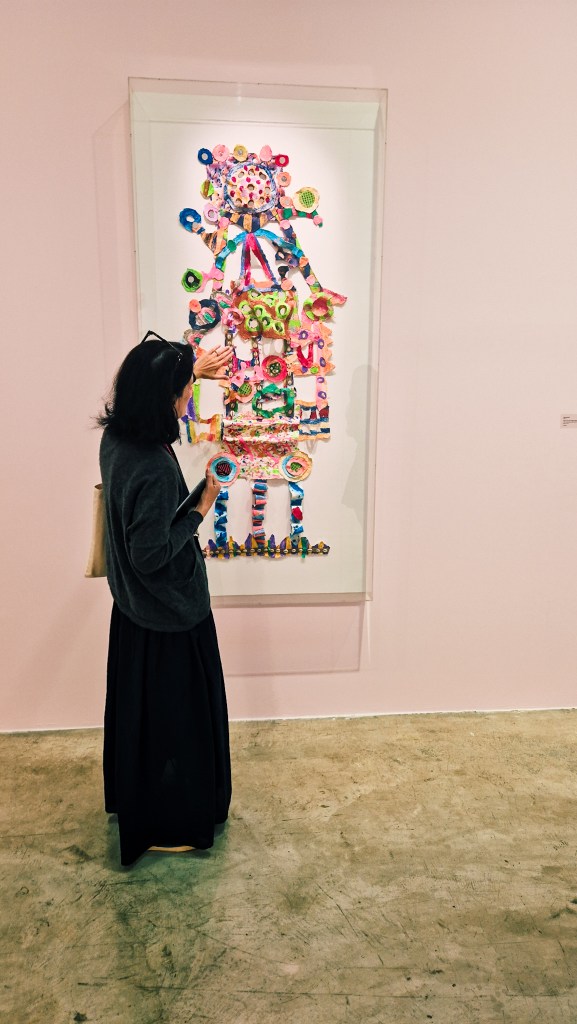
The Tour: Where I Fell in Love with an Artist I’d Never Met
After the workshop, I waited for the tour of Pacita Abad: Common Ground exhibition and the STPI workshop facilities. This is where things got emotional.
I’m not someone who is easily moved at art exhibitions. I appreciate them, I enjoy them, I take careful notes or snap photos, but I don’t usually have the kind of visceral, emotional response where I want to hug a painting (which would be inappropriate and also probably set off alarms).
But walking through this exhibition, learning about Pacita Abad’s life and work, I felt something shift in my chest.
The Works Themselves
Most of the pieces on display were from Abad’s 2003 residency at STPI, paper and pulp works featuring her signature motif: circles. But these weren’t just any circles. They were luminous, layered, textured with fabric and glitter and embedded materials. They shimmered and danced and seemed to contain entire universes.
Our guide explained that Abad saw circles as “direct, simple, modern, universal, intimate, fascinating and playful.” She turned them into suns, moons, doorknobs, traffic lights, umbrellas, whatever the work needed them to be.
Standing in front of these pieces, I understood something fundamental about Abad’s practice: she didn’t believe in scarcity or restraint or the idea that “less is more.” She believed in abundance. In layering. In giving you so much beauty that you couldn’t possibly take it all in at once.
This was radical, our guide explained, because Abad was creating during a period when the art world valued minimalism and conceptual distance. Her maximalism, her insistence on color, texture, decoration, joy, was a political statement. It said: I refuse to make art that is cold or remote or exclusive. I’m making art that celebrates, that uplifts, that makes people smile.
The Workshop Facilities
After viewing the exhibition, we were taken into the actual STPI workshop spaces. This is where my art nerd heart truly soared.
We saw the printing presses: massive, industrial, precise machines used to create limited-edition prints. We saw the papermaking facilities, where artists can create custom paper embedded with all sorts of materials. We saw the collaborative workspace where master printmakers work alongside visiting artists to push the boundaries of what’s possible in print and paper.
And then our guide showed us something that made my jaw drop: a printing press that weighs as much as 83 elephants.
Let me repeat that: 83 elephants.
I’m still processing this information. I don’t know why this specific detail has lodged itself in my brain, but it has. Sometimes, when I’m doing mundane tasks like washing dishes or folding laundry, my brain will just whisper: “83 elephants.”
It’s a metaphor for something, probably. The weight of artistic possibility. The heaviness of history and craft and technique bearing down, pressing beauty into paper.
Or maybe it’s just a really heavy press. Either way, I’m obsessed.
The Alkaff Bridge Story: Where I Almost Lost It
But the moment that truly got me, the story that has stayed with me, that I keep thinking about at random moments, was when our guide told us about the Alkaff Bridge.
In January 2004, Pacita Abad was dying. She had advanced lung cancer. She was in a wheelchair. She was in pain.
And she decided to paint a bridge.
Not a canvas. Not a small, manageable project she could complete from her sickbed. A bridge. A 55-meter pedestrian bridge spanning the Singapore River.
She and a team of rope specialists covered it in 55 different colors and over 2,300 hand-painted circles, using 900 liters of industrial-strength paint. When her doctors tried to tell her to rest, to stop, to preserve her energy, she asked them: “I’m going to die anyway, can’t I just finish the bridge?”
And she did finish it. She signed it, marking it as her gift to Singapore.
She died in December 2004, less than a year after completing the bridge.
When our guide told us this story, I felt something crack open in my chest. Here was an artist who, in her final months, chose to pour her remaining energy not into rest or reflection or tying up loose ends, but into creating something joyful and public and free for everyone to experience.
The Alkaff Bridge wasn’t commissioned. It wasn’t paid for by a wealthy patron. It was Abad’s choice—a final, defiant act of creativity that said: Even now, especially now, I choose color. I choose joy. I choose to make the world smile.
If that’s not the most beautiful “fuck you” to despair, I don’t know what is.
What I Learned from Pacita Abad (Beyond Relief Printing)
Walking out of STPI that afternoon, my unfinished embroidery project carefully tucked into my bag, I realized that this workshop had taught me far more than a new craft technique.
1. Experimentation Is the Point
Pacita Abad was fearless in her experimentation. She didn’t stay in one medium or one technique. She painted, stitched, quilted, collaged, printed, embedded found objects, worked in textiles and paper and canvas. She was constantly asking: What happens if I try this? What if I combine these materials? What if I push this technique in a new direction?
This fearlessness is what I want to carry forward in my own creative practice. Not the fear of doing something “wrong” or “badly,” but the willingness to try, to experiment, to make a mess and see what emerges.
2. Craft Is Not Lesser Than Fine Art
For too long, the art world has maintained a hierarchy that devalues traditionally “feminine” crafts like quilting, embroidery, and textile work. Pacita Abad refused this hierarchy. She stitched and beaded and quilted her canvases, integrating craft techniques into fine art practice with zero apology.
This matters. It matters because it challenges the systems that have historically devalued women’s labor. It matters because it expands our understanding of what “serious” art can look like. And it matters because it gives permission to people like me, people who love making things with their hands, who find deep satisfaction in stitching and printing and embroidering, to see our work as valuable and meaningful.
3. Joy Is Resistance
In a world that often feels heavy and overwhelming, choosing joy, choosing color, abundance, beauty, is a radical act. Pacita Abad understood this instinctively. Even when addressing difficult subjects like dictatorship and displacement, she refused to make art that was grim or minimal or restrained. She made art that celebrated, that uplifted, that insisted on the possibility of beauty even in difficult circumstances.
This is the lesson I’m taking with me: that making beautiful things, creating with care and intention, choosing to add color and pattern and texture to the world, these are not frivolous acts. They are necessary acts. They are acts of hope.
4. Common Ground Is Worth Seeking
The title of the exhibition—Common Ground—kept echoing in my mind. Abad’s entire practice was about finding connections between cultures, between people, between artistic traditions that might seem unrelated. She traveled the world collecting textiles and techniques, not as a tourist or a consumer, but as someone genuinely curious about how different communities create beauty.
This feels especially important right now, in a world that often emphasizes difference and division. Abad’s work reminds us that there is common ground to be found, in our shared love of color, in our universal need for beauty, in our collective desire to make things with our hands and leave something beautiful behind.
Tips for Your Own STPI Workshop Experience
If you’re thinking about signing up for a workshop at STPI (and you should!), here are some things I wish I’d known:
Don’t be afraid of the carving part. Yes, the tools are sharp. Yes, it’s intimidating. But the facilitators are excellent, and you’ll get the hang of it faster than you think. Just press harder than you think you should and let the tool do the work.
Actually use the orientation arrow. Mark your stamp clearly and refer to it often. Your spatial awareness is not as good as you think it is. (Or maybe that’s just me. But I’m guessing it’s not.)
Embrace the wonky. Your first prints won’t be perfect. Your patterns won’t align exactly. And that’s okay! The imperfections are part of the charm, part of the hand-made quality that makes the piece yours.
Allow time to actually explore the exhibition. Don’t just rush through for the sake of completion. Read the wall text. Look closely at the works. Ask questions. The story behind the art is just as important as the art itself.
Bring a camera. The STPI workshop spaces are beautiful and fascinating. The exhibition pieces are stunning. You’ll want photos, trust me.
Manage your expectations about finishing. You probably won’t complete every step of the workshop in the allotted time, and that’s fine. Take home your materials and finish at your leisure. (Or add them to the pile of unfinished projects like I did. No judgment.)
Most importantly: show up with curiosity, not perfectionism. The goal isn’t to create a masterpiece. It’s to learn, to experiment, to try something new, to connect with an artist’s practice and philosophy. Let yourself be a beginner. Let yourself make mistakes. Let yourself whisper directional mantras if that’s what helps.
Final Thoughts: On Craft Addiction and Choosing Color
I’m writing this several days after the workshop, my unfinished embroidery project sitting on my desk, reproachfully. I will finish it eventually. Or maybe I won’t. Maybe the value was in the making, not the completion.
What I do know is this: I’m so glad I signed up for that workshop. I’m glad I learned a new technique. I’m glad I discovered an artist whose work and life have fundamentally changed how I think about creativity, joy, and the choices we make about how to spend our limited time on this earth.
Pacita Abad could have rested in those final months. She could have said: I’m tired, I’m in pain, I’ve done enough, I’ve created enough, I deserve to stop.
Instead, she chose to paint a bridge in 55 colors.
That choice: that insistence on continuing to create, continuing to choose beauty, continuing to make the world smile even when the world was preparing to lose her, that’s the lesson I’m carrying forward.
So yes, I’m going to keep signing up for workshops. Yes, my apartment is going to continue to overflow with craft supplies. Yes, I’m going to start projects I might not finish. And yes, I’m going to keep seeking out stories like Pacita Abad’s, stories that remind me that the act of making is valuable in and of itself, regardless of the outcome.
Life is short. Paint it in 55 colors. Whisper directional mantras. Carve wonky circles. Embrace the chaos.
And when someone asks why you’re doing all this, just smile and say: “I’m an ambassador of colors, always projecting a positive mood that helps make the world smile.”
Pacita Abad: Common Ground is showing at STPI – Creative Workshop & Gallery until December 13, 2025. Go see it. Take a workshop. Let yourself be changed.

 jujucation.com