
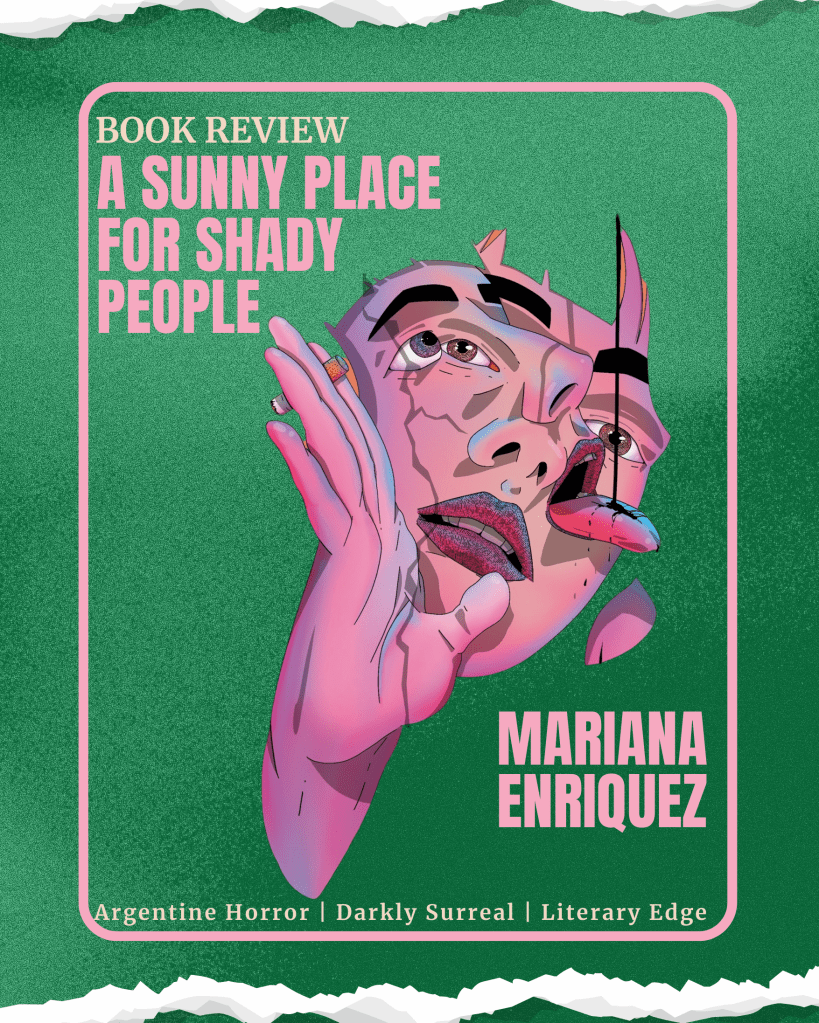
I’ll admit it upfront: I’m a complete horror wimp. I read with the lights on. I skip pages when things get too graphic. And yet, here I am, having finished Mariana Enriquez’s A Sunny Place for Shady People, feeling like I’ve been through something important, even transformative.
This collection doesn’t play by the usual horror rules. There are no vampires lurking in castles or serial killers stalking teenagers. Instead, Enriquez gives us something far more unsettling: the horror of everyday life in Argentina, where murdered girls become ghosts in middle-class neighborhoods, where vintage dresses carry the rage of dead women, and where refrigerator graveyards hide the secrets of disappeared persons.
What Makes This Collection Different
Enriquez understands that true horror doesn’t need elaborate monsters. She finds terror in a woman’s face slowly disappearing, in children with black eyes begging to be let inside, in the way trauma inscribes itself onto our bodies whether we want it to or not. Her Buenos Aires isn’t a picturesque backdrop but a character itself, decaying and haunted by both literal ghosts and the specter of dictatorship violence.
The writing (brilliantly translated by Megan McDowell) pulls you in with this lyrical, almost hypnotic quality. You find yourself reading passages that are genuinely beautiful even as they describe something grotesque. It’s the literary equivalent of not being able to look away.
My Reading Experience: A Journey Through Discomfort
Let me be honest about my journey through these twelve stories. “My Sad Dead,” the opening tale about an elderly woman who sees the ghosts of murdered girls, was my favorite. It was heartbreaking and empathetic in ways I didn’t expect from horror.
The titular story sent me down a research rabbit hole about the real Elisa Lam case (don’t Google it before bed, trust me). “Face of Disgrace” filled me with such dread that I had to take a break. And “Night Birds”? That’s when I instituted my strict daylight-reading-only policy.
There were definitely moments when I fast-forwarded through particularly graphic descriptions. I’m squeamish, and Enriquez doesn’t shy away from bodily horror. But even the stories that made me uncomfortable stayed with me, which I think was entirely the point.
10 Things This Collection Taught Me About Horror (and Life)
1. Horror Lives in the Ordinary Enriquez doesn’t need haunted mansions or ancient curses. She finds terror in apartment buildings, consignment shops, and abandoned train stations. The message? The things we should fear most are often hiding in plain sight.
2. Your Body Keeps the Score Women’s bodies in these stories bruise from cursed clothing, transform during menopause, and disappear feature by feature. It’s a visceral reminder that trauma isn’t just psychological but physical, that our bodies remember what we’d prefer to forget.
3. Ghosts Are Just Unresolved Trauma Every ghost in this collection represents something unfinished, unacknowledged, or deliberately buried. Argentina’s disappeared persons, murdered women, victims of systemic violence—they refuse to stay silent.
4. Empathy Is a Superpower In “My Sad Dead,” grief opens Emma to see others’ suffering. Enriquez suggests that our lowest moments can actually make us more attuned to injustice if we let them.
5. Geography Matters Buenos Aires isn’t interchangeable with any other city. Its specific history of dictatorship, its class divisions, its abandoned spaces—all of it shapes the horror. Place matters in ways we often overlook.
6. Not Everything Needs Explanation Western readers love tidy explanations. Enriquez refuses. Some stories end without resolution, without answers. Life is like that too, and the discomfort teaches us something valuable about sitting with uncertainty.
7. Gender Makes You Vulnerable This collection doesn’t let you forget that being a woman comes with particular dangers. The stories are saturated with violence against women, not as exceptional horror elements but as the normalized backdrop of existence.
8. Complicity Is Complicated Characters in these stories aren’t simply good or evil. They’re complicated, sometimes cruel, often complicit in small ways. Enriquez asks us to consider our own moments of moral failure without offering easy forgiveness.
9. Restraint Is More Terrifying Than Gore What Enriquez doesn’t describe is often more disturbing than what she does. She lets your imagination do the heavy lifting, proving that suggestion beats explicit description every time.
10. Horror Can Be Political This isn’t escapist fiction. Every story is rooted in real social issues: disappeared persons, violence against women, class inequality, psychiatric abuse. Enriquez proves that horror can bear witness to atrocities that realistic fiction might sanitize.
The Verdict: Has It Converted Me?
Am I suddenly a horror fanatic who’ll seek out every scary book? Honestly, no. But has Enriquez expanded what I thought horror could do? Absolutely. This collection proved that horror, when done well, isn’t about cheap scares but about forcing us to confront truths we’d rather ignore.
Would I recommend it? With caveats, yes. If you’re sensitive to violence against women, skip it. If you need happy endings and moral clarity, skip it. If you’re triggered by themes of mental illness, suicide, or bodily horror, definitely skip it.
But if you want fiction that challenges you, that makes you uncomfortable for all the right reasons, that stays with you long after you’ve finished—then yes, absolutely pick this up. Just maybe keep the lights on.
Ready to discuss? What’s the most unsettling book you’ve ever read? Drop your recommendations in the comments. And if you’ve read Enriquez, which story haunted you most?

 jujucation.com