
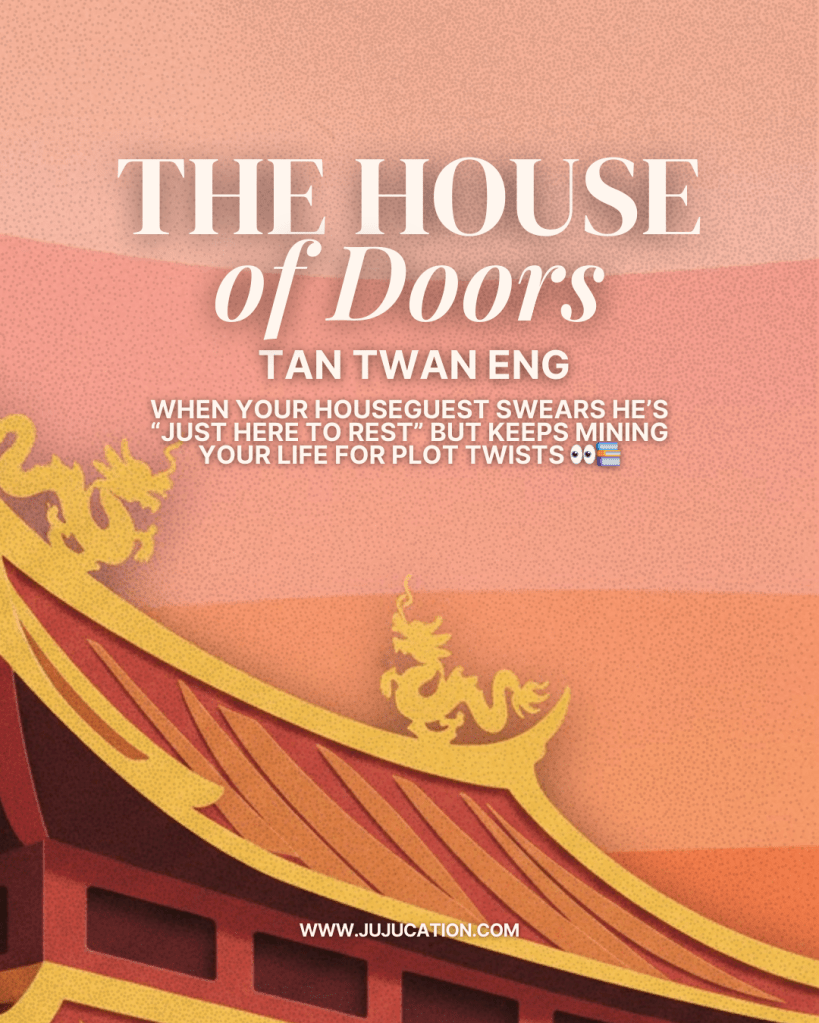
Let me tell you about the kind of book that makes you miss your subway stop. The kind where you’re mentally apologizing to your dinner mates because you’d rather stay home with Lesley Hamlyn in 1920s Penang than make agonizing small talk.
The House of Doors by Tan Twan Eng is that book.
Historical fiction often promises lush settings and complicated characters but delivers Wikipedia entries in period costumes. This novel? It delivers. Set in British Malaya during the 1920s, it follows Lesley Hamlyn, a British expat whose life becomes deliciously complicated when Somerset Maugham (have not heard about him until I read the novel but consider my interest piqued) shows up at her door with his personal assistant Gerald, looking for story material.
And boy, does Lesley have stories.
The Setup: When Your Houseguest Is Mining Your Trauma
The brilliance here is the framing device. Maugham isn’t just a character but a mirror held up to the ethics of storytelling itself. He’s collecting material, observing, taking notes, and you’re left wondering: whose story is this really? When does inspiration become exploitation?
Lesley’s memories unspool in a non-linear narrative that jumps between 1910 and 1947. We get her involvement with Chinese revolutionary Sun Yat-sen, her deeply flawed marriage to Robert, and the central scandal involving her best friend Ethel Proudlock’s murder trial (based on actual events, because reality is always stranger than fiction).
Tan Twan Eng writes like someone who understands that the best historical fiction isn’t about fancy dresses and tea parties. It’s about power, desire, and the lies we tell ourselves to survive in systems designed to break us.
5 Things This Book Does Better Than Your Average Historical Novel
1. It Refuses Easy Answers Nobody here is purely good or evil. Lesley makes choices that will make you wince. Robert is unfaithful but not entirely unsympathetic. Even Maugham, portrayed with surprising tenderness, uses people while genuinely caring about them. Life is messy. This book honors that.
2. Colonial Malaya Becomes a Character The setting isn’t wallpaper. Penang in the 1920s pulses with tension between British colonizers and local populations, between tradition and revolution. You can practically smell the humidity and feel the weight of societal expectations.
3. Female Agency Gets Complicated Lesley isn’t a modern woman dropped into history. She’s a product of her time, constrained by marriage, society, and her own internalized limitations. Watching her navigate these constraints, sometimes succeeding and sometimes failing spectacularly, feels achingly real.
4. The Writing Is Stunning Without Being Showy Tan Twan Eng has a gift for language that never calls attention to itself. Descriptions land with precision. Dialogue reveals character. Nothing feels overwritten, yet everything feels deliberate.
5. It Makes You Think About Stories Themselves Who gets to tell their story? Who gets written into history and who gets edited out? Maugham’s presence constantly reminds us that every narrative is a choice, and every choice has consequences.
What You’ll Take Away From This Book
Beyond the gorgeous prose and intricate plotting, The House of Doors offers genuine insights:
- History is subjective. What we remember, what we choose to forget, and who controls the narrative shapes everything.
- Identity is negotiated, not fixed. Characters constantly renegotiate who they are against forces of colonialism, gender expectations, and personal desire.
- Storytelling has ethics. When writers take real lives and transform them into art, someone pays a price.
- Regret is universal. Whether you’re a British expat in Malaya or a closeted writer stealing stories, we all carry the weight of roads not taken.
The Verdict: Should You Read This?
Read it if:
- You love books where setting is as important as plot
- You’re interested in Southeast Asian colonial history
- You appreciate novels that trust your intelligence
- You find moral complexity more interesting than moral clarity
Skip it if:
- You need fast-paced thrillers with clear villains
- Historical fiction bores you unless there’s time travel involved
- You prefer plot over character development
- Atmospheric novels put you to sleep
Final Thoughts
This is my first Tan Twan Eng novel, and I’m already eyeing The Garden of Evening Mists and The Gift of Rain. His ability to weave historical figures into fiction while maintaining both authenticity and narrative drive is remarkable. At around 300 pages, The House of Doors proves you don’t need 800 pages to create a rich, immersive world.
The book made me think about power, memory, and the stories we tell about ourselves. It made me want to visit Penang. It made me reconsider Somerset Maugham. Most importantly, it reminded me why I fell in love with historical fiction in the first place.
Have you read The House of Doors? Drop your thoughts in the comments below! And if you’re looking for more literary historical fiction recommendations, subscribe to get reviews delivered straight to your inbox.

 jujucation.com