
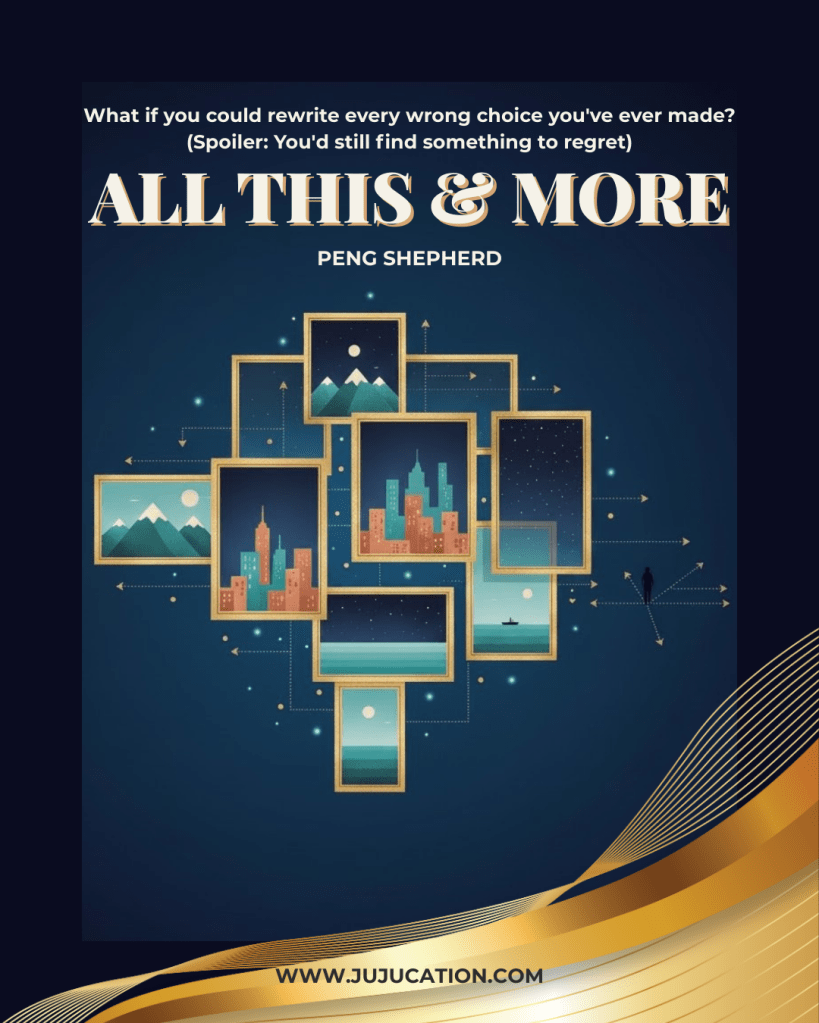
Let me tell you about the most unsettling book I’ve read this year.
It starts innocently enough: Marsh, 45, divorced, invisible even to herself, wins a spot on a reality show that lets contestants rewrite their past using quantum technology. Career stalled? Marriage imploded? Teenage daughter won’t speak to you? Step into the Bubble and choose differently.
Sounds like wish fulfillment, right? Reader, it is not.
What Peng Shepherd has created is part Choose Your Own Adventure throwback, part philosophical nightmare, part razor-sharp critique of our optimization-obsessed culture. And it works precisely because it refuses to give you what you think you want.
Why This Book Gets Under Your Skin
I picked this up after a milestone birthday (let’s not discuss which one) when I was deep in the “what if” spiral we all pretend we don’t do. The premise hooked me immediately. The execution? Messier than I expected, but that’s almost the point.
Marsh isn’t likable in the way we’ve been trained to expect female protagonists to be. She’s passive, then reckless, then obsessive. She makes choices that prioritize her fantasy of perfection over the actual people in her life. And watching her spiral through increasingly perfect-looking lives that somehow feel emptier than the last is like watching someone drown in possibility.
The structure mirrors those old adventure books we devoured as kids, complete with decision points where you actively choose what Marsh does next. Nostalgic? Yes. Gimmicky? Sometimes. Effective at illustrating how infinite choice leads to paralysis? Devastatingly so.
What You’ll Learn (Whether You Want To Or Not)
The Optimization Trap Every alternate life Marsh constructs looks flawless until she’s living it. High-powered lawyer in Hong Kong? Sure, but Harper barely knows you. Wildlife photographer in Iceland? Gorgeous, but you’re alone. The novel’s most brutal truth: there is no version of your life without compromise, loss, and things you wish you’d done differently.
Identity Is Not Interchangeable Here’s where it gets philosophically chewy. Marsh tries to erase her mistakes, but Shepherd shows us that you cannot amputate parts of your past without losing something essential. Your worst choices taught you why they were wrong. They built your capacity for wisdom, empathy, restraint. Remove them and you don’t become better; you become less.
Other People Are Not Supporting Characters The most haunting element: watching Ren, Marsh’s high school sweetheart, deteriorate across multiple reality resets. He becomes increasingly unrecognizable as Marsh rewrites him into different contexts. The message cuts deep: the people you love are not variables in your success equation. They have their own narratives, and you don’t get to sacrifice their coherence for your optimization.
Commitment Requires Foreclosure When everything is possible, nothing feels worth choosing. The novel argues that meaning arrives through limitation, through accepting that some doors must close forever so you can walk fully through the one you’ve chosen.
Peace Comes From “What Now?” Not “What If?” The turning point isn’t when Marsh finds the perfect life. It’s when she stops searching for it.
The Execution: Where It Stumbles
Let’s be honest: the middle section drags. The quantum mechanics explanation stays deliberately vague (thematically appropriate, reader-frustrating). Marsh’s indecisiveness can grate. The branching structure creates repetition that occasionally feels tedious rather than illuminating.
I found myself wanting to shake her around the halfway point. All that potential, all those choices, and she kept wasting them on increasingly baroque fantasies. Then the twist hits, everything she’s fantasized about suddenly becomes true, and the novel pivots into territory that feels almost absurdly meta. Your mileage may vary on whether this works.
Who Needs This Book In Their Life
Read it if you:
- Are navigating your 30s, 40s, or beyond and feeling the weight of accumulated choices
- Love speculative fiction that explores big philosophical questions through personal stories
- Want meaty book club material that will generate actual discussion, not just polite nodding
- Are fascinated by reality TV and interested in its ethical implications
- Enjoyed The Midnight Library but wanted something with sharper teeth
Skip it if you:
- Need straightforward narratives without metafictional elements
- Want protagonists who make consistently smart, likable choices
- Prefer your science fiction with clear, detailed explanations
- Are seeking pure escapism or conventional happy endings
The Verdict
“All This And More” is a thought experiment that occasionally trips over its own ambition, but when it works, it works devastatingly well. It’s the kind of book that won’t let you go even when you’re frustrated with it, because underneath the quantum mechanics and reality TV critique is a question we all carry: did I choose wrong?
Shepherd’s answer is both comforting and challenging: you didn’t choose wrong. You chose. And every choice forecloses possibilities while opening others. The only way out is through acceptance, not revision.
I’d give it a solid recommendation with the caveat that it requires patience and philosophical engagement. This isn’t a book that provides easy answers or conventional satisfaction. It’s a book that makes you think about your own life while you’re reading about Marsh’s many lives.
And honestly? After a certain age, that’s exactly the kind of story you need.
Have you read “All This And More”? Did you find Marsh frustrating or sympathetic? What choice would you rewrite if you could? Drop your thoughts in the comments. I promise not to judge your quantum mechanics fantasies.

 jujucation.com