
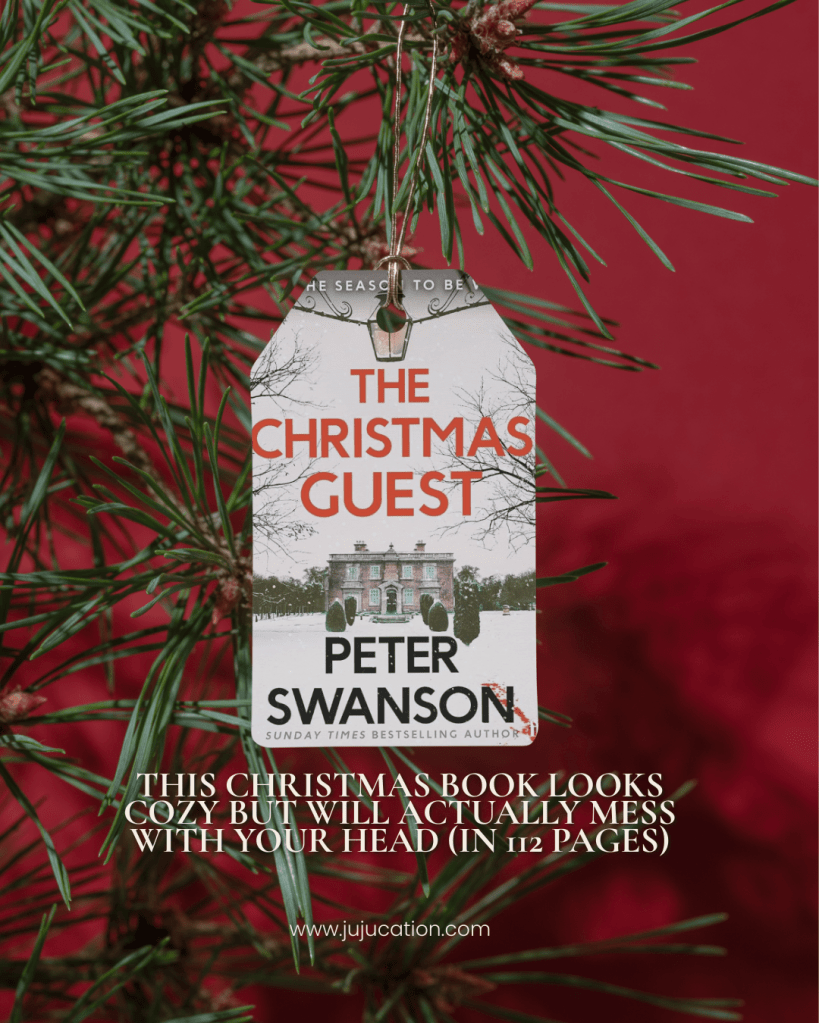
So. This happened.
I tore through this book in one sitting on a Tuesday night when I absolutely should have been doing something responsible. Anything, really. Dishes. Emails. Existing like an adult. Instead, I sat there blinking at the last page, slightly chilled, very awake, and thinking, well… that escalated.
At first glance, The Christmas Guest shows up wearing the costume of a perfectly polite holiday mystery. You know the look. Snow dusting old stone manors, fireplaces crackling enthusiastically, villagers who smile a little too hard and say very little at all. It’s the sort of setting that feels engineered for mulled wine and sensible conclusions. But Peter Swanson is not interested in playing fair. He lets you admire the wreaths and garlands just long enough before doing something sharp and deeply unsettling.
It starts in 1989. Ashley Smith, an American art student living in London, lonely in that particular way you only notice at night, gets invited to spend Christmas at her friend Emma’s family estate, Starvewood Hall. The house is crumbling but grand, like it’s being held together by tradition and sheer stubbornness. The family is chillingly warm, odd, charming in a slightly off-kilter way. And then there’s Adam. Emma’s twin brother. Quiet. Handsome. Moody in a way that would absolutely pass for romantic if this were a different kind of book.
Ashley, being twenty and far from home and desperate for a storybook Christmas, falls for it. All of it. The house. The attention. The fantasy of belonging.
Except there’s a problem. A rather large one. Adam is suspected of murdering a local girl.
A girl who looks disturbingly like Ashley. That’s when the book quietly tightens its grip.
The story unfolds through Ashley’s diary, discovered decades later by a narrator clearing out her apartment. That framing matters more than you think. It is not just a clever device. It is the mechanism by which the whole thing turns. Because somewhere along the way, almost without warning, you realize you have been reading the wrong story. Or at least trusting the wrong version of it.
And when that realization lands, it lands hard.
Why This Is Actually Good and Not Just Seasonal Filler
It’s short on purpose.
At 112 pages, this could have been stretched into a full-length thriller. Swanson refuses to do that. The book is lean, atmospheric, and slightly merciless. Every scene pulls double duty, building the Christmas fantasy while quietly laying the groundwork for what’s coming. No bloated backstory. No sentimental detours. Just snow, suspicion, and the slow dread of watching someone walk cheerfully toward disaster.
The diary format is smarter than it looks.
Ashley writes the way people do when they are trying to convince themselves everything is fine. She’s hopeful. Earnest. Willfully optimistic. Which means the reader is constantly spotting what she glosses over or explains away. It’s uncomfortable in the best possible way, because the voice feels familiar. We have all narrated our own bad decisions like they were misunderstandings instead of warnings.
It understands class, fantasy, and how badly we want to belong.
Ashley’s fascination with British country life is handled with precision. She has been seduced by this world of old money and tradition so badly that she ignores red flags the size of actual flags. The book quietly asks a brutal question: when have you given someone dangerous the benefit of the doubt simply because they matched the aesthetic you wanted?
For me, it was a perfectly laminated kouign-amann, golden and glossy, promising butter and bliss, and then you bite in and realise it’s been aggressively over-salted and is somehow both burnt and raw at the same time. Different genre. Same mistake.
The twist reframes everything without cheating.
No cheap tricks. No dream sequences. The final reveal changes how you understand the story, who is telling it, and why. It feels less like a trick and more like realizing the person across from you at dinner has been lying by omission all night, and now you have to replay every conversation in your head.
Things You’ll Pick Up Along the Way
Holiday aesthetics make excellent camouflage. Pine branches and candlelight don’t fix dysfunction. They just make it smell better.
Attraction is terrible for judgment. Ashley likes Adam, so she bends herself into knots justifying why he probably didn’t kill anyone. We have all been there, ideally with much lower stakes.
Diaries are stories we tell ourselves. Ashley’s entries are sincere, but they are also selective, biased, and missing crucial context. Yours probably are too.
Small towns remember everything. This village is picturesque, gossipy, and packed with decades of resentment. Charming on the surface. Suffocating underneath.
Genre expectations can make you careless. Ashley keeps wondering whether she’s in a romance or a mystery, which prevents her from seeing she might actually be in a tragedy.
The past does not stay buried. The present-day frame shows how events from decades ago still dictate present-day choices. That diary is not nostalgia. It’s evidence.
Sometimes the wrong person gets to tell the story. The final reveal is really about narrative authority and what someone gains by controlling it.
Who This Book Is For and Who Should Probably Pass
Read it if:
You want winter atmosphere without sugary sentiment
You love books that take ninety minutes to read but days to process
You enjoy unreliable narrators and frame narratives
“Psychological suspense with snow” sounds better than a cozy whodunit
Skip it if:
You need a long novel with deep character excavation
You want Christmas reading to be comforting and safe
Ambiguous endings make you irrationally angry
Diary formats or multiple timelines drive you up the wall
My Entirely Subjective Rating
I’m giving this 4 out of 5 stars, and I am docking one purely because I wanted another thirty pages after the reveal. The book is so tightly plotted that there’s almost no room to breathe. That’s impressive, yes, but also a little frustrating when you want to linger and Swanson has already pushed you forward.
Still, there’s something deeply satisfying about a Christmas book that refuses to perform joy on command. In a season obsessed with picture-perfect celebrations, this one quietly suggests that the cozy facade might actually be doing harm. That maybe some ghosts are better left uninvited.
Read it on a cold night with something warm to drink.
And maybe keep the lights on.
Your Turn
Have you read this yet? Are you team “give me dark holiday books” or team “Christmas reading must be pure fluff”? And if you’ve finished The Christmas Guest, did the ending work for you, or did you immediately want to argue with it? I’m still thinking about it, honestly.
Save this for your winter TBR, and take a look at my other holiday book reviews if you want more atmospheric reads that won’t bore you to tears.

 jujucation.com