
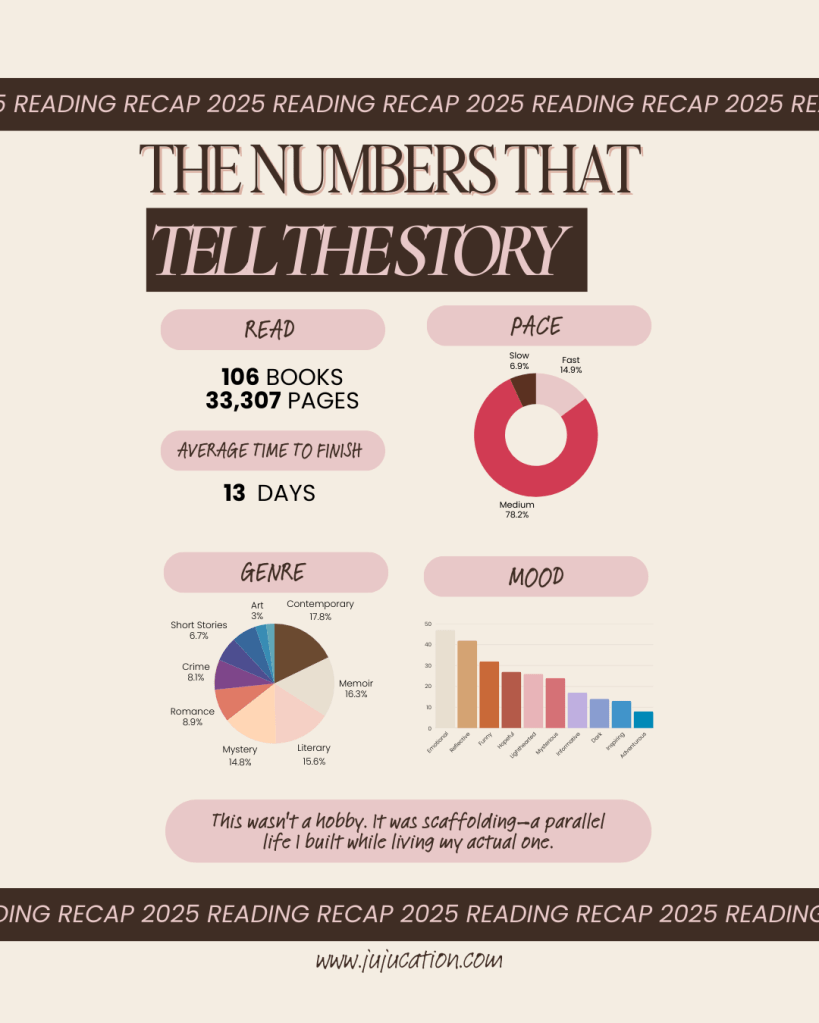
33,307 pages. 106 books. One chaotic, beautiful, grief-soaked, cozy-mystery-loving year of reading like my life depended on it.
If you’re wondering whether that’s a lot, let me put it this way. I averaged about 300 pages per book and essentially lived a parallel life inside other people’s stories while still managing to run a business, teach workshops, and occasionally remember to eat lunch.
This isn’t just a reading recap. It’s a map of how I moved through 2025, what I was avoiding, what I was seeking, and what accidentally found me anyway.
The Big Picture: What 106 Books Looks Like
Here’s what happens when you read over 30,000 pages in a year. You start to see patterns. Not just in the books themselves, but in why you reached for them.
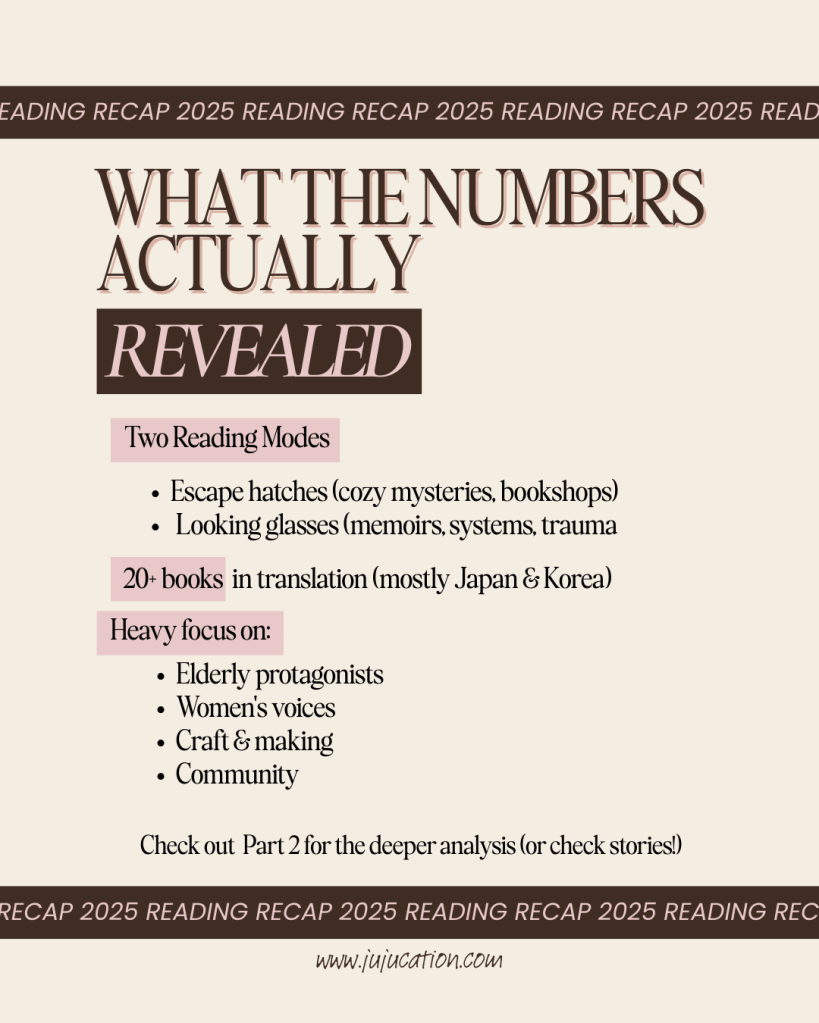
My 2025 reading life split into two distinct moods.
The escape hatch: Cozy mysteries where elderly women solve murders over tea. Bookshops where healing happens between the shelves. Neighborhoods where everyone knows everyone and secrets get solved by Tuesday.
The looking glass: Memoirs about trauma and survival. Books about dictatorships, sociopathy, and what happens when systems break. Stories that don’t let you look away.
I toggled between these two modes all year: soft landings and sharp edges, comfort and examination, rest and reckoning.
The Numbers (That Actually Tell Stories)
Longest Book: 639 Pages of World-Building
The Will of the Many by James Islington clocked in at 639 pages. This brick of a fantasy novel showed up in October, right when I apparently needed to disappear into someone else’s hierarchical magical academy drama instead of dealing with my own professional crossroads.
Shortest Book: 48 Pages of Practical Magic
Creative Candle Making by Meredith Mennitt. Because of course my shortest book is literally about crafting. It’s peak on-brand. Even my leisure reading doubles as research for the next workshop I’m teaching.
The contrast here says everything. I read for immersion and for ideas I can use with my hands.
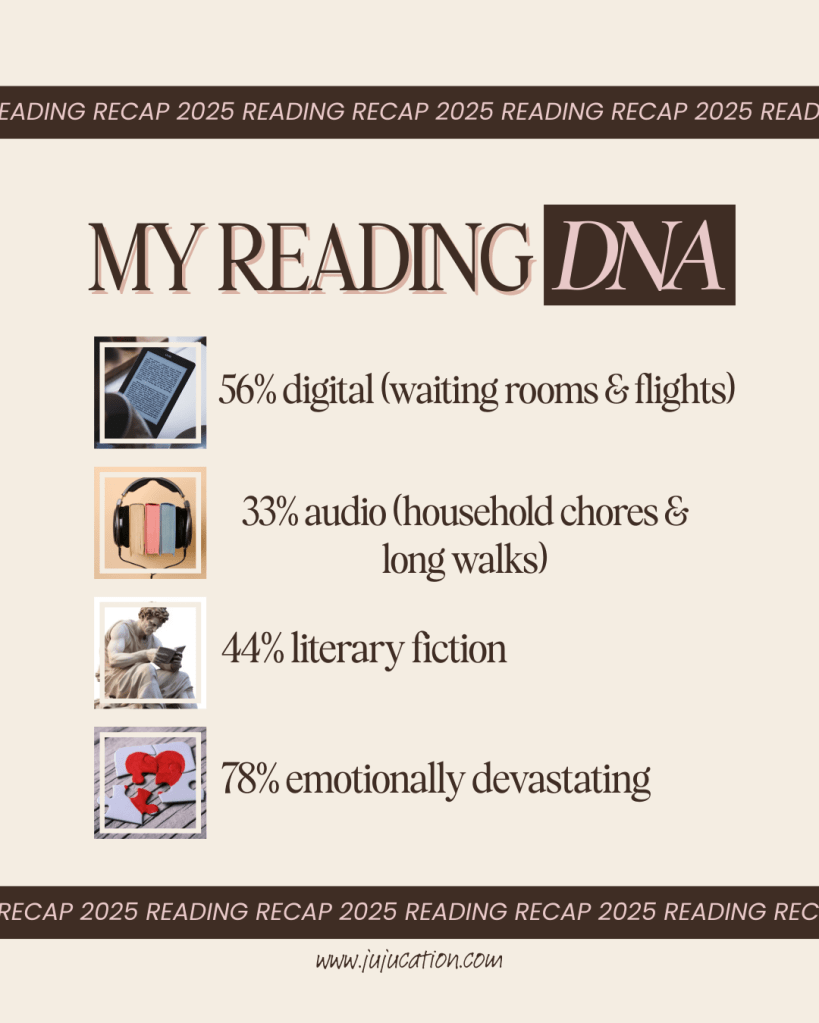
The Format Split: I’m apparently a digital-heavy reader who occasionally remembers audiobooks exist. Fifty-six percent of my five-star reads were ebooks, which tracks because I read on my phone/Kindle whenever I have free time. Thirty-three percent were audiobooks for those days when I take longer walks or bus rides. And exactly one hardcover made the cut, Charlie Mackesy’s The Boy, the Mole, the Fox and the Horse, because some books are meant to be held.
The Genre Breakdown: Literary fiction dominated at 44%, which explains why I kept texting my bookish friends, “I’m emotionally devastated but in a good way?” Mystery and nonfiction each got 22%, while fantasy and romance claimed 11% each. Now we all know, I am not a genre snob but I’m just picky about which genre books earn my emotional investment.
The Mood: Seventy-eight percent of my five-stars were tagged “emotional.” But before you picture me sobbing into my Kindle (though yes, that happened), these books were also adventurous, inspiring, darkly challenging, and funny. I don’t want to escape reality. I want books that make reality make sense.
What I Actually Read (Beyond “Just Books”)
Cozy Mysteries Became My Emotional Architecture
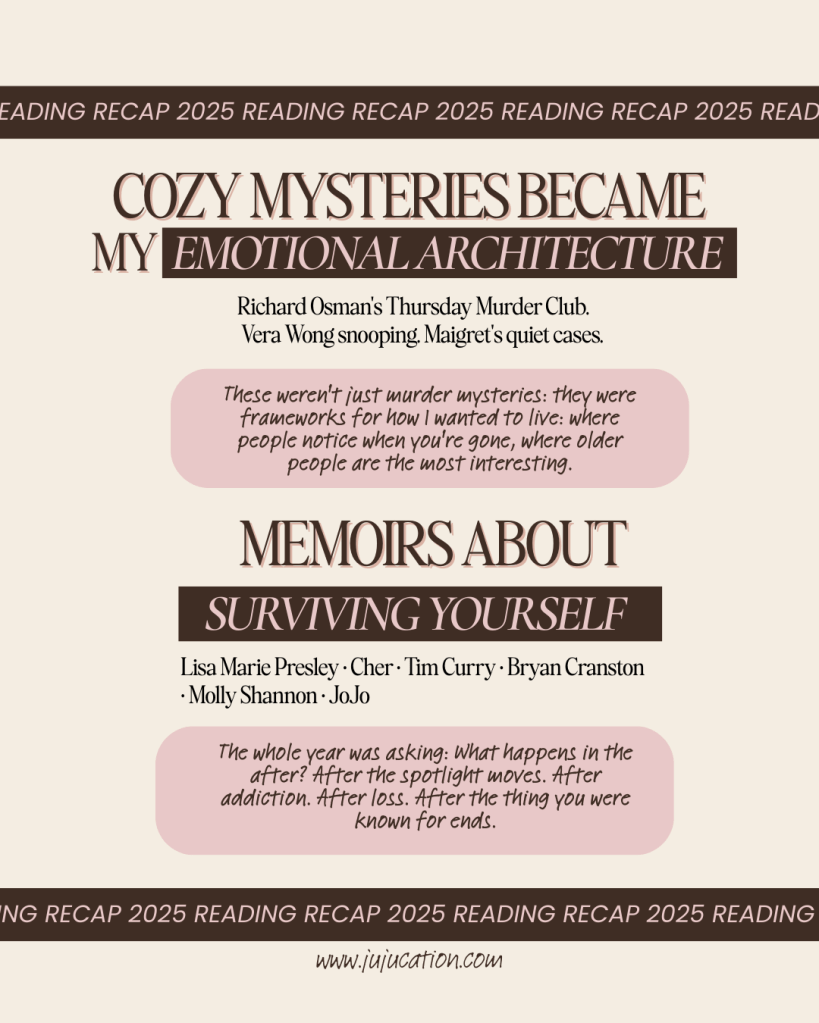
Richard Osman’s Thursday Murder Club series. Ovidia Yu’s Su Lin mysteries. Vera Wong snooping around her neighborhood. Georges Simenon’s Maigret novels.
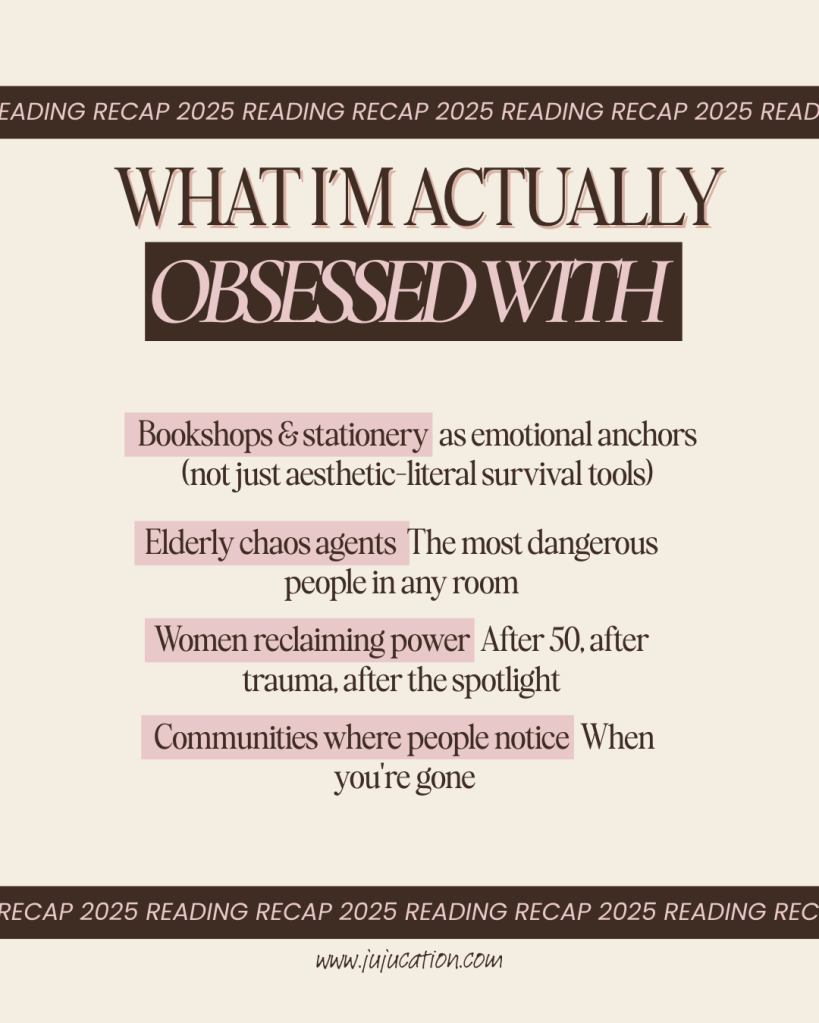
These weren’t just murder mysteries. They were frameworks for how I wanted to live, in communities where people notice when you’re gone, where older people are the most interesting ones in the room, where problems get solved through conversation and careful attention.
I needed worlds where murder happens but kindness still wins.
Memoirs About Surviving Yourself
I read Lisa Marie Presley, Cher, Bryan Cranston, Carol Burnett, Molly Shannon, JoJo Levesque, Carlos Santana, and Tim Curry this year. Not because I’m starstruck, but because I needed to see how people rebuild after the spotlight moves, after addiction, after loss, after the thing they were known for ends.
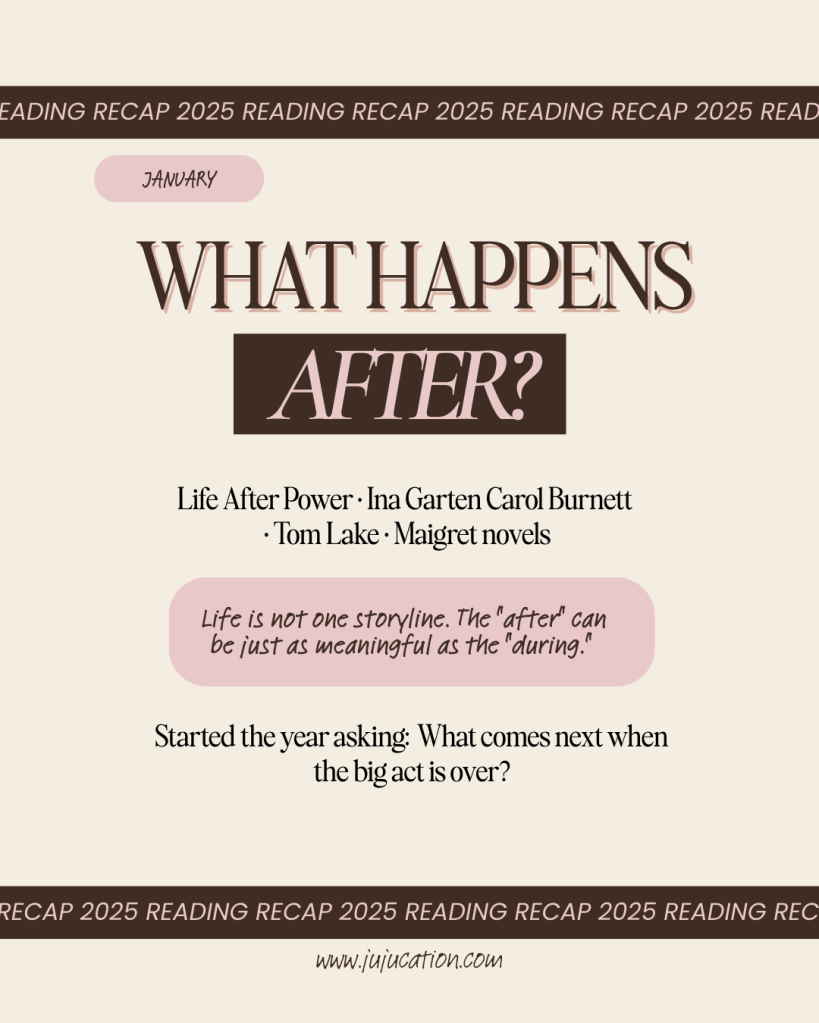
January started with Life After Power, about what ex-presidents do when they’re not presidents anymore. December ended with Tim Curry’s Vagabond, about what a performer does when their body can’t perform the same way.
The whole year was asking: what happens in the after?
Books About Books (Because Meta Is My Brand)
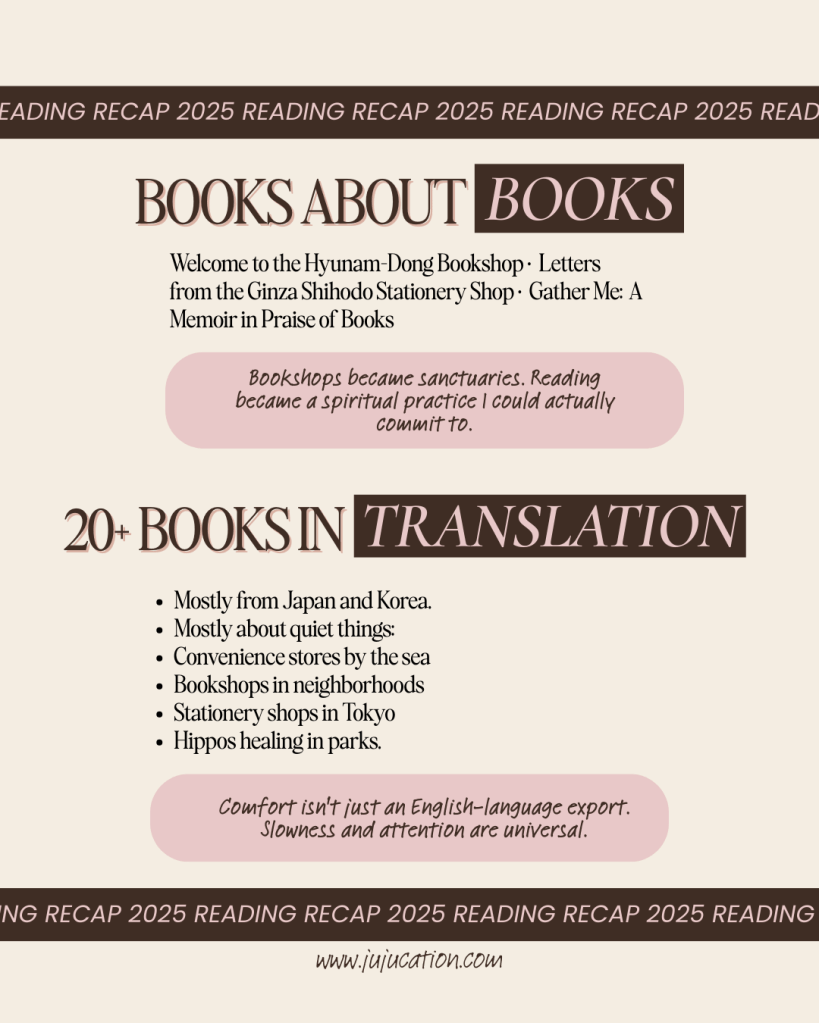
Gather Me: A Memoir in Praise of the Books That Saved Me. Welcome to the Hyunam-Dong Bookshop. The Bookshop Woman. Letters from the Ginza Shihodo Stationery Shop.
I didn’t just read books. I read books about reading books, books about people who sell books, books about people whose lives were saved by books.
This is how I process: by watching other people process. Books became characters. Bookshops became sanctuaries. Reading became a spiritual practice I could actually commit to.
The Translated Fiction That Changed My Mood
I read at least 20 books in translation this year, mostly from Japan and Korea, mostly about quiet things: convenience stores by the sea, bookshops in neighborhoods, stationery shops in Tokyo, hippos in parks.
These books arrived like palate cleansers between heavier reads. They reminded me that comfort isn’t just an English-language export, that slowness and attention are universal languages.
Month-by-Month: The Threadlines
January: Power After the Main Plot
I started the year thinking about what comes after. Presidents figuring out post–White House life. Ina Garten reframing luck as preparation. Carol Burnett reflecting on decades of craft.
Philosophy: Life isn’t one storyline. The “after” can be just as meaningful as the “during.”
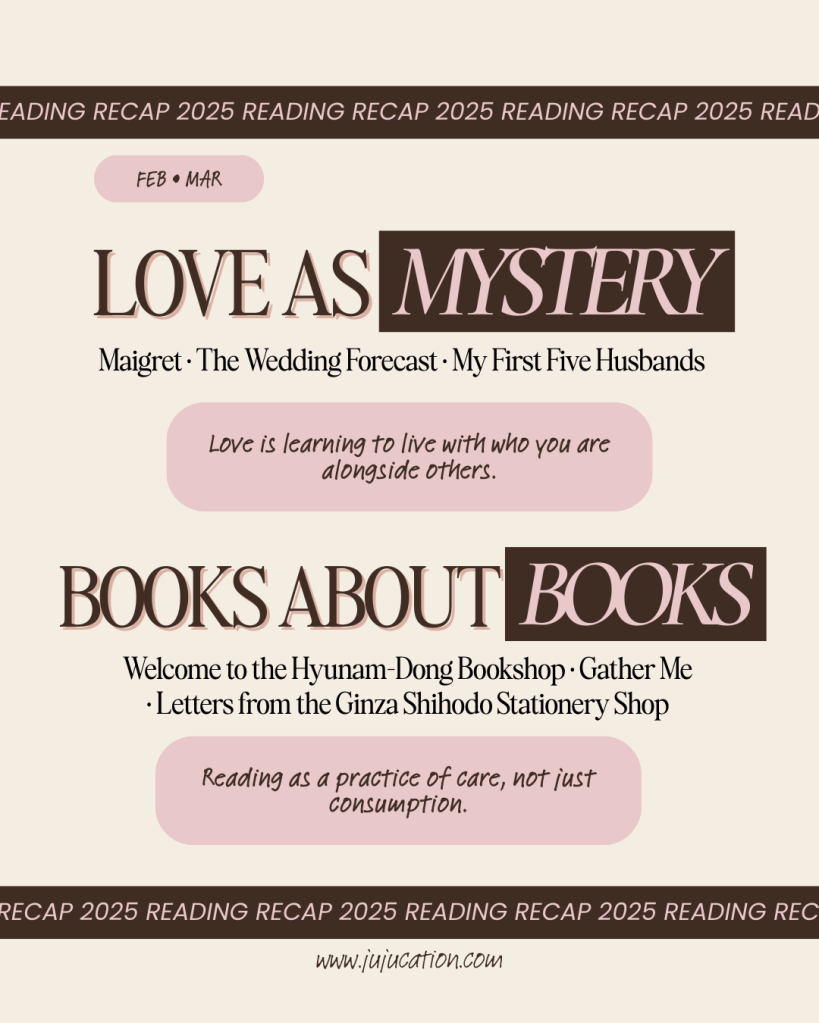
February: Love as a Mystery to Solve
Multiple Maigret novels. Wedding forecasts. Rue McClanahan’s five husbands. Romance as something to investigate, cross-examine, occasionally laugh at.
Philosophy: Love isn’t about finding the right person. It’s about learning to live with who you are alongside others.
March: Books About Books (aka My Love Language)
Meta-reading month. Books as lifelines, community builders, survival tools. Gather Me. Welcome to the Hyunam-Dong Bookshop. Preloved.
Philosophy: Stories and objects carry memory and possibility. Reading isn’t consumption, it’s care.
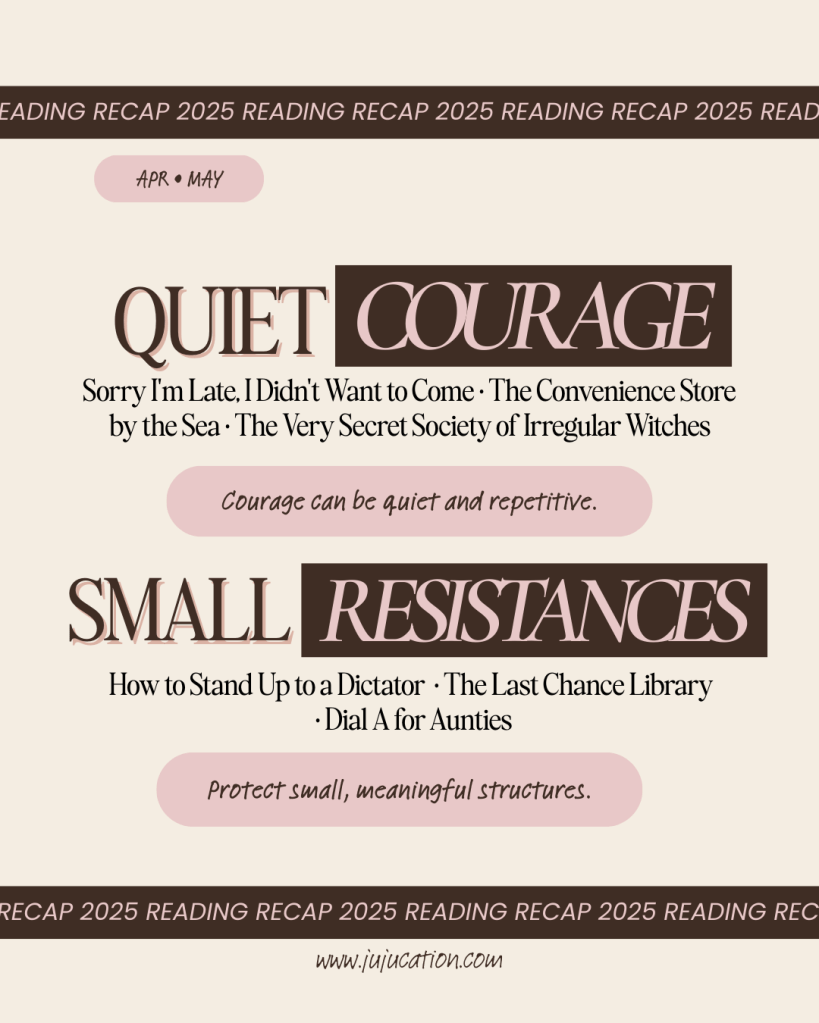
April: Quiet Courage and Everyday Magic
Introverts pushing themselves. Witches finding community. Jeju divers risking their bodies. Art critics learning to see differently.
Philosophy: Bravery can be quiet and repetitive. Magic is the alchemy of attention.
May: Resistance in Small Spaces
Maria Ressa versus dictators. Aunties defending family networks. Librarians protecting community spaces. Radio hosts creating connection.
Philosophy: Resistance doesn’t always look like protests. Sometimes it’s holding onto a library, a bookshop, a phone line.
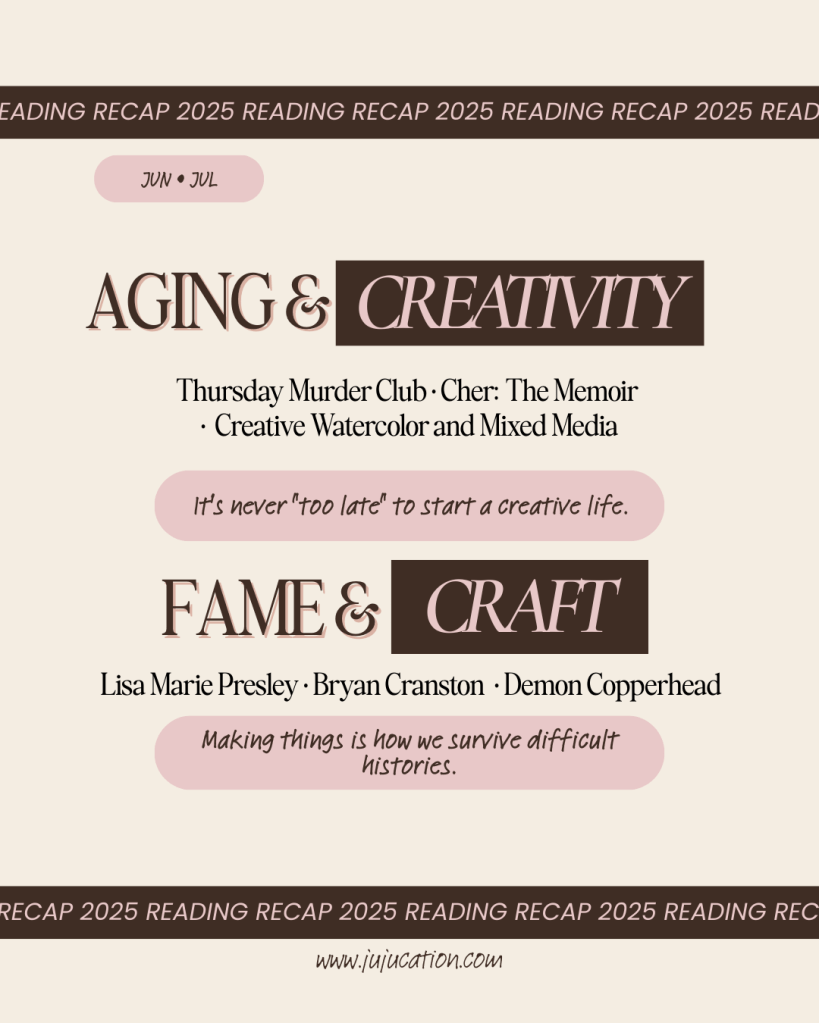
June: Aging Is Not Decline
Elderly detectives. Cher rewriting her legend. Creative watercolor guides. Illustrated books about kindness.
Philosophy: Aging is a different stage of play, mischief, and making. It’s never too late.
July: Fame, Craft, and the Price of Visibility
Musician and actor memoirs. Filipino crime fiction. Easy Crafts for the Insane.
Philosophy: Behind every polished performance is mess, compromise, and pain, but also craft and love. Making things is how we survive.
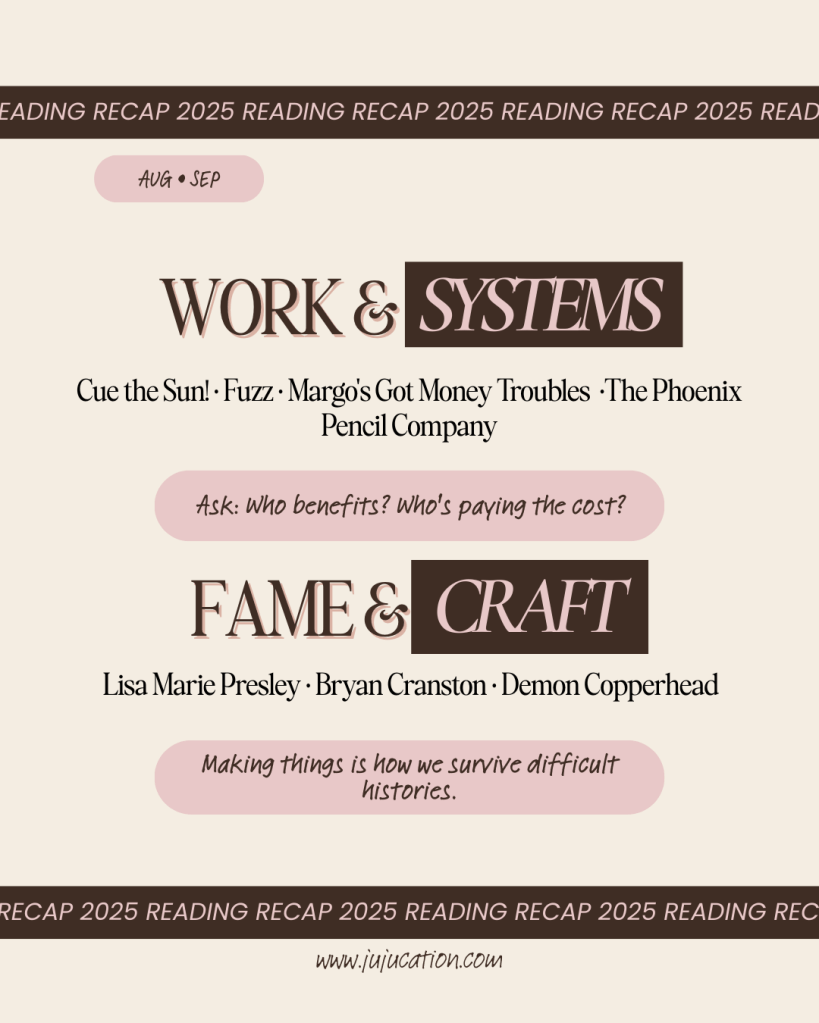
August: Work, Capitalism, and Who Benefits
Reality TV as constructed reality. Environmental legal tangles. National reclamation projects. Companies as narrative engines.
Philosophy: Systems aren’t neutral. They’re stories someone is telling, often to maintain power. Ask who benefits.
September: Healing Is Slow and Imperfect
Therapist case studies. Sociopathy examined. Japanese healing fiction. Cozy mysteries as emotional repair.
Philosophy: People aren’t their diagnoses or worst days. Community spaces are crucial to healing.
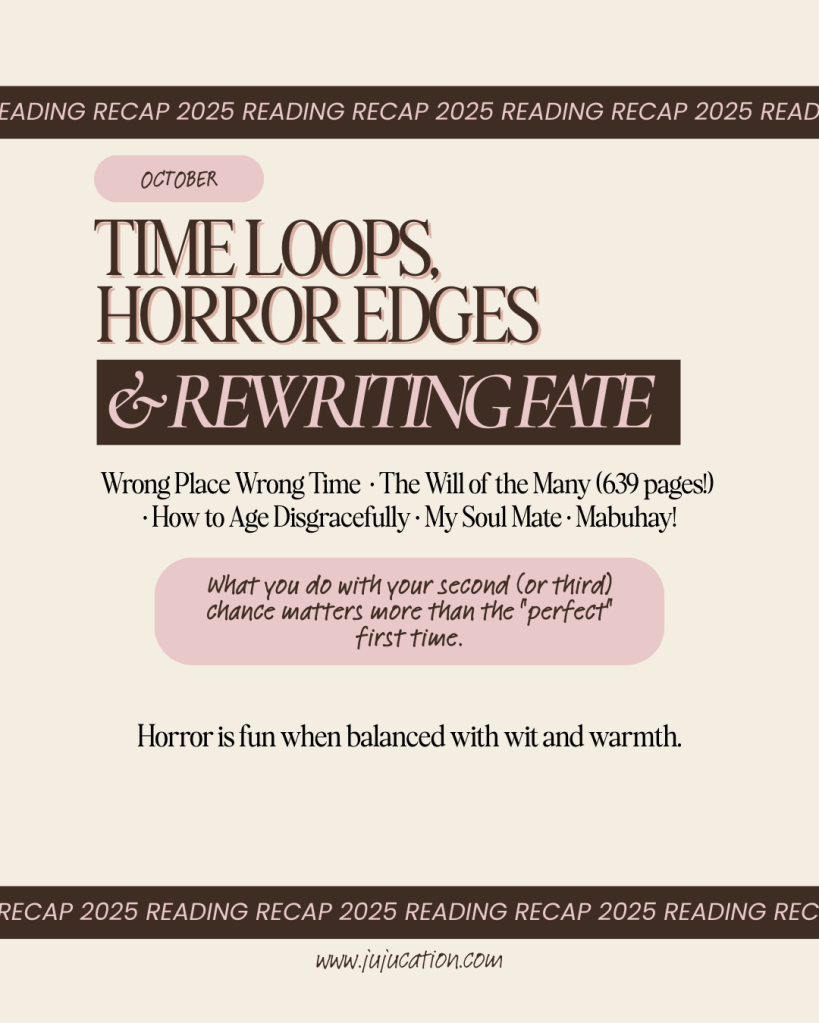
October: Time Loops and Rewriting Fate
Wrong place, wrong time scenarios. Horror edges. Ghosts and second chances. Aging disgracefully.
Philosophy: Fate is negotiable. What you do with your second chance matters more than the perfect first time.
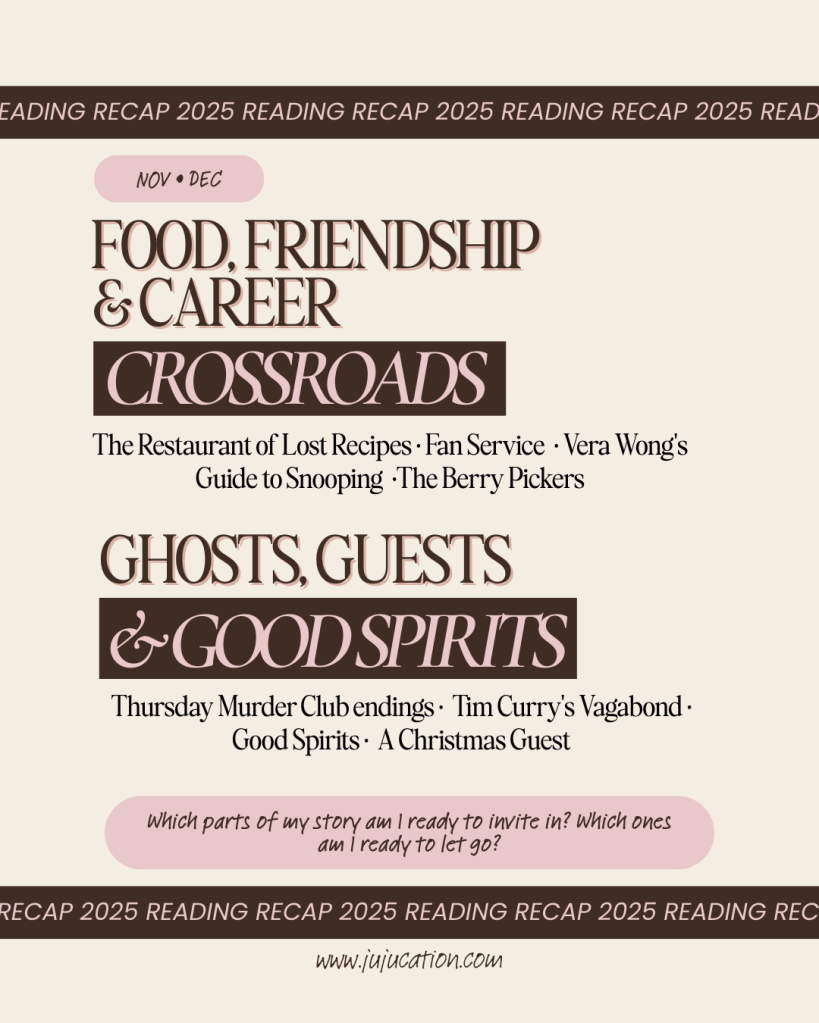
November: Food, Fandom, and Career Crossroads
Restaurant mysteries. Food detectives. Fandom and parasocial relationships. TV game shows and virtual worlds.
Philosophy: The things that sustain us, food, fandom, love stories, aren’t “just” hobbies. They’re lifelines.
December: Ghosts, Guests, and Good Spirits
Thursday Murder Club endings. Tim Curry’s theatrical memoir. B.K. Borison’s haunted cocktail bar. Peter Swanson’s uneasy holiday houseguest.
Philosophy: Closure can be gentle. The best endings feel like walking friends to the door. Which parts of your story are you ready to invite in? Which ones are you ready to let go?
The Pattern I Didn’t Know I Was Following
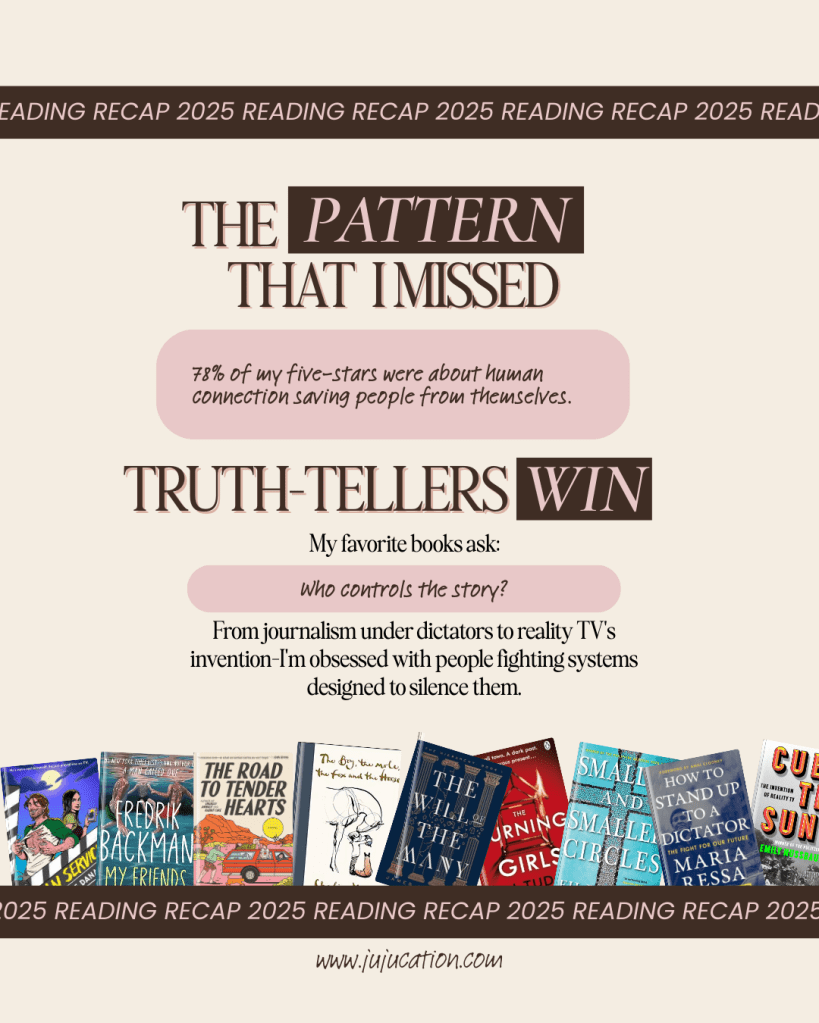
Here’s where it gets interesting. After staring at my reading list like it was a personality test, I noticed something: I’m obsessed with stories about human connection saving people from themselves.
Take My Friends by Fredrik Backman. Four teenagers bond over a chaotic summer, and twenty-five years later, that friendship literally saves someone’s life. Or The Road to Tender Hearts by Annie Hartnett, where a grieving dad, his estranged daughter, some orphaned kids, and a therapy (?) cat called Pancakes, build a family from leftover pieces of their broken lives.
Even Charlie Mackesy’s illustrated philosophy hit the same note: “Asking for help isn’t giving up. It’s refusing to give up.”
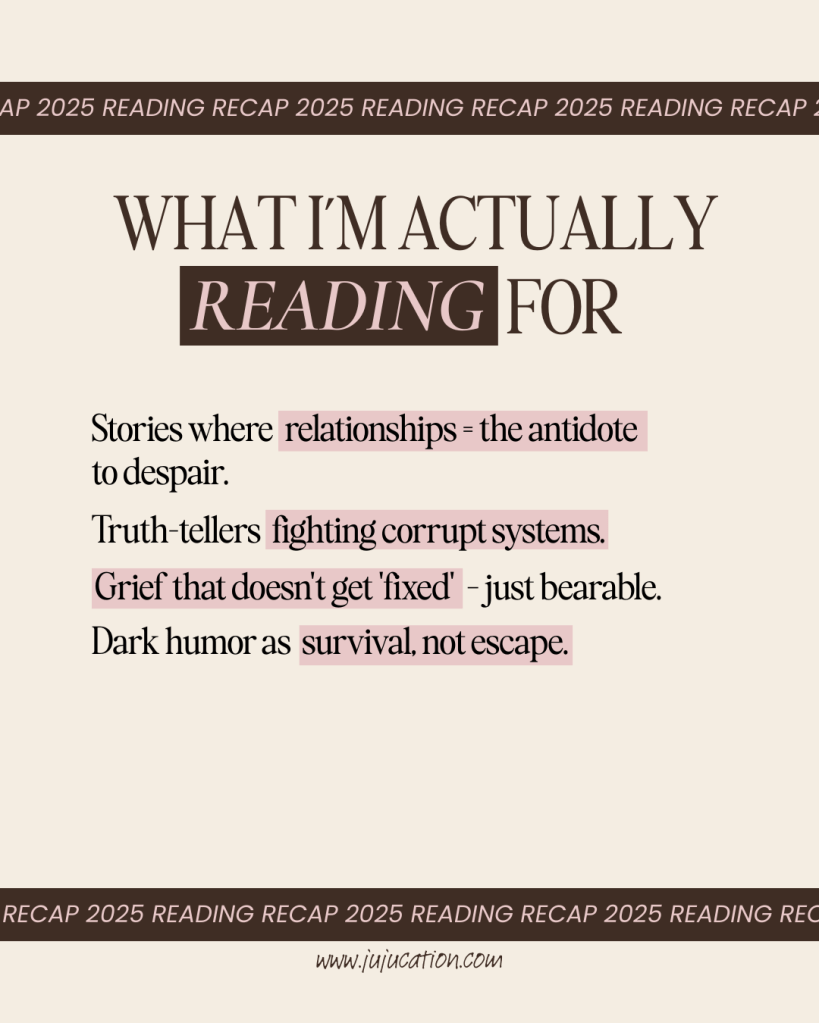
Apparently, I believe relationships are the antidote to despair. Who knew my reading list was secretly therapy?
The Truth-Tellers and the System Fighters
My two favorite nonfiction reads this year were Maria Ressa’s How to Stand Up to a Dictator and Emily Nussbaum’s Cue the Sun! The Invention of Reality TV. On the surface, they’re wildly different. One’s about journalism under authoritarianism, the other’s about reality TV’s cultural impact.
But they’re both asking the same question: Who controls the story? Who decides what’s true?
Ressa asked her newsroom staff daily, “What are you willing to sacrifice for the truth?” Meanwhile, Nussbaum traced how reality TV warped our understanding of consent and authenticity. Both books made me think about power, narrative, and who gets to speak.
This theme showed up in my mystery picks too. Smaller and Smaller Circles by F.H. Batacan doesn’t just solve murders. It exposes how institutions (church, police, media) protect themselves instead of victims.
I’m apparently drawn to books where someone fights back against a system designed to silence them.
What I’ve Learned About Grief (And Why I Keep Reading About It)
Five of my nine five-star books feature characters drowning in loss. But here’s the thing: none of them “heal” in that neat, tidy way self-help books promise.
In The Road to Tender Hearts, the dad doesn’t stop missing his dead daughter. He just learns to build something new with the kids who need him now. In My Friends, the characters don’t forget their abusive childhoods. They just make survival bearable by showing up for each other.
I don’t want stories where everything gets fixed. I want stories where people figure out how to keep going anyway. Where wisdom replaces innocence. Where connection beats cure.
So What Kind of Reader Am I, Actually?
After dissecting my reading habits like a particularly nerdy forensic scientist, here’s what I’ve figured out:
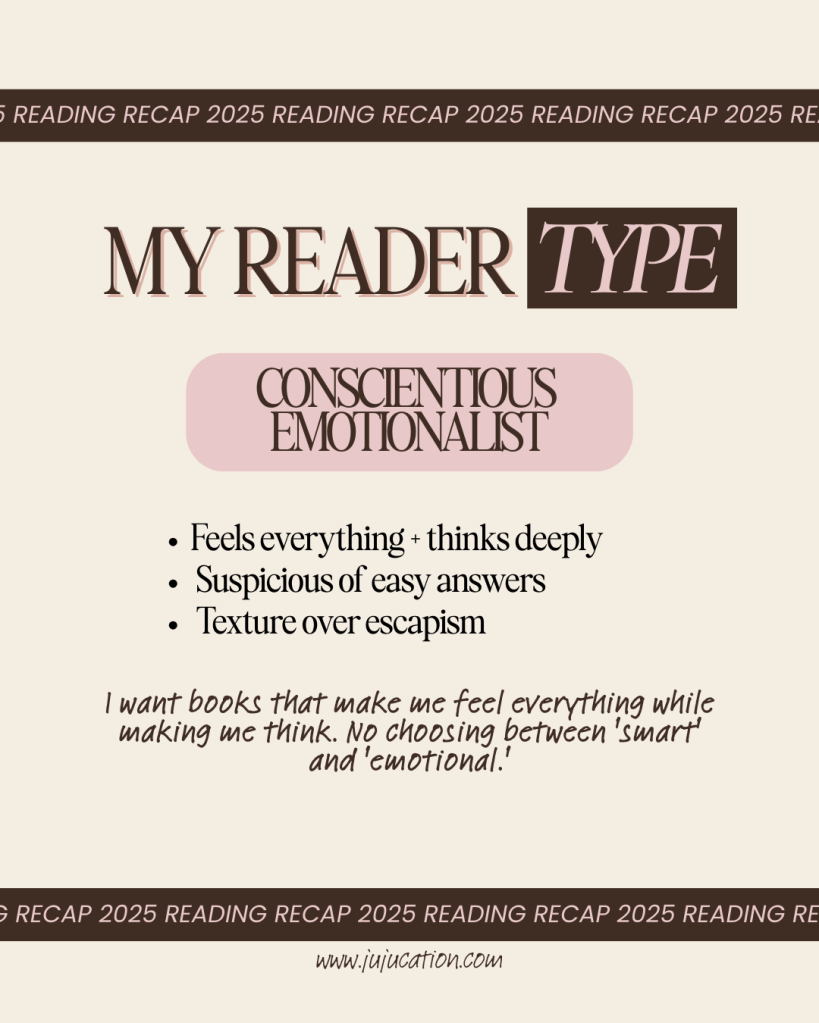
I’m a conscientious emotionalist. I want books that make me feel everything while also making me think. I refuse to choose between “smart books” and “emotional books” because the best ones are both.
I’m suspicious of easy answers. My favorite protagonists face impossible choices and choose honesty anyway. They’re flawed, fallible, and trying their best in systems designed to break them.
I read for texture, not escape. My five-star books are deeply rooted in specific places, Manila’s Payatas slum, a Yorkshire village, a Swedish summer, a Philadelphia road trip. I don’t want generic backdrops. I want to feel the dirt under my fingernails.
Humor is non-negotiable. Dark comedy isn’t an escape. It’s survival. Annie Hartnett’s Angel of Death cat, J. Tudor’s exorcism kit, Backman’s absurdist moments. These details show me characters who maintain perspective even when everything’s falling apart.
What This Year Taught Me
1. I’m Obsessed With Bookshops and Stationery
I already knew this, it was just a confirmation of my preferences. Not just aesthetically. These aren’t just pretty spaces. They’re emotional anchors. Physical objects of creativity that hold us when everything else feels unstable.
2. Elderly Chaos Agents Are My Heroes
Older people breaking rules. Elderly detectives. Grandmothers with secrets. The Thursday Murder Club crew. They reminded me that you don’t stop being interesting or dangerous or capable just because you’ve aged.
3. Craft Is How People Survive Chaos
Craft showed up everywhere: food writing, celebrity memoirs (the craft of performance), reality TV production, ghost-artist comics. The message was clear. Making something, anything, is how we shape raw life into something shareable.
4. Translation Is Quiet Rebellion
My translated reads centered bookshops, stationery, food, and neighborhood life from Japan and Korea. It was my way of saying the world is bigger than English, and comfort can be imported.
5. I Read Women Navigating Power
My shelves leaned heavily toward women’s voices. Women in memoir and contemporary fiction. Women navigating mental health, aging, creativity, and reclaiming their lives.
What I’m Avoiding in 2026
- Books praised for “escapism.” If the main selling point is “unputdownable,” I’m already suspicious. My brain wants weight, not just momentum.
- Heavily marketed debuts with light substance. I’ve read too many books that satisfied my curiosity but didn’t change anything.
- Irony without earnestness. I’m done with books that treat sincerity like weakness. Life’s too short for narratives that mock genuine connection.
- Genre fiction that doesn’t transcend conventions. I read fantasy, romance, and mystery, but only when they’re doing something more than hitting expected beats.
The 2026 Reading Plan
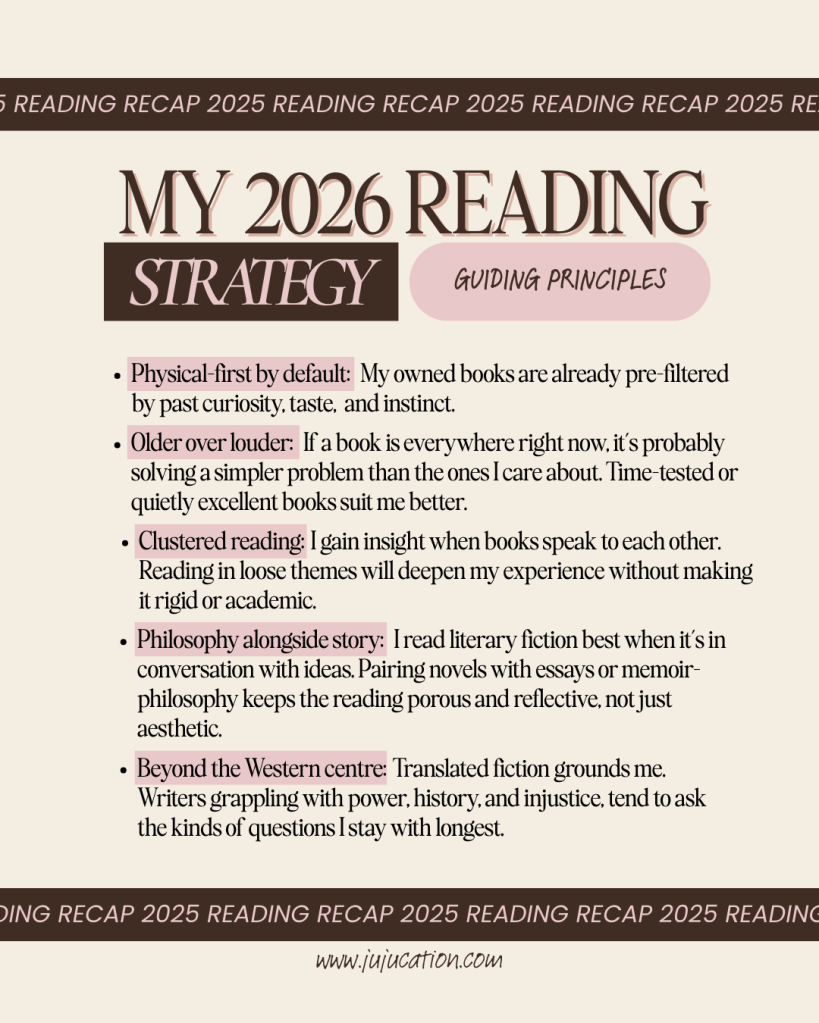
- I’m going deeper instead of wider. Here’s what that looks like:
- Following authors, not trends. Backman, Hartnett, Ressa. I’m chasing writers whose philosophical orientation matches mine, not whatever BookTok says I should read.
- Seeking translated literature intentionally. Two of my five-stars were translations, and they brought perspectives I wouldn’t have found otherwise. More of that, please.
- Building thematic reading clusters. Instead of random selection, I’m creating mini-collections. Four books on resilience, three on journalism, two on family. Pattern recognition as literary practice.
- Trusting my format instincts. Digital for character-dense fiction I’ll want to reference. Audio for author-read memoirs. Hardcover for books that demand to be held and contemplated.
What 33,000 Pages Actually Means
This isn’t a flex. It’s scaffolding.
Reading became the structure I built my days around. A way to hold curiosity, comfort, and examination all at once. A parallel life I could step into when my actual life felt too loud or too quiet or too uncertain.
These 106 books weren’t just entertainment. They were templates for living. Proof that people survive terrible things. Evidence that community matters. Reminders that aging doesn’t mean stopping. Maps for what comes after the main plot ends.
If you made it this far, you’re probably a fellow reader who understands. Books aren’t just books. They’re how we figure out who we are and who we want to become.
Here’s to 2025, the year I read like my life depended on it. Because in a lot of ways, it did.
What did you read this year that changed something in you? Drop a comment. I want to know.



 jujucation.com