
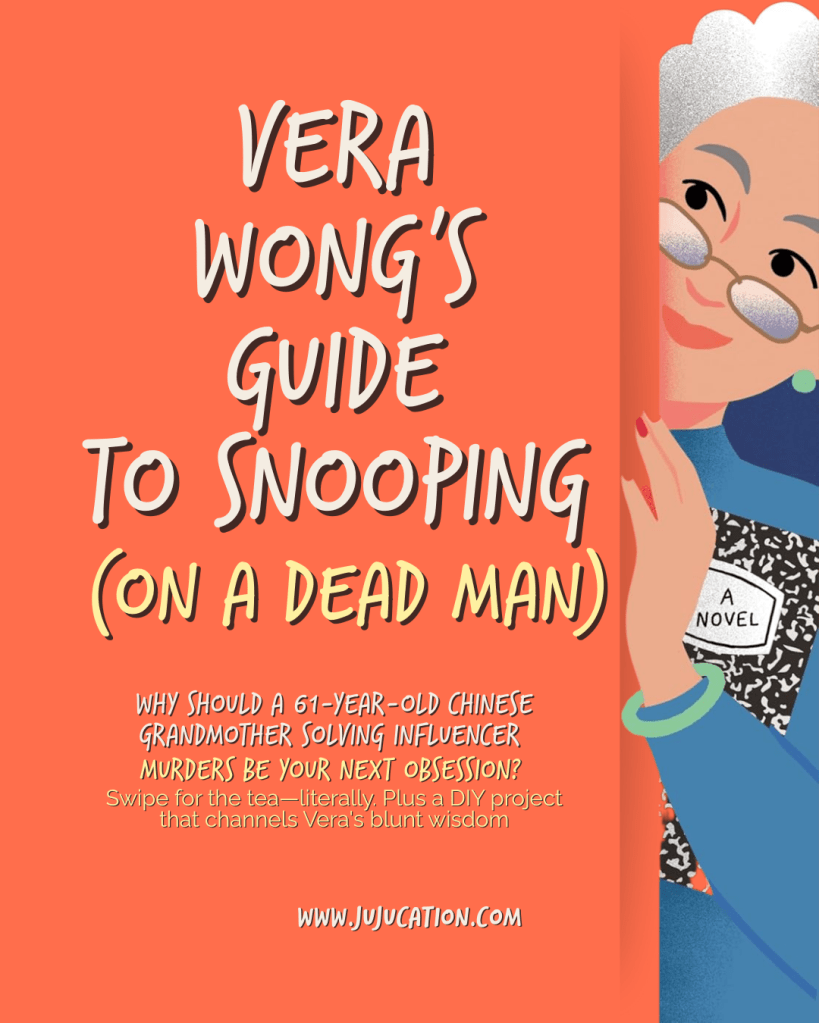
I know what you’re thinking. Another cozy mystery? Another quirky older woman solving crimes while baking things?
But here’s the thing about Vera Wong: she doesn’t bake. She makes medicinal teas that taste questionable but somehow fix your life. She doesn’t stumble adorably into murder; she barges into it with the confidence of someone who knows she’s right (she usually is, which is infuriating). And this isn’t your grandmother’s cozy mystery, unless your grandmother has opinions about Instagram influencers, human trafficking rings, and the devastating loneliness of performed identity.
Jesse Q. Sutanto’s Vera Wong’s Guide to Snooping (on a Dead Man) is what happens when you give a cozy mystery actual teeth, social commentary that bites, and a protagonist who makes you want to call your mom and also become more like her.
Well. Mostly.
The Setup (No Spoilers, I Promise)
Vera’s life is almost too good. Her teahouse is thriving, her son is dating a cop (convenient for future snooping), and her found family from the first book is doing great. Naturally, she’s bored. Enter: a phone scam that makes her feel old and vulnerable, a desperate young woman searching for her missing friend, and a dead body that may or may not belong to a fake influencer with a suspiciously perfect Instagram feed.
What starts as Vera being nosy (her superpower) spirals into an investigation of digital identity, online exploitation, and a trafficking ring that uses social media to prey on vulnerable people. Along the way, she collects more strays, makes more dumplings, and proves that the antidote to algorithmic isolation is one stubborn woman who refuses to let you eat alone.
What Makes This Book Absolutely Brilliant: A Listicle Because I’m Predictable
1. Vera Wong Is Everyone’s Dream Problematic Fave
She’s pushy, judgmental, and convinced she knows what’s best for you. She’s also devastatingly perceptive, fiercely loving, and the kind of person who shows up when everyone else disappears. Her “meddling” is really just radical presence in an age of ghosting and performed connection.
2. It’s Cozy AND Uncomfortable (In the Best Way)
Yes, there are dumplings and tea ceremonies and warm found family moments. There’s also human trafficking, financial exploitation, and the genuine terror of being scammed in a digital landscape designed to make you vulnerable. Sutanto refuses to choose between comfort and complexity.
3. The Social Media Commentary Hits Different
This isn’t a boomer rant about “kids these days and their phones.” It’s a nuanced exploration of how curated identities, validation-seeking, and the hunger for visibility create genuine danger. The dead influencer’s fake life (private jets, luxury resorts, enviable travel) versus his actual existence is a gut punch about what we’re willing to perform for likes.
4. Found Family That Feels Earned, Not Manufactured
Every character in Vera’s orbit arrives broken: financially exploited, romantically deceived, culturally displaced, generationally traumatized. They don’t heal neatly. They heal through being witnessed, fed, and loved stubbornly until they can’t help but become family.
5. It’s Funny Without Being Lightweight
Vera’s observations are hilarious (“You no good at this? Then why you do it?”), but the humor never undercuts the stakes. You’ll laugh and then immediately feel gutted by a revelation about trafficking networks. This tonal balance is wildly hard to pull off, and Sutanto nails it.
6. Older Women Get to Be Complex, Not Just Cute
Vera isn’t a twee grandma who knits and says darling things. She’s sharp, occasionally cruel (when warranted), sexually aware, and deeply intelligent. She’s allowed to be difficult, right, powerful, and irreverent. In a culture that renders older women invisible, this feels revolutionary.
The Honest Part (Because We’re Friends Here)
Okay, real talk. This sequel doesn’t quite capture the magic of the first book, and I need to be honest about that.
The character situation: There are maybe too many people now. I loved that Sutanto kept the crew from book one (continuity matters!), but adding an entirely new cast means Vera’s circle is getting overcrowded. It’s hard to invest in everyone when you’re juggling this many storylines, and some characters feel less developed as a result.
Vera feels… different: Here’s the thing that bothered me most. In the first book, Vera is savvy, sharp, almost unnervingly perceptive. In this one, especially early on, she comes across as kind of foolish? The phone scam scene makes her seem naive in a way that doesn’t feel characteristic. I get that Sutanto was trying to show vulnerability, but it felt like a different person wearing Vera’s skin.
The charm factor: The first book had this effortless warmth and wit that made it feel special. This one has moments of brilliance but overall feels like it’s working harder for the same effect. The magic is still there, just dimmed a bit.
That said, I did finish it, and I did like it. It’s still better than 90% of cozy mysteries out there. It just wasn’t lightning striking twice, you know?
What You’ll Actually Learn (Beyond Whodunit)
Digital literacy is survival: The book doesn’t tell you to avoid technology; it teaches you to recognize power dynamics and who profits from your vulnerability
Love is a verb: Showing up, asking hard questions, making tea, refusing to let people disappear. That’s what love looks like in action
Performance is exhausting: Whether you’re curating an Instagram feed or maintaining respectability, the cost of being fake is higher than the cost of being real
Connection requires presence: In an age of parasocial relationships and algorithm-driven feeds, actual face-to-face witnessing is countercultural and healing
Intergenerational wisdom still matters: Vera’s age isn’t a limitation; it’s her superpower. Lived experience beats algorithmic optimization every time
Who This Book Is Actually For
Read it if you:
- Need a protagonist who’s your age or older and still getting to have adventures
- Want mystery with substance (not just vibes)
- Are interested in the dark side of influencer culture
- Love found family narratives that don’t feel saccharine
- Appreciate humor that coexists with real stakes
- Want to see Asian American characters who aren’t stereotypes
- Enjoyed the first book and want closure with these characters
Skip it if you:
- Prefer hardboiled crime over cozy mystery
- Are uncomfortable with themes of exploitation and trafficking
- Don’t like multiple POV narratives
- Need your fiction to be purely escapist
- Were hoping for a sequel that matches or exceeds book one (temper expectations)
STORY SPARKED PROJECT: VERA’S WISDOM ORACLE CARDS (CANVA EDITION)
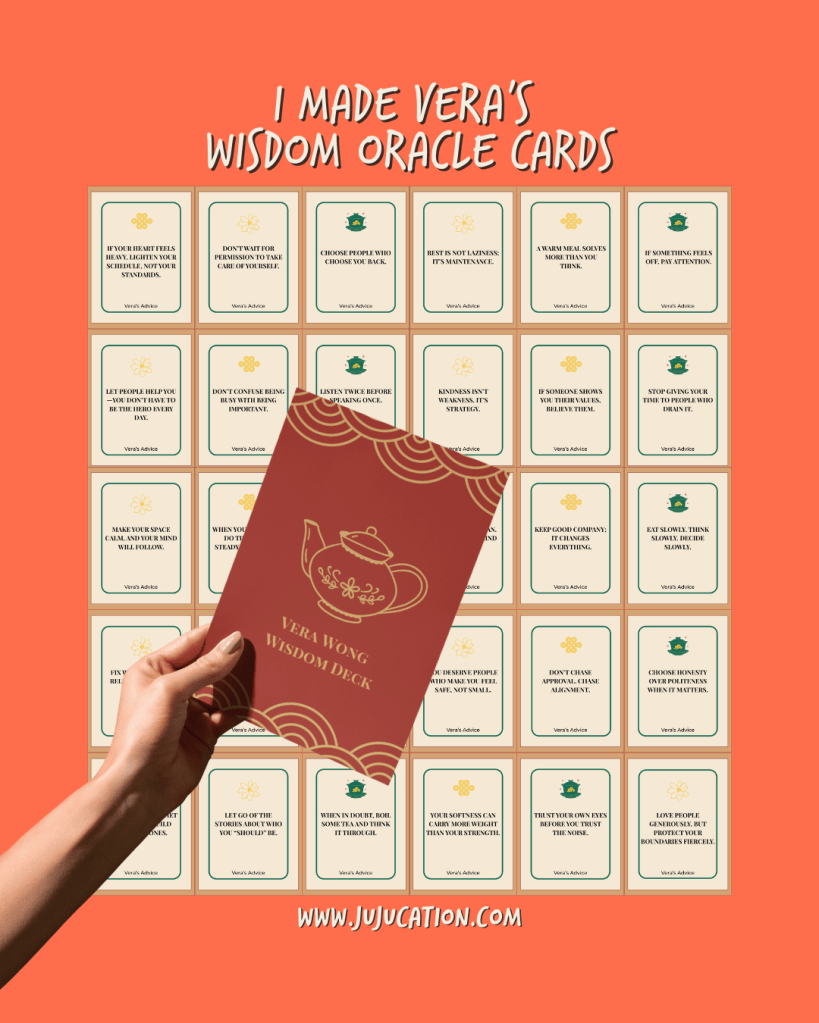
Because this is the Story Sparked Series, we don’t just read books. We make things inspired by them. This time, instead of crafting a physical deck by hand, I translated Vera’s blunt, loving wisdom into a digital format using Canva, making it easy to refine, reproduce, and print on demand.
Vera’s advice feels like something you’d want to return to again and again. Turning it into a printable oracle-style deck felt like the right way to honor that voice while keeping the process accessible and flexible.
The Concept
Create a Canva-designed wisdom card deck featuring Vera-isms. Advice that’s firm but caring, slightly judgy but deeply practical. The kind of thing Vera would say while handing you tea you didn’t ask for but absolutely need.
This deck consists of 30 Vera-isms plus one backing card, designed digitally and ready for print whenever you want.
What You’ll Need
- A Canva account (free works just fine)
- A printable card size template:
- 2.5 x 3.5 inches (playing card size), or
- 3 x 4 inches (affirmation or oracle card size)
- A short list of quotes or affirmations inspired by Vera
- Optional: access to a local or online print-on-demand service
Step 1: Write Your Vera-isms (30 Cards)
Start by writing your quotes in a separate document before designing anything. This helps you focus on voice and clarity.
Channel Vera’s tone. Blunt but loving. Practical, not flowery. Advice that feels grounding rather than aspirational.
You’re aiming for lines that make you pause, nod, and maybe feel gently called out.
Some examples:
“Stop performing for people who don’t matter”
“Real love looks like showing up”
“Your vulnerability is not your weakness”
“Eat something warm and sit with your feelings”
“Who matters to you? Go spend time with them”
Once written, edit them down until each line feels unmistakably “Vera.”
I created 30 Vera-isms, each designed to stand on its own as a moment of reflection or quiet guidance.
Step 2: Design the Cards in Canva
Create a new Canva design using your chosen card size. My design approach:
- Warm neutrals with accents of red or jade green
- Subtle Chinese-inspired motifs like tea leaves, porcelain textures, or steam curls
- Clean typography with plenty of breathing room
- Rounded corners for a soft, welcoming feel
At the front of each card:
- A small icon or illustration at the top (tea cup, ladle, bao, mandarin orange, magnolia)
- The main quote centered and easy to read
- A small label at the bottom such as “Vera’s Advice,” kept light and unobtrusive
Back of the card:
- One consistent design across the deck
- Deep red or jade background
- A simple emblem or illustration
- Title text such as “Vera Wong Wisdom Deck”
After designing your first card, duplicate the page until you have 30 quote cards plus one backing card. Paste one Vera-ism per card.
Step 3: Create the Backing Card
In addition to the 30 quote cards, design one backing card that represents the deck as a whole.
This card can include:
- The deck title
- A simple symbol or motif
- A short line about the intention of the deck, if you’d like
This gives the set a finished, cohesive feel when printed.
Step 4: Optional Companion Guide (Digital or Printable)
If you want to expand the project, you can create a short companion guide in Canva as well. This can be a single-page PDF or a small folded booklet.
It might include:
The intention behind the deck
How to use it (daily pulls, reflection moments, gifting)
A short note on why Vera’s wisdom matters
Example prompt for “Stop performing for people who don’t matter”: Who are you performing for? What would change if you stopped? What scares you about being fully yourself?
This step is optional, but it adds emotional context for readers who want to go deeper.
Step 5: Export for Print-on-Demand
When your deck is ready:
- Export as PDF Print
- Enable crop marks and bleed if your printer requires it
From there, you can print at home, through a local print shop, or via an online print-on-demand service whenever you want more copies.
Step 6: Use or Share
Use the deck for quiet daily check-ins. Pull a card when you feel stuck. Keep it on your desk. Gift it to someone who needs gentle, practical encouragement.
And because this is digital-first, it’s easy to revise, expand, or redesign as your relationship with the story evolves.
Perfect For
- Daily intention-setting and reflection
- A printable keepsake inspired by the book
- Gifting without the pressure of handmade production
- Translating story themes into something tangible
Practicing Vera’s philosophy: care as action, presence over performance, love shown through small, steady choices
The Verdict
Vera Wong’s Guide to Snooping is proof that genre fiction can be smart, socially aware, and still entertaining, even if it doesn’t quite reach the heights of its predecessor. It’s a love letter to older women who refuse to be invisible, to found families that heal what blood families break, and to the radical power of showing up in real life when everyone else is performing online.
Jesse Q. Sutanto has created something rare: a cozy mystery with actual bite and a protagonist who will make you want to be more present, more honest, and possibly make more dumplings. Is it perfect? No. But honestly, neither is Vera, and that’s kind of the point.
Also, if you don’t text your mom after reading this, you have no soul. (I don’t make the rules.)
Have you read the Vera Wong books? Are you Team Meddling Grandmother or do you think she’s too much? Did the second book live up to the first for you? And more importantly, if you make the wisdom cards, PLEASE tag me in photos because I need to see your Vera-isms. Drop all your thoughts in the comments below.

 jujucation.com