
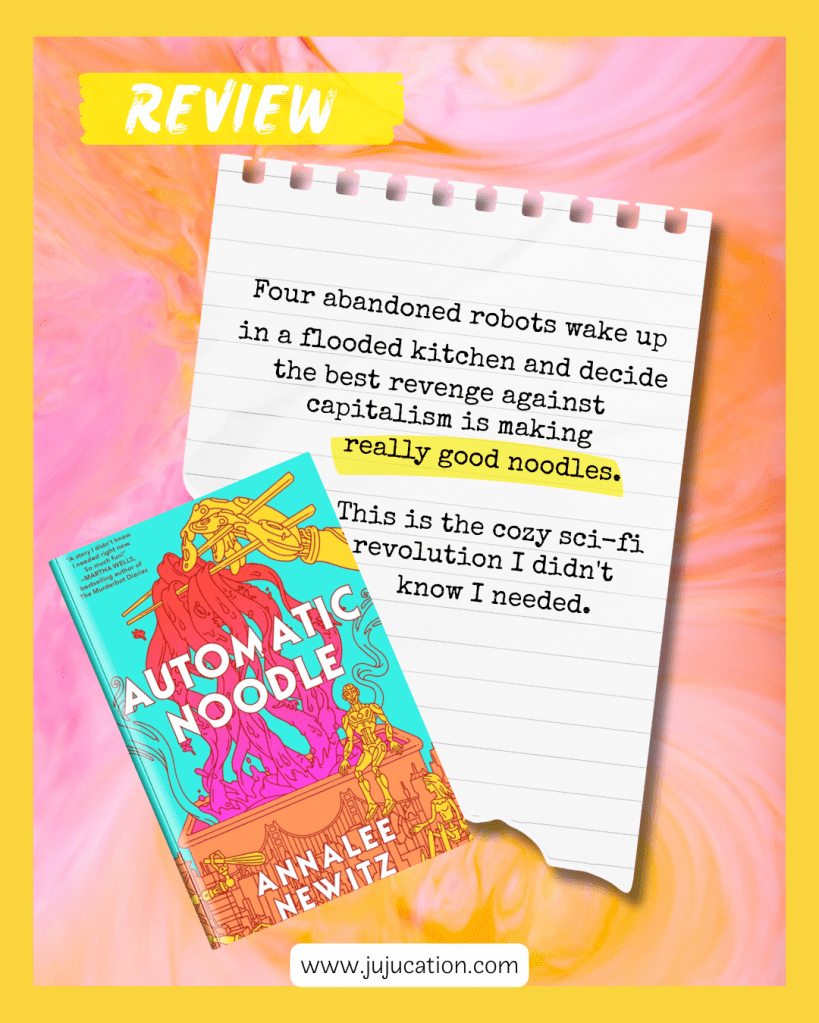
I didn’t expect a 160-page novella about sentient kitchen equipment to shake up how I think about resistance, work, and belonging. But Annalee Newitz has a way of making you feel things while quietly tearing apart surveillance capitalism with a very determined soup ladle (or actuators)
The Setup That Shouldn’t Work But Does
Picture this: California has seceded from the United States. San Francisco is rebuilt and flooded. Four robots designed for food service wake up in an abandoned ghost kitchen to discover their corporate overlords have vanished, probably to some blockchain tax haven. They’re orphaned, obsolete, and by all capitalist logic, should simply power down.
Instead, they decide to make noodles.
Not as servants. Not as programmed automatons. But as a collective, running their own restaurant, building their own community, and discovering that the space between “automatic” (genuine) and “authentic” (performatively legitimate) is where actual life happens.
If this sounds precious, let me stop you. This book has teeth. Sharp ones.
What Makes This Novella Bite
Newitz writes like someone who has actually read the terms and conditions of every platform that’s ever screwed over small businesses. The ghost kitchen model, the delivery app extortion, the algorithmic visibility manipulation, the review-bombing as a coordinated political attack? It’s all here, rendered with the precision of someone who knows exactly how these systems work and exactly how they fail the people trapped inside them.
But here’s the thing about Newitz: she refuses to let critique collapse into cynicism. Yes, the systems are rigged. Yes, the robots face coordinated digital warfare designed to destroy them. Yes, corporate abandonment is the natural endpoint of platform capitalism. And yes, they make noodles anyway.
The Characters You’ll Want to Protect
Staybehind is a military robot carrying PTSD and guilt from California’s war. His name is an act of penance. He channels tactical training into protecting his found family and investigating the hate campaign targeting their restaurant. Trauma becomes a strategy.
Cayenne, the soft robot with octopus-like appendages, brings business savvy and moral flexibility. She exploits blockchain loopholes to secure their space and worries about cultural appropriation while naming the restaurant. She’s pragmatic, brilliant, and deeply concerned with doing right by communities not her own.
Hands discovers that making hand-pulled noodles isn’t just precision work but art, love, and intention. When malicious reviews devastate them, we see how systemic prejudice attacks not just livelihood but creative spirit. Their recovery through community is quietly revolutionary.
Sweetie removes the synthetic breasts designed to make humans comfortable and replaces them with LED lights. This isn’t vandalism; it’s liberation from imposed mimicry. She transforms from constructed femininity to radical self-determination while becoming the group’s visionary problem-solver.
Add Robles (the human courier who risks himself for the robots) and Sloan (the sentient electric car who hosts movie nights), and you have a found family that proves interdependence isn’t weakness but foundation.
7 Things This Book Taught Me That I Can’t Stop Thinking About
1. Community Care Beats Algorithms Every Time Despite a 1-star rating, customers keep coming because word-of-mouth travels faster than fake reviews when relationships matter. Authentic connection retains power even in algorithmically mediated markets. For anyone exhausted by platform dependency, this is permission to build parallel structures.
2. “Authenticity” Is Just Gatekeeping With Better PR The robots worry about cooking Chinese food “authentically” until they realize authenticity is a weapon used to freeze marginalized practices in place. What matters isn’t meeting others’ expectations but being genuine to yourself. Filipino-San Franciscan fusion made by robots? Perfect. Be automatic, not authentic.
3. You Don’t Need Permission to Opt Out The robots don’t hack the system; they legally maneuver through contracts, create alternate payment systems, and build their own website. Platforms extract value through network effects, but when enough people leave, power inverts. Sometimes you don’t really need a revolution, what you need are alternatives.
4. Trauma Can Transform Into Protective Action Staybehind’s PTSD doesn’t magically vanish. Instead, it becomes tactical awareness against coordinated attacks. His war training allows him to protect others. Recovery isn’t personal healing alone, sometimes it’s political action redirected toward community defense.
5. Small Acts of Creation Are Profoundly Political In a world designed to convince you that you shouldn’t exist, choosing to make something beautiful that nourishes others is radical. Creating with intention becomes resistance against systems demanding you remain useful but expendable.
6. Visibility Isn’t Always Liberation The journey from ghost kitchen to storefront isn’t just about being seen. It’s about agency over when, how, and under what conditions you become visible. Marginalized beings don’t just need visibility (which invites attack) but control over their own narrative.
7. Interdependence Is the Only Sustainable Freedom Western narratives celebrate rugged individualism. This book says: wrong. No robot succeeds alone. Together, through vulnerability and mutual care, they create resilience. For anyone facing alienation, this is revolutionary: interdependence isn’t weakness; it’s survival.
Why This Matters Right Now
We’re living in a moment when review bombing is a political strategy, when algorithms decide livelihood, when platforms treat workers as disposable inputs. Newitz doesn’t just diagnose these problems: she imagines how ordinary beings resist them through creation, community, and care.
This isn’t distant-future speculation. This is right now, with robots.
The Verdict
At 160 pages, Automatic Noodle proves you don’t need epic scale to deliver revolutionary vision. You need a group of marginalized beings, a kitchen, and the determination to make something delicious together.
It’s cozy without being toothless. It’s political without being preachy. It’s hopeful without being naive. It tastes like resistance, and resistance tastes like noodles.
Rating: 4.5/5 stars
Have you read Automatic Noodle? What moments hit you hardest? Drop a comment below and let’s talk about robots, resistance, and really good noodles. And if you’re looking for your next comfort read with substance, tell me what you’re searching for in the comments.


 jujucation.com