
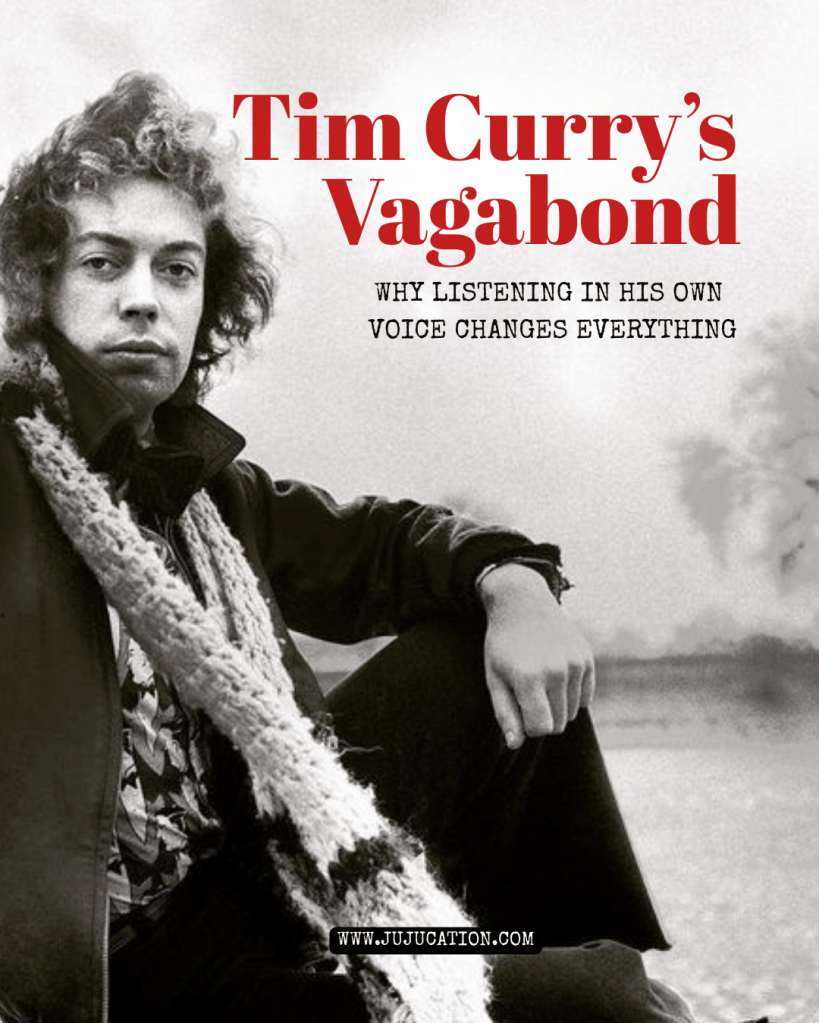
Another celebrity memoir that promises “raw honesty” and then delivers polished PR stories and carefully chosen anecdotes that make everyone look good?
Vagabond is not that book.
This is the memoir Tim Curry was always going to write. He explains that “vagabond” was never just a clever title. It was an identity shaped by moving constantly as a kid and by a career spent bouncing between stages, film sets, and recording booths. He talks about being fired from a Stoppard play after his stroke and he doesn’t soften how much that hurt. And somehow, for a man known for some of the loudest characters in cinema, the book itself is surprisingly quiet.
That’s exactly why it works.
The Audiobook Changes Everything
If you’re going to experience Vagabond, do it as an audiobook.
Curry narrates his own story, and his voice, altered by the 2012 stroke that slowed his speech, becomes part of the memoir itself. You can hear the stroke. He speaks more slowly. There are hesitations. The rhythm is sometimes uneven. And instead of weakening the experience, it makes it deeply moving. You’re not just listening to someone talk about resilience. You’re hearing it happen, over ten hours and forty minutes, as Curry refuses to let physical limitations shut him up.
The charm is still there. The wit is still there. The theatrical timing is still there, just delivered more deliberately.
I bumped the playback speed to 1.25x or 1.5x to find a pace that works for me, but one thing is for sure, no professional narrator could touch this. Curry even apologizes at one point for how his speech sounds now, and of course I reject the apology. I wanted to hear his voice, exactly as it is, telling his story.
What Makes This Memoir Worth Your Time
Curry organizes the book around his work rather than personal drama. Theatre beginnings. Rocky Horror. Decades on stage and screen. A prolific voice acting career. If you’re looking for gossip, you’ll be disappointed. If you want an actor thinking honestly about his craft, his regrets, and what happens when your body can’t do the thing you’ve built your life around, this book delivers.
The 2012 stroke runs through the later chapters like a fault line. He writes about losing the ability to communicate, about the craniectomy to remove blood clots, about learning how to pivot toward voice work when physical performance was no longer possible. Hearing these moments in the audiobook adds another layer entirely. Listening to him talk about the deaths of his mother and sister, in a voice slowed by the very stroke he’s describing, creates a kind of poignancy that print alone can’t reach.
This is the vulnerability memoirs always promise and rarely deliver.
10 Things You’ll Learn From Vagabond (That Nobody Tells You About Building a Life)
1. Rootlessness can be a skill, not just a wound
Curry’s military-brat childhood taught him to adapt fast and inhabit new personas quickly. Your unsettled years might be training, not just scars.
2. Say yes to contradictions
His teenage pact to “explore all contradictions” became a career philosophy. Camp and seriousness, villainy and tenderness, the risky and the safe—contradictions expand your range instead of narrowing it.
3. Success doesn’t require visibility
By refusing to traffic in gossip, Curry redefines success as sustained craft rather than constant headlines. A quieter career might be healthier and more satisfying than you think.
4. Your identity survives bodily betrayal
The stroke disrupted his performer’s life violently, but the inner artist stayed intact. Grieving lost capacities doesn’t mean surrendering who you are.
5. “Yes, but differently” is powerful
Instead of treating illness as an endpoint, Curry shifted to voice work and appearances that worked around his limitations. You can re-route your skills when the original path closes.
6. Modesty and myth can coexist
Curry seems genuinely surprised by his cult status. External myth-making often has nothing to do with how artists quietly understand their own lives.
7. Regret teaches without imprisoning
His reflections on wishing he’d treated his mother better are painful but not self-flagellating. They read as lessons consciously passed forward, an invitation to repair relationships while you still can.
8. Most careers run on persistence, not destiny
By foregrowing auditions, bad gigs, and “student hunger,” Curry demystifies acting as labor rather than glamorous fate. Persistence, not “being chosen,” powers most long careers.
9. Some stories aren’t yours to tell
His decision not to name romantic partners models an ethics of storytelling that respects privacy. Memoir can be intimate without being exploitative.
10. Aging is a role shift, not a fade-out
The later sections portray an older artist who can’t travel or perform like before but can still guide through memory and voice. Aging becomes a new act, not an exit.
Format Matters: Print vs. Audiobook
Unlike so many celebrity memoirs that feel heavily ghostwritten, this one feels unmistakably his. Listening removes any doubt. This is Tim Curry, telling his story in his own words, at his own pace.
The dry humor. The restraint. The intelligence under the theatricality. All of it lands differently when you hear his actual voice.
I think if you read the print version, you’ll still get the substance. What you’ll miss is the texture. The determination underneath the pauses. The resilience in the timing. The sense that you’ve been invited into the dressing room after the show, when the makeup is off and someone is quietly taking stock of the roles they’ve played and the ones they still can.
Who Should Read (or Listen to) This
Go with the audiobook if:
- You’re a Rocky Horror, Clue, or IT fan
- You like hearing artists tell their own stories
- You want to witness resilience, not just read about it
- Authentic vulnerability moves you
- You’re navigating illness, loss, or creative change yourself
Choose print if:
- You prefer setting your own reading pace
- You like underlining and taking notes
- You want the craft without the emotional intensity of hearing his altered voice
Skip it if:
- You’re looking for gossip or romantic revelations
- You want high drama and scandal
- You need your memoirs fast, loud, and flamboyant
The Real Reason This Matters
Vagabond, especially as an audiobook, feels like being invited into Curry’s dressing room after a long run. Costumes hung up. Makeup gone. What’s left is a thoughtful person sorting through roles, regrets, and the stubborn joy of continuing.
It doesn’t give you every secret. It gives you something better. A way of thinking about how to stay creative when the spotlight fades and your body stops cooperating. And then, very quietly, it turns the question back on you. Now that you’ve heard my story, what are you going to do with yours?
Listening becomes an act of witnessing. Not just his artistry, but his refusal to disappear. This isn’t inspiration packaged for easy consumption. It’s an artist showing what adaptation actually looks like when everything changes and you keep going anyway.
If you’ve read or listened, I’d love to hear what stuck with you. What contradictions are you exploring in your own vagabond life?

 jujucation.com