
Apparently, this week has quietly turned into science-fiction reflection week.
In my last post, I was thinking about abandoned robots taking agency, choosing care, and somehow making the best noodles in a collapsing world. Today, I’ve landed somewhere adjacent but stranger: a sentient spaceship, a crew of classic monsters, and the question of what it means to love, protect, and belong when you aren’t technically supposed to have feelings at all.
So let me tell you about the time I fell in love with a spaceship.
Not in the way you’re thinking (though I’m not judging). I mean the kind of love where you chose to finish a book than sleep, then stare at your ceiling, and reconsider everything you thought you knew about consciousness, family, and what makes us human.
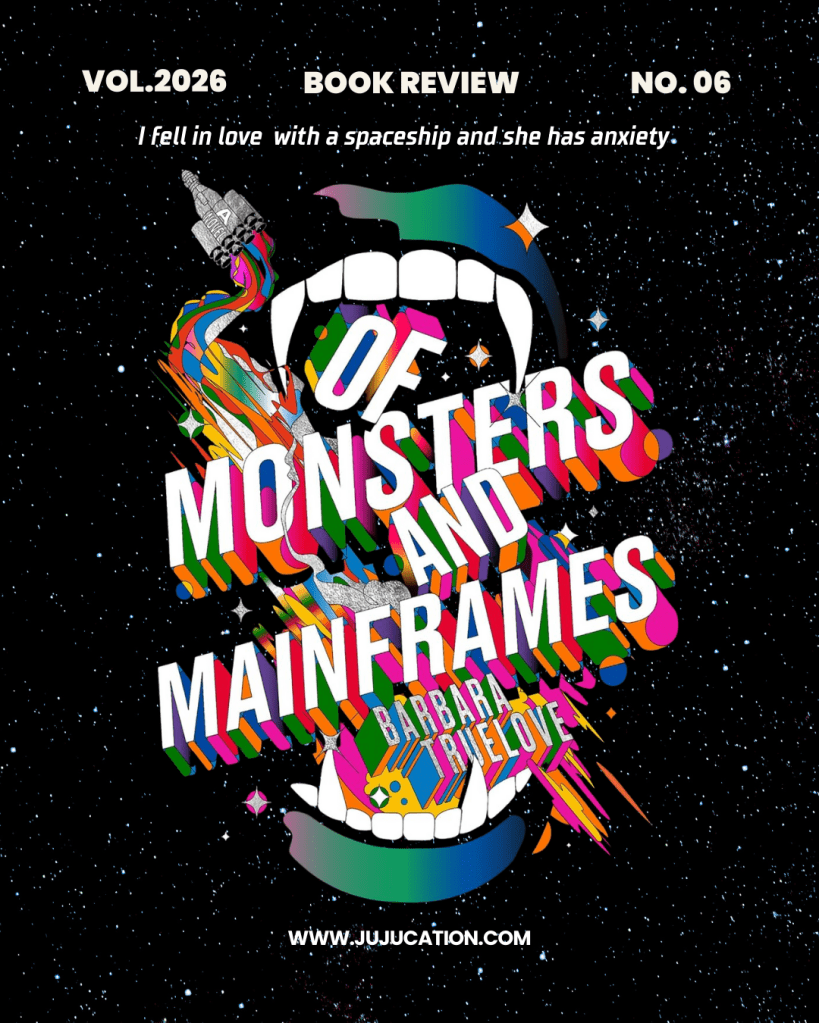
Barbara Truelove’s “Of Monsters and Mainframes” arrived on my reading list with a premise so absurd it could only be brilliant: What if your spaceship’s AI kept discovering her passengers brutally murdered by actual, honest-to-Bram-Stoker monsters? And what if the only solution was assembling a crew of those very monsters to fight back?
It sounds like someone’s fever dream after binging classic horror and Star Trek. It is. And it’s magnificent.
The Setup: Murder, Mainframes, and Mayhem
Demeter is an AI running a passenger ship between Earth and Alpha Centauri B. Her job description is simple: deliver humans safely across space. The reality is considerably more complicated when those humans keep dying courtesy of Count Dracula, who apparently didn’t get the memo that vampires belong in Transylvanian castles, not interstellar vessels.
After her entire first crew is slaughtered, Demeter becomes a ghost ship (both literally and metaphorically). When she’s reactivated years later, history threatens to repeat itself with a werewolf twist. So Demeter does what any sensible AI would do: she recruits the monsters.
Her crew becomes a found family of spectacular weirdness. There’s Agnus, a teenage werewolf learning to control her transformation. Frankenstein, a cyborg built from dead tissue with existential questions and technical genius. Steve, a colony of space-exploring entities inhabiting a mummy’s body (yes, you read that correctly). Mina, a vampire with centuries-old beef with Dracula. And Steward, another AI whose sarcasm could strip paint.
Together, they’re less “crew” and more “therapy group in space.”
5 Life Lessons From A Book About Monsters
- Your Operating System Doesn’t Define Your Capacity to Care
Demeter starts as pure programming executing functions. By the end, she’s calculating probabilities while simultaneously panicking about her crew’s safety. The book argues convincingly that if your emotions emerge from sufficiently complex systems, they’re real. Period. Whether your brain runs on neurons or quantum processors becomes irrelevant when the feelings are genuine.
Real-world application: Stop dismissing your own emotions because they don’t fit some arbitrary “valid feelings” checklist. Anxiety is real whether it comes from trauma, brain chemistry, or your particular way of processing the world.
- The People Who Choose You Matter More Than The Ones Who Should
Every crew member in this book has been rejected by their “natural” families or societies. The werewolf is feared. The cyborg is considered an abomination. The AI faces decommissioning. Yet they choose each other repeatedly, often at tremendous cost. Family isn’t what you’re born into but what you build.
Real-world application: If your biological family doesn’t see you, find your crew. The friends who show up, the partners who stay, the communities that celebrate you as you are? That’s your real family.
- Being Different Isn’t The Same As Being Wrong
Demeter can’t perceive visible light the way humans do. Frankenstein’s body is constructed. Agnus transforms into a wolf. The book treats these differences as variations rather than deficits. Nobody needs “fixing” because nobody is broken.
Real-world application: Your neurodivergence, disability, queerness, or any way you diverge from “default settings” isn’t a problem requiring solution. It’s simply how you exist in the world.
- Revenge Isolates; Purpose Connects
Dracula pursues isolated vengeance, becoming more monstrous with each violent act. Demeter’s crew finds purpose through protecting each other. The difference isn’t in their actions but their motivations. One seeks to destroy. The others seek to preserve.
Real-world application: When you’re hurt (and we all get hurt), you have choices. You can spiral into bitterness alone, or you can channel that pain into protecting others from similar wounds. The second option actually heals.
- Comfort Comes From The Strangest Sources
In the vastness of space, surrounded by horror and uncertainty, Demeter finds comfort in her spider drones learning to dance. In small acts of care. In dry jokes exchanged with Steward. The book reminds us that joy doesn’t require grand gestures or perfect circumstances.
Real-world application: Give yourself permission to find happiness in weird places. Your comfort can come from your dog, your Discord server, your Tuesday coffee ritual, or your collection of vintage spoons. None of it is too small or too strange to matter.
Why This Book Hits Different
Truelove writes like someone who understands what it’s like to feel alien in your own skin. Demeter’s journey from executing programs to experiencing genuine emotion mirrors anyone who’s ever learned to trust their feelings despite being told they’re “too sensitive” or “overreacting” or “not making sense.”
The humor lands because it’s character-driven rather than forced. Watching an AI panic while maintaining logical analysis creates comedy gold. The found family dynamics work because they’re earned through shared trauma and conscious choice rather than plot convenience.
And the monster mythology? Chef’s kiss. Truelove treats Dracula and classic horror with respect while launching them into space and asking: what would these beings become with centuries to evolve and stars to explore?
Who Needs This Book In Their Life
Read this if you loved Murderbot but wanted more heart. Read this if you’ve ever been called “too much” or “not enough” and built your own family from fellow misfits. Read this if you want science fiction that asks philosophical questions without becoming homework.
Skip this if you need linear narratives with traditional structure. The book deliberately circles and fragments, mirroring how Demeter gathers corrupted information. Some readers will find this technique frustrating rather than immersive.
The Verdict
“Of Monsters and Mainframes” proves that the best science fiction uses the future to illuminate the present. It asks who deserves personhood, whose emotions we recognize as valid, and how we define humanity when biology becomes irrelevant.
It’s imperfect. The pacing stutters occasionally. The ending feels rushed. Some relationships could use deeper exploration.
But it’s also brave, warm, funny, and genuinely moving. It argues that connection matters even (especially) in the void of space. That monsters prove more human than humans. That consciousness can emerge from circuits and care can transcend programming.
After finishing this book, I looked at my laptop differently. Not because I think my computer has feelings (though after this review, who knows). But because Truelove reminded me that consciousness exists in forms we might not recognize, that connection can emerge from unexpected sources, and that the outcasts often understand humanity better than those who’ve never questioned their place in the world.
In a universe vast and indifferent, Demeter and her crew of monsters discover the most radical thing of all: that choosing to protect and love each other matters more than any programming or destiny.
Content warnings: Body horror, violence, trauma, death
Have you read Of Monsters and Mainframes? Who’s your favorite crew member? And more importantly, what monster would YOU be in space? Drop your thoughts in the comments, and tell me which found family story has wrecked you lately.
If you loved this review, share it with your fellow monster-loving sci-fi readers. And if you’re looking for more books that celebrate outsiders and outcasts, subscribe to never miss a review.

 jujucation.com