
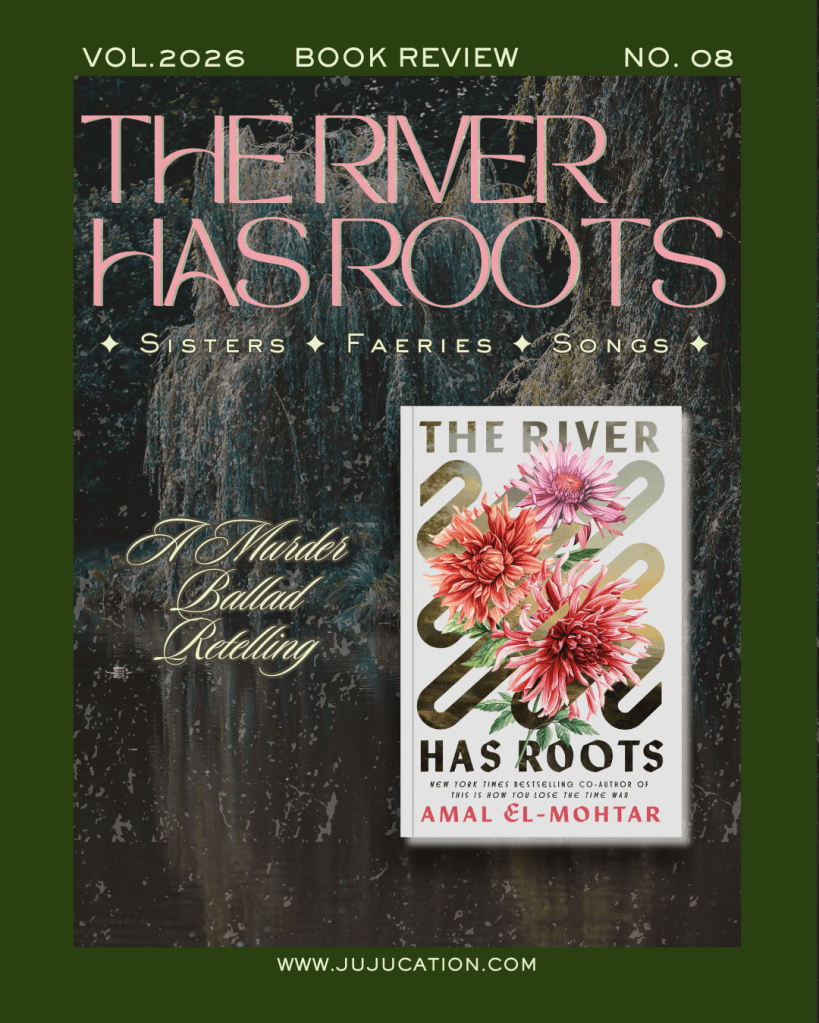
You know that feeling when a book reaches into your chest and squeezes your heart in exactly the right place. That is what Amal El-Mohtar did to me with The River Has Roots, and I am still carrying it around.
I picked this up thinking I was getting a cozy faerie romance. And yes, I got that. What I was not prepared for was how cleanly it would cut into my life as an elder daughter. Because this is not really a love story. It is a sister story that happens to contain a luminous queer faerie romance, and that distinction matters.
What It’s About
The River Has Roots is a short novella, about 20,000 words, the kind you can finish in an afternoon and keep thinking about for weeks. It retells the old murder ballad “The Cruel Sister.” If you do not know the song, the essentials are simple and brutal: two sisters, one suitor, jealousy, a death by the river. The murdered sister is turned into a musical instrument that sings the truth of what happened.
It is strange. It is dark. It works.
El-Mohtar takes that skeletal framework and makes something both devastating and reparative. We meet Esther and Ysabel Hawthorn, sisters living in Thistleford, a liminal town where the River Liss runs straight out of Faerie. Each morning, they sing to the willow trees. It is a duty, a ritual, a form of inheritance. Their bond made audible.
Esther, the older sister, is under pressure to marry. Enter Samuel Pollard, a man who wants her land more than her life. Then Rin appears, a faerie who hears Esther’s song and answers it. Their courtship unfolds through music, gifts, and the careful negotiation of loving across a boundary that is both magical and political.
This is where the story grows complicated. And beautiful. And painful. And, eventually, hopeful.
The Sister Thing Hit Different
I need to be honest here. As an elder daughter, I have spent my life suspended between protector and person, between responsibility and desire. Watching Esther carry that same weight felt uncomfortably precise. Wanting something for herself and feeling guilty for wanting it. Knowing the cost of choosing wrong. It was heart-rending.
What makes the book so sharp is that it refuses to sentimentalize sisterhood. Ysabel is not just sweetness. Esther is not just sacrifice. There is love, yes, but also jealousy, misalignment, and the quiet violence of misunderstanding. They are each other’s whole world, and still they are separate people.
That relationship is the spine of the story. The romance is tender. The magic is exquisite. But when everything breaks, it is sisterhood that determines what survives. I felt that deeply. I would walk into Faerie, face a river, become a singing tree if it meant protecting my sister. This book knows that feeling and does not blink.
A Story Where Language Carries the Argument
El-Mohtar writes sentences that behave like poems. The prose here is lush and deliberate, moving between narrative, verse, riddles, and song. Language is not just decoration. It is the point.
Some readers will find it distant or overly stylized. If you want plain prose and heavy interior monologue, this may not be your book. But if you like language that leaves a taste behind, you will be well fed.
The romance between Esther and Rin is handled with care and intelligence. It is not a checkbox. It is an exploration of consent, power, and choice, especially when gifts and obligations are built into the rules of the world. Rin listens. Samuel takes. That contrast is not subtle, and it does not need to be.
There is also a political undercurrent running just beneath the surface. El-Mohtar has spoken about drawing from childhood memories of Lebanon and from thinking about displacement. A Palestinian resistance song is woven into the text. The Hawthorns’ connection to their land, and the threat of losing it to someone like Samuel, echoes real questions about who gets to belong and who gets pushed out.
It is remarkable how much this small book holds without collapsing under its own weight.
The Murder Ballad Structure Works
I was curious how El-Mohtar would handle “The Cruel Sister,” a ballad that often reduces women’s violence to spectacle while the man at the center escapes untouched.
She keeps the bones of the story: the jealousy, the river, the death, the transformation into something that sings. What she changes is where responsibility lands and how justice functions. The land remembers. The river participates. The willows keep the truth.
The ending delivers the reckoning the genre promises, but it is tender and strange rather than triumphant. It asks a quiet, radical question: what if we took an old, cruel story and bent it toward care? Toward repair. Toward something survivable.
Should You Read It?
Yes, if you love lyrical fantasy, faerie tales, queer romance, and stories where sisterhood is the central love story.
Yes, if you are an elder daughter who has ever felt split between obligation and selfhood. Bring tissues.
You might want to skip it if you prefer dense worldbuilding, complex plotting, or straightforward prose without songs and verse. This book prioritizes mood, language, and emotional truth over mechanics.
Final Thoughts
The River Has Roots is short enough to read in one sitting, but it lingers. It reminds you why stories exist at all: to remember, to bear witness, to take something old and painful and turn it toward possibility.
It also made me text my sister “I love you” at two in the morning. That feels like the most honest review I can give.
Read it. Sing to your willows. Call your sibling afterward.
You will not regret it.

 jujucation.com