
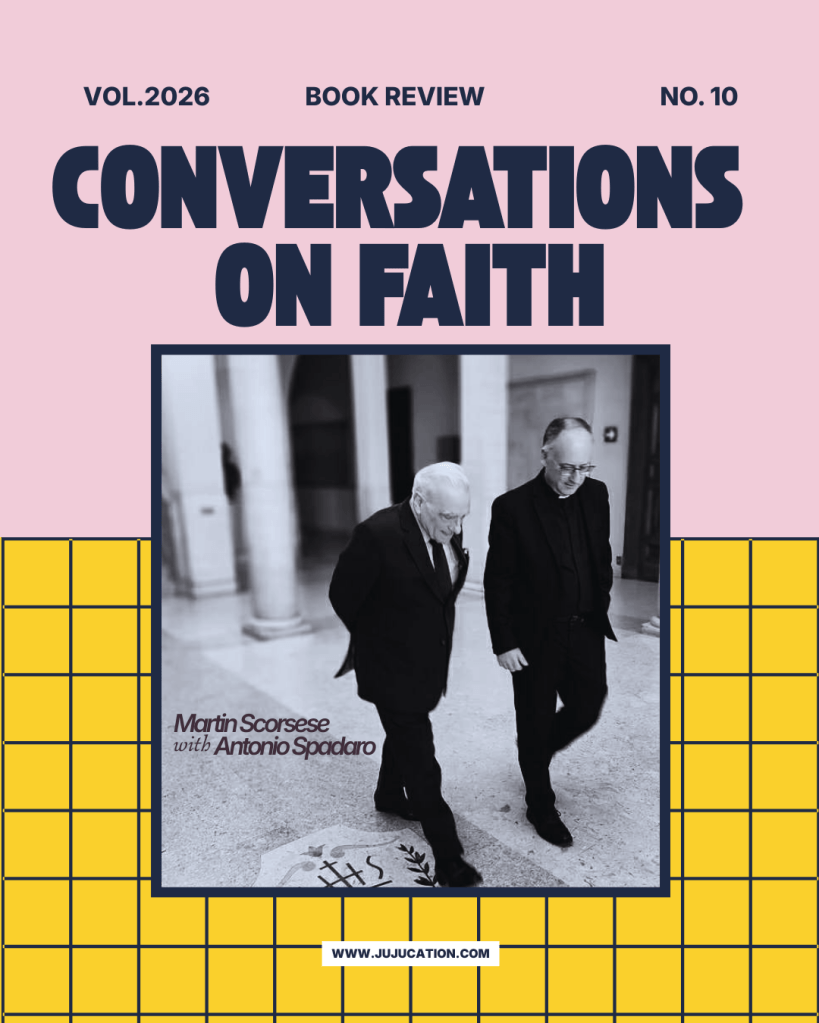
I’m not a Scorsese completist. I’ve seen Gangs of New York, Hugo, and most recently Killers of the Flower Moon. That’s pretty much it. But after watching Killers, I couldn’t shake a question: how does someone who clearly takes faith seriously make films drenched in betrayal, greed, and violence? Not gratuitous violence, but the kind that sits heavy in your chest for days. The kind that feels morally serious. I picked up Conversations on Faith because I needed to understand how those two things coexist in one person.
Turns out, that tension is the entire point.
This isn’t a celebrity memoir or film theory textbook. It’s six dialogues between Martin Scorsese and Jesuit priest Antonio Spadaro, recorded over eight years, about how Catholic guilt, grace, and God’s silence have shaped a lifetime of filmmaking. And it reads like the kind of late-night conversation where someone finally says the thing you’ve been thinking but couldn’t name.
Who This Book Is Actually For
Here’s the thing: you don’t need to be a cinephile to get something from this book. I’m living proof. What you do need is curiosity about how people hold contradictions together, how faith survives when you’re staring at human darkness, and whether art can tell hard truths without becoming cynical.
Spadaro isn’t a film critic trying to decode hidden meanings. He’s a theologian who takes movies seriously as spiritual texts, and he asks Scorsese the questions I didn’t realise I want answered: Why does violence always carry moral weight in your films? What does it mean that your characters can’t escape their consciences? Where is God when everything looks corrupted beyond repair?
And Scorsese answers not with neat doctrine, but with stories, images, and honest admissions about his own struggles.
What You’re Actually Reading
The book is structured around six core conversations, moving from Scorsese’s Catholic childhood in New York (altar boy, almost-seminarian, streets and churches as one landscape) through to his late-career reflections on aging, art, and what it means to keep making films that ask hard questions about redemption.
You get stories: the new priest who gave young Martin books by James Baldwin and showed him “you don’t have to live like this.” The realization that he wanted to be a priest but didn’t have the vocation. The question inherited from family drama: “Am I my brother’s keeper?” And then you get Scorsese tracing how all of that spilled into his characters—men caught between vanity and repentance, self-destruction and the desire to be loved.
What makes it work is that Spadaro brings Ignatian spirituality into the mix (discernment, finding God in all things, the drama of conscience) and Scorsese responds with images, scenes, shoot stories. So it becomes a double portrait: a director trying to name his faith honestly, and a priest learning to read cinema as a spiritual practice.
What Makes This Book Different
1. It treats “Catholic guilt” as creative fuel, not just baggage
Scorsese is blunt: guilt is his most important Catholic legacy. But instead of leaving it there, they explore how guilt becomes the engine for characters who can’t escape the consequences of their choices. It’s not shame for shame’s sake. It’s the starting point for deeper honesty.
2. It reframes violent films as morally serious, not exploitative
This is what I came for. The book argues that depicting the full ugliness of betrayal and violence is necessary if redemption is going to mean anything. This isn’t nihilism. It’s the insistence that grace only matters when you face the darkness head-on. You can’t talk about mercy if you’re pretending evil doesn’t exist or doesn’t leave real damage.
3. It shows what spiritual dialogue actually looks like
This isn’t a priest lecturing or a filmmaker defending himself. It’s two people questioning each other without defensiveness. Scorsese admits ambivalence and failure. Spadaro is transparent about his theological questions and aesthetic reactions. It’s the kind of conversation that makes you think, “Oh, this is what mature faith looks like.”
4. Pope Francis shows up as a surprising catalyst
Francis invites Scorsese to help the world “see Jesus in a new language,” which sparks fresh creative work late in Scorsese’s career. It’s a small thread in the book but a big idea: what if the institutional church and artists collaborated instead of clashing?
Things I Loved
The conversational tone never gets preachy or academic. Even when they’re discussing Ignatian spirituality or complex theology, it stays grounded in specific stories and images. Scorsese talks about film the way some people talk about prayer, as a demanding practice that forces you to confront your obsessions.
I loved the honesty about unanswered questions. They never arrive at neat certainties. Instead, they model what it looks like to live faithfully with doubt, which is weirdly comforting if you’ve ever felt disqualified by your own questions.
The section on Silence is worth the price of the book alone. Scorsese unpacks the “silence of God” in suffering, the ambiguous heroism of believers who apostatize under torture, and what it means to seek traces of grace in damaged lives. Reading this made me immediately add Silence to my watch list, which I honestly didn’t see coming.
And I appreciated that the book doesn’t try to scrub Scorsese’s films of their darkness. The argument isn’t “actually, these movies are wholesome if you look closely.” It’s “these movies are spiritually serious because they refuse easy answers about violence, power, and complicity.”
What This Book Is Really About
On the surface, it’s about how Catholicism shows up in Scorsese’s films. But pull back and it’s really asking: Can you find God in morally compromised contexts without romanticizing sin? What does it mean to make art that tells the truth about human darkness while still leaving space for grace? How do you keep faith alive when it’s messy, ambivalent, and full of silence?
The answer the book offers isn’t a formula. It’s a practice. Art as spiritual discipline. Filmmaking as a kind of ongoing examination of conscience. And faith as something that survives not because you have all the answers, but because you keep asking the questions honestly.
For someone like me, who’s wrestled with how to hold faith and brutal honesty together, this was exactly what I needed to read.
Who Should Read This / Who Can Skip
Read it if:
- You’ve wondered how faith survives when you’re confronting human corruption and violence
- You’re interested in whether depicting darkness can be a moral act
- You want to understand what drives artists who take both craft and spirituality seriously
- You’re drawn to honest conversations about doubt, guilt, and grace
- You’re curious about Silence (or Killers of the Flower Moon, or any Scorsese film) and want the deeper context
- You appreciate Ignatian spirituality or Pope Francis’s approach to culture
Skip it if:
- You’re looking for a straightforward theology textbook or doctrinal guide (this is exploratory, not systematic)
- You prefer tidy spiritual conclusions over open-ended wrestling
- You have zero interest in film, art-making, or creative process
- You’re firmly opposed to any depiction of violence in media and unwilling to entertain a different perspective
The Bottom Line
This isn’t a perfect book. Sometimes the conversations circle back over the same ground, and there are references to films I haven’t seen that probably would have landed harder if I had. But it’s a rare thing: a sustained, intelligent conversation between a filmmaker and a theologian that respects both disciplines without flattening either one.
What it does beautifully is show that the line between sacred and secular is thinner than we think. A film about greed and murder can hold more theological weight than a sanitized Bible movie if it honestly faces sin, responsibility, and the hunger for redemption. And faith, real faith, isn’t about certainty. It’s about the willingness to keep wrestling.
If you’ve ever felt like your spiritual questions disqualify you, or if you’ve wondered whether telling hard truths and holding faith can coexist, this book will meet you exactly where you are. And it might just send you to your watch list with a completely different lens for what you’re about to see.
So, real talk: Have you ever watched a film that made you question how the filmmaker holds their beliefs and their brutal honesty together? What was it, and did it change how you see their work?
If you’re into reviews that treat books (and films) like they actually matter, subscribe for more honest takes on art, faith, and the questions that won’t let us go.

 jujucation.com