
My thanks to Times Reads Publishing for providing a review copy of The Dinner Party by Viola van de Sandt.
If this review persuades you to spend time with a fictional dinner party that is significantly worse than any you’ve attended in real life, you can find the book through Times Reads Publishing’s stockists and retail partners.
As always, all opinions, emotional reactions, literary overthinking, and unresolved feelings about ambiguous endings are entirely my own.
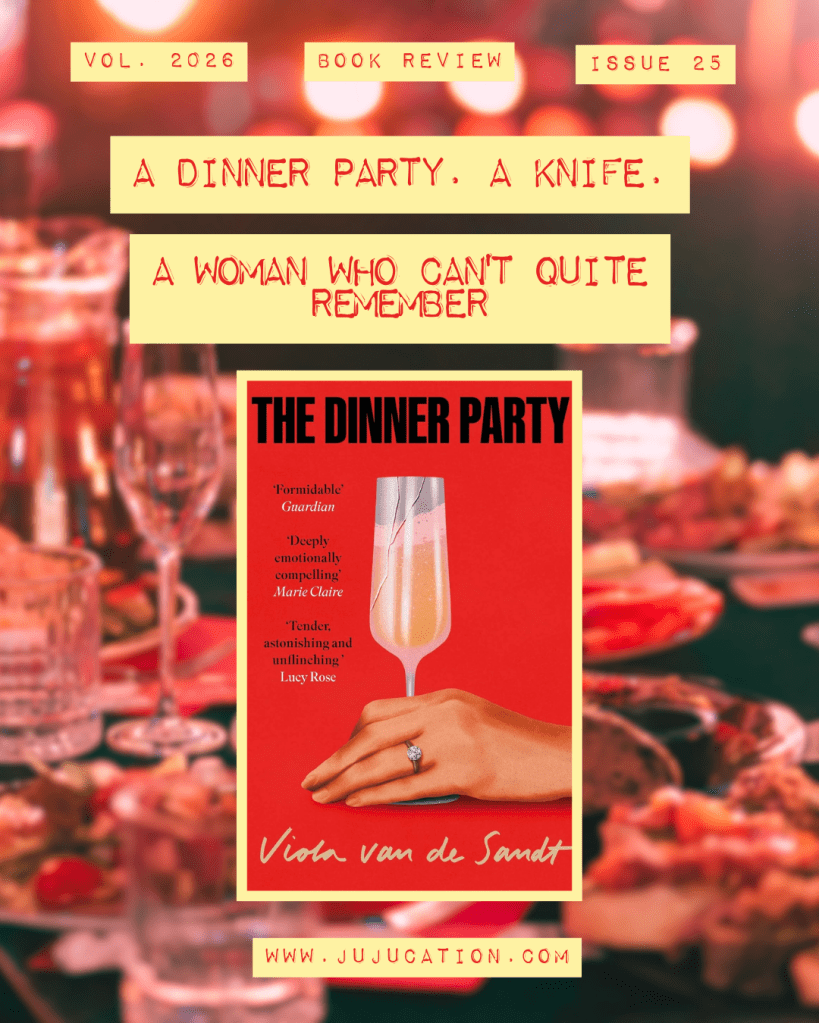
Content Warning: The Dinner Party contains depictions of coercive control, emotional abuse, gaslighting, domestic violence, sexual violence, trauma-related memory fragmentation, and animal cruelty. None of these themes are treated lightly, but they are explored directly and in detail. If you’re currently protecting your peace or navigating similar experiences yourself, this may be one to approach with care.
Let me tell you the exact moment I knew this book and I were going to have a complicated relationship.
Franca, our narrator, agrees to host a dinner party in the middle of a heatwave, with a broken fridge, for guests she doesn’t particularly want, cooking a braised rabbit she cannot eat for ethical reasons, from a recipe she barely knows. And she says yes. She just says yes.
My internal response was not sympathetic. It was: absolutely not. We are ordering takeout, we are lying about a gas leak, and no one is setting foot in this house tonight. I would have been on the phone with a delivery app before Andrew finished his sentence.
But here’s the thing van de Sandt is very patiently engineering while I was busy drafting my imaginary exit strategy: Franca can’t say no. Not because she’s passive, not because she’s dim, not because she’s a flat literary device designed to suffer prettily. Because the no has been quietly, methodically dismantled. Year by year. Dinner by dinner. Small concession by small concession. By the time Andrew announces the party, the no has been gone so long she’s stopped noticing it’s missing.
That’s the whole book. That’s what you’re reading.
The Dinner Party is not the novel I expected. I thought I was getting a psychological thriller with literary ambitions. I got something harder to classify: a novel about the architecture of control, and the long, unglamorous, frequently disorienting work of surviving it. If you want catharsis and clean answers, this book will frustrate you. If you want something true, it might sit in your chest for a while.
I’m still deciding which one I got. Both, maybe. Mostly just the second one.
The Setup
Franca lives alone in Berlin. She works in a department store, sees a therapist named Stella, and carries herself like someone who has spent years learning to take up very little space. Stella asks her to write. So Franca writes letters to Harry, her former best friend, circling around a night in London she can almost recall, except for the parts that refuse to surface.
The novel moves between this present quiet and the years that led to it: a relationship with Andrew, a charming tech entrepreneur she followed from Utrecht to London, who slowly made every decision — where she lived, what she cooked, whether she needed to work, who she was — feel like it had already been made before she arrived. The dinner party is where all of it breaks open. You’re there for both the event and the aftermath, and neither of them will let you get comfortable.
What Makes This Book Different
1. The fragmented memory is a symptom, not a technique.
Franca’s account is contradictory and incomplete. But unlike novels that deploy an unreliable narrator as a structural puzzle to solve, van de Sandt is precise about the reason: Franca’s mind is protecting her. The gaps are trauma. The competing versions of the same moment aren’t ambiguity for its own sake. They’re what happens when a brain decides the full version is too much to hold at once. It shifts the whole reading experience from “what really happened?” to “what can she bear to know right now?” — which is a much more interesting question, and a more honest one.
2. The abuse has no dramatic reveal.
Andrew never has a villain speech. His cruelty is primarily social, practical, and relentlessly normalized. He insists she cook meat she doesn’t eat. He tells guests she’s a problem drinker. He makes her financially dependent under the guise of care. The accumulation is the point. By the time physical violence arrives, it’s horrifying precisely because it has been so thoroughly, patiently prepared for. The novel never lets you point to a single moment and say “there, that’s when it started.” Because that’s not how it starts.
3. The dinner party itself is pressure-cooked symbolism that doesn’t feel like symbolism.
Every element of that evening carries meaning, in the spoiled rabbit, the heatwave, the guests performing their own significance for each other. But van de Sandt earns it. The scene never tips into allegory because it’s also just a genuinely awful evening that goes irreversibly wrong. The literary architecture is invisible until you’re already inside it, which is a neat trick.
4. The ending is not a resolution. It’s something more honest than that.
Franca at the end of the novel is not healed. She’s present. She’s painting her walls a color she chose. She’s planning to see Harry. The knife, and whose blood, and what exactly happened: genuinely unclear. That refusal to deliver a tidy accounting is the most radical thing about the book. Recovery, van de Sandt insists, is not clarity achieved. It’s the decision to keep going without it. Make of that what you will. I found it both truthful and slightly maddening, which feels about right.
Things I Loved
The reveal about Harry. I can’t tell you what it is, but I can tell you it completely shifted my understanding of every scene they’d shared, added a layer of what everyone in this story has had to conceal, and made me want to go back to the beginning immediately. The kind of surprise that earns its place because it changes the meaning, not just the plot.
Stella. She’s a therapist written like an actual human being. No performed warmth, no neat wisdom dispensed on cue. Just a persistent, patient return to the facts while respecting the defenses that have kept Franca upright. She’s the most quietly impressive character in the book and she barely takes up space on the page, which feels intentional.
The cat scene. Not what it first appears to be. I sat with it for a while, troubled, before I understood what van de Sandt was actually doing: showing how destabilized Franca’s perception has become, how little she can trust her own account of what’s right in front of her. It’s disturbing in exactly the right register, and I say that as someone who nearly put the book down.
The pacing of the abuse narrative. It doesn’t announce itself. You see what Andrew is doing about three steps before Franca has finished accommodating it. That lag between reader recognition and character recognition is uncomfortable in the specific way good fiction is uncomfortable: it implicates you in the watching.
What This Book Is Really About
It’s about how control is installed so quietly that by the time you notice it, it feels like your own personality.
It’s about how trauma protects itself by fracturing the story you try to tell about it, so even you can’t find the beginning.
It’s about the difference between the life that belongs to you and the life you’ve been talked into inhabiting, and how terrifyingly similar those two things can look from the inside.
And underneath all of that, it’s about what it costs to choose yourself when you’ve spent years learning not to. The question this book leaves in your chest is not “what happened that night?” It’s “how did she get here?” And then, a bit later, less comfortably: “have I ever negotiated myself into a smaller version of my life without noticing?”
That last question I’d rather not answer out loud. But it’s the one that stayed.
Who Should Read This / Who Can Skip
Read this if:
- Psychological fiction that prioritizes interiority over plot is your preference
- You’re interested in how coercive control operates before it becomes visible
- You loved Assembly, Asylum Road, or Cleopatra and Frankenstein
- You’re comfortable with, and maybe even appreciate, ambiguous endings
- You want trauma written with precision rather than sentiment
Proceed carefully if:
- You’re sensitive to sexual violence or domestic abuse depicted in clinical detail
- Animal cruelty is a hard limit for you (the cat scene is real and it’s a lot)
- You’re currently processing your own trauma and need something that isn’t going to poke at that
- Fragmented, nonlinear storytelling leaves you feeling cheated rather than challenged
Skip it if:
- You want a plot-driven thriller with answers at the end
- Ambiguity frustrates you and moral clarity is non-negotiable
- You find European literary fiction slow or, let’s be honest, a bit much
- You need to finish a book feeling better than when you started. No judgment. Sometimes that’s exactly the right requirement.
The Bottom Line
The Dinner Party is a formidable, controlled, genuinely unsettling debut that does exactly what it sets out to do. My hesitation is personal, not critical: I kept wanting the novel to arrive somewhere I could stand on, and it deliberately refuses to provide that ground. The emptiness I felt at the end is the book working correctly. I understood that intellectually. Emotionally, I still held out hope for a different ending all the way to the last page.
If you’re looking for a book that respects your intelligence and refuses to flatter your need for closure, this is it. Go in with your eyes open and maybe have a lighter read queued up for immediately after.


