
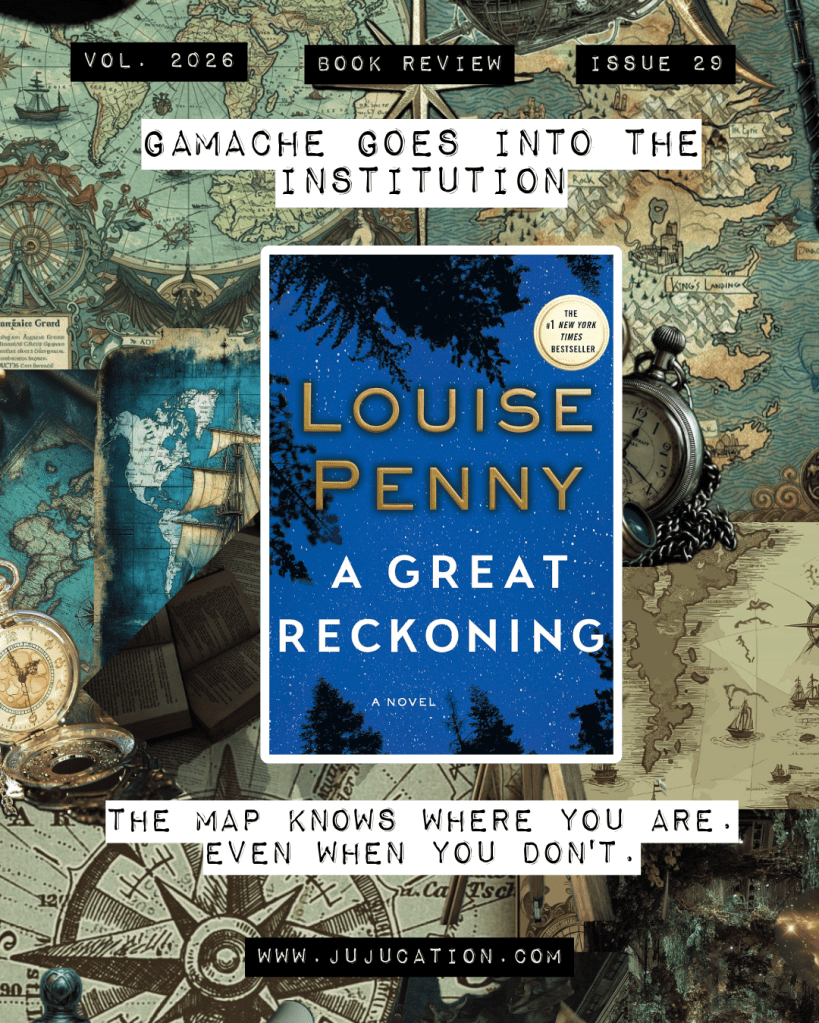
There’s a moment in this book where someone explains that a map is not a record of what exists. It’s a decision about who gets to exist. What gets drawn in. What gets left out. Three Pines has been erased from every official map of Québec, and by the end, the reason is so tender it will get you somewhere around page 400 before you’ve had time to brace.
I read that sitting at my desk at a my new job, looking up terms I am still learning to spell, preparing reports for clients who keep asking me questions I answer with the specific confidence of someone who Googled it forty minutes ago. Not exactly Three Pines. Not exactly the Sûreté Academy either. But somewhere in the middle: a person who is real and doing work that matters and not quite on the map of the life she thought she was building.
This is book twelve. I am not here to convince you to start the series. I am here to tell you what it does to you when you’re already this deep in and Penny decides to move the furniture.
Where This Fits in the Penny Universe
Books ten and eleven put Gamache in various forms of exile and retreat. Book twelve brings him back with authority and a mission, and that shift in register is immediate. He’s no longer a man recovering. He’s a man who has decided something. Penny moves the primary setting from Three Pines to the Sûreté Academy, the institution that trains Québec’s police, and the change is deliberate and a little bracing. The village is still there, the bistro still anchors the emotional throughline, but this is a book about institutions now, not communities, and those are different animals. The warmth is still present. The stakes are higher. The betrayals land with more weight than they’ve had since book nine.
The Setup
An intricate hand-drawn map, over a century old, turns up stuffed inside the walls of the Three Pines bistro like insulation. It depicts a Québec that doesn’t match any existing record, and inside it, Three Pines has been erased. Meanwhile, Gamache arrives at the Sûreté Academy to find a culture shaped entirely by one man, Professor Serge Leduc, who has spent years grooming cadets into compliance and breaking anyone who pushed back.
Gamache selects four at-risk cadets for his mentorship, including Amelia Choquet: tattooed, pierced, former addict, written off by essentially everyone in the room before she opens her mouth. He gives each cadet a copy of the mystery map. Then Leduc turns up dead, shot in the head, with a copy of the map in his room.
The investigation turns on Gamache. Then on the cadets. Then on his oldest friend. The map mystery turns on a story of erasure so quiet and so precise that it will wreck you, and you won’t fully see it coming.
What Makes This Book Different
1. Penny takes Gamache out of the place that defines him and trusts the character to carry it. Three Pines is a security blanket for the reader as much as it is for Gamache. Removing him and dropping him into an institution built on hierarchy and enforced silence is a real risk. It works because Gamache’s moral clarity isn’t dependent on a cozy setting. He brings it with him, which is the whole point.
2. Amelia Choquet is one of Penny’s best characters, full stop. She arrives looking like every danger signal, and Penny is completely deliberate about the reader’s discomfort with her. By the end, Amelia is the most principled person in the novel, and you have to sit with the fact that you doubted her because she didn’t look safe. Penny doesn’t let you off the hook for that. It’s not comfortable. It shouldn’t be.
3. The cartography metaphor does actual work. Lots of literary mysteries hang a symbol over the story and wait for you to notice how clever it is. The map in this book earns its meaning. The question of who gets to be on the map, and who has had to erase themselves to survive, is not decoration. It’s the argument the entire novel is making.
4. The Brébeuf arc is devastating and precise. Gamache’s oldest friendship ends here, and the way it ends is not dramatic in the way betrayals usually are in fiction. Brébeuf commits murder believing it is an act of love. What breaks him, and what should break the reader, is the moment he realizes he was wrong. He substituted his own judgment for Gamache’s humanity, and he never asked. That’s the whole thing, in two sentences.
A Personal Aside
About two-thirds of the way through, Penny introduces the four signposts. The cardinal directions Gamache believes every principled person must be willing to say: I’m sorry. I was wrong. I don’t know. I need help.
I started to work in an industry where I have no background in. “I don’t know” and “I need help” are not aspirational moral stances for me right now. They are my daily operating mode. I say them approximately eleven times before lunch.
What Penny is arguing is that this is not a weakness. This is the thing that makes Gamache the most dangerous person in any room full of people who are too proud to admit they’re lost. I found this extremely comforting, and also a little annoying, because I didn’t ask a fictional French-Canadian police commander to validate my professional humility while I was just trying to enjoy a murder mystery. And yet.
Things I Loved
The cartographic reckoning. Gamache explains to the cadets what dead reckoning means: a sailor who’s lost sight of land and can’t find the stars navigates by the last known position, the direction, the speed, the time elapsed. He admits he doesn’t know exactly where he is, and he keeps going anyway. The novel’s title earns itself in that one explanation.
Amelia in the bistro. She’s out of place in every visible way, and Myrna sits across from her and just looks at her, straight and clear, without pity or performance. It’s a small scene. It reframes everything you think you know about Amelia, and it does it quietly.
The Marie Valois reveal. A woman who mapped a world that erased her, who did her life’s work under a man’s name because there was no other way to be seen. The reveal is quiet, almost offhand, and it hit harder than anything louder would have. Penny trusts the reader to feel it without being told to.
Beauvoir becoming a father. A small throughline but a real one. Watching him navigate new parenthood alongside a murder investigation, watching Gamache watch him, knowing how far both of them have come. It’s earned in a way that only works because we’ve been in this series for eleven books already.
The film I kept staging in my head. I don’t know when it started, somewhere around the map unrolling on Gamache’s desk, but I couldn’t stop casting it. The academy’s cold corridors. Amelia Choquet walking into frame looking like every warning sign and being the only honest person in the room. The stained glass window catching light. I don’t know who should make this film, but I want them to make it. This book has a visual logic that most mysteries don’t earn. Penny earns it.
What This Book Is Really About
Penny is writing about what it costs to be the person who tells the truth in a room full of people who have agreed not to.
Gamache walks into an institution that has survived by punishing honesty and rewarding silence. He is not naive about what he’s doing. He knows the cost. What the novel refuses to resolve cleanly is this: is it enough to be the one who tells the truth, if the truth arrives too late to protect the people who needed it?
The map is the answer. Marie Valois erased herself because the world wasn’t ready to include her. Gamache buries the file that would destroy Amelia’s future because he decides that some truths do more damage than the silence would have. Brébeuf tells himself a story about love and loyalty and acts on it without once asking Gamache what he actually wanted. Everyone in this book is navigating by their own best reckoning, with incomplete information, in the dark.
Penny doesn’t give you a clean verdict on who got it right. She just asks you to sit with the question. I have been sitting with it.
Who Should Read This / Who Can Skip
Read it if:
- You’re already in the series and Brébeuf’s name means something to you
- Institutional corruption as moral laboratory sounds like your kind of problem
- Amelia Choquet sounds like someone you want to follow for several more books (she is)
- You can sit with a quiet ending and let it settle
Come back to it if:
- You haven’t met Brébeuf yet. You need that history for the ending to land properly.
- You read Penny for village cozy and the academy setting sounds cold to you. It is, deliberately.
- You’re mid-crisis and need comfort. This book is precise and purposeful, not gentle.
The Bottom Line
This is one of the strongest books in the series, and also one of the least immediately satisfying. Penny is working at altitude here: the mystery is propulsive, Amelia is extraordinary, the cartography metaphor pays its rent. But the emotional center of this book, which is Brébeuf, requires you to have loved him across earlier volumes to feel the full weight of losing him. Without that history, it’s just a plot point. And the ending, while thematically exact, is quiet in a way that could read as a withholding if you’re not in the right frame for it.
Read it as part of the series, at this exact point in the series. That’s what it was designed for. That’s where it works.


