
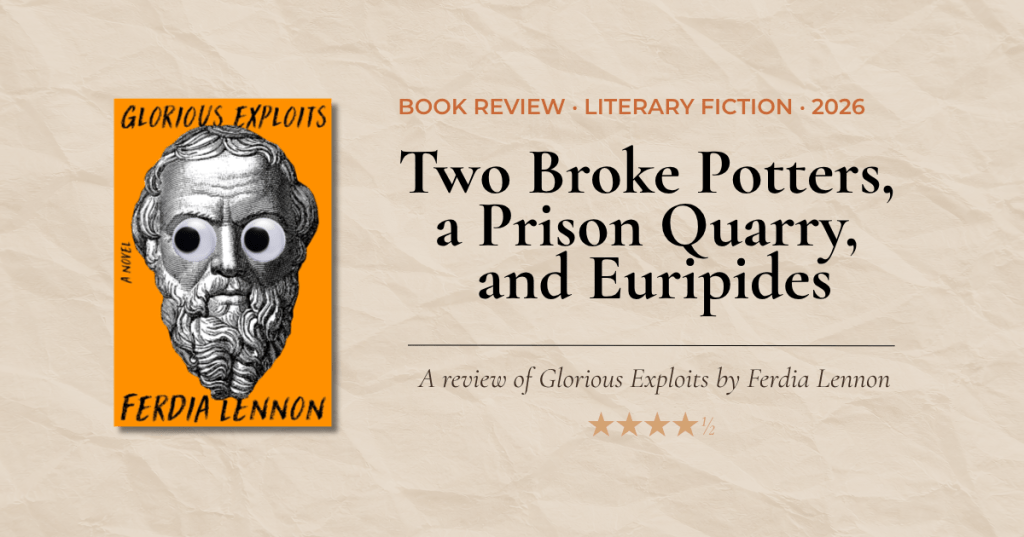
Two Broke Potters Walk Into a Prison Quarry. I Was Not Prepared.
I picked this up expecting a gimmick, which is a habit I’ve developed from years of reading, which is to say years of being let down by books with very good jacket copy and very little going on underneath it.
This one had all the markings of that kind of book. Unemployed Syracusan potters. Athenian prisoners of war. Greek tragedy staged in a limestone quarry in 412 BC, narrated in modern Irish vernacular.
I said to myself: this is either a brilliant formal argument or a lit-fic party trick dressed up in a toga, and I know which one I was betting on.
I was wrong.
I’m telling you this upfront so you understand that everything that follows is credible.
What Is Actually Happening Here
Lampo and Gelon are best friends who are also broke, which in 412 BC Syracuse is not a remarkable distinction but does narrow your options considerably. Gelon loves Euripides the way some people love a band they discovered at seventeen: privately, devotedly, with the kind of intensity that looks unhinged from the outside and makes complete sense from the inside, if you’ve ever loved anything that hard.
Lampo loves Gelon the way you love the person who has simply always been there, which is a different kind of love than the one people write poems about, and in some ways the more durable one because it doesn’t require any particular feeling on a given Tuesday, just continuation.
There are Athenian prisoners dying in the quarries outside their city, and among them are trained actors, and Gelon has a plan, and Lampo goes along with it not because he believes in it, not because he thinks it will work, but because this is his person and so that’s just how it goes.
This is the whole book. Everything else is detail.
The Voice Is Working Very Hard and You Won’t Notice Until It Stops
Lampo narrates in present tense. He calls things “crackers.” He worries about money the way the rest of us worry about money, which is constantly and in the background of everything else, like a radio left on in another room.
This could have been precious, could have been a writer showing off his Classics degree while wearing period costume and expecting you to applaud. Instead it functions as an argument that Lennon never states outright but makes on every page: these are people, the gap between 412 BC and now is mostly just geography, and the present tense isn’t a stylistic choice so much as a moral one. He is insisting, sentence by sentence, that the distance we usually put between ourselves and ancient history is a comfort we’ve invented and don’t actually deserve. I find this convincing.
I find most arguments convincing when they’re delivered well, and this one is delivered exceptionally well.
What I Actually Loved
Gelon’s grief is one of the things I keep returning to, days after finishing. His wife and infant son died before the novel begins, and he sees them in crowds sometimes, hears their voices in the middle of ordinary days.
Lennon writes this without pathologising it or making it precious, which is genuinely the harder thing to do, and the result is something that just sits there on the page feeling true: grief behaving the way grief does when you don’t have the luxury of stopping to tend to it properly, when you still have to think about the costume budget and the show is still happening on Thursday regardless.
The prose rhythm is doing something similar, sentences varying in length the way real thought varies in length rather than the way a workshop exercise does it.
And then there’s a scene involving Lampo’s extremely poor financial decisions that is genuinely, properly funny, and Lennon uses the laugh the way a good thriller uses tension: he makes you laugh, and then he uses it, and what comes after lands harder because you were mid-laugh thirty seconds ago. He knows exactly what he’s doing in that sequence.
What It Refuses to Do
There are whole shelves of novels about creativity and survival that lean hard on the idea that making something beautiful heals what’s broken, that art is the thing that gets you through, that the act of creation is itself a form of rescue.
Glorious Exploits is not that book, and it is better for it. The production is genuinely moving, people are changed by it, and the terrible things still happen anyway, and Lennon does not flinch from this or soften it or allow the art to save anyone in the way art-about-art novels usually maneuver things so that art saves someone, usually at the end, usually just in time.
He is clear-eyed about this the whole way through, and it is the book’s most mature quality and also its quietest devastation, the kind that doesn’t announce itself but is just there when you close the book and sit with it for a minute.
The Honest Bit
The romantic subplot involving Lyra never quite catches up with everything else in the book. There are moments where she functions more as a moral weight than a fully inhabited person, and you feel the slight absence of interiority the way you feel a draught from a window that’s almost but not quite fully closed, not enough to ruin anything, just enough to notice. These are real complaints, and I’m including them so that when I tell you everything else is extraordinary, you believe me.
Rating: 4.5 / 5
Full marks for making me genuinely care about two fictional potters in 412 BC Sicily, which I did not budget for emotionally when I started the year. Half a star for the ending, which asks slightly more of you than it quite earns, though I want to be clear that “slightly” is doing a lot of work in that sentence and the gap is small.
One Question, and Then I’ll Leave You Alone
Has a book ever made hope and despair feel like weather rather than opposites, like they’re just taking turns, stepping around each other in the hallway, using the same door?
Because Glorious Exploits did that to me repeatedly over the course of reading it, and I’m still not entirely sure what to do with it.
If you’ve read it, I want to know what you made of the ending. Not what you think about it. What you made of it.
There’s a difference, and I think this book earns that distinction. Drop it in the comments, or don’t, and just sit with it a while. That’s allowed too.

 jujucation.com