
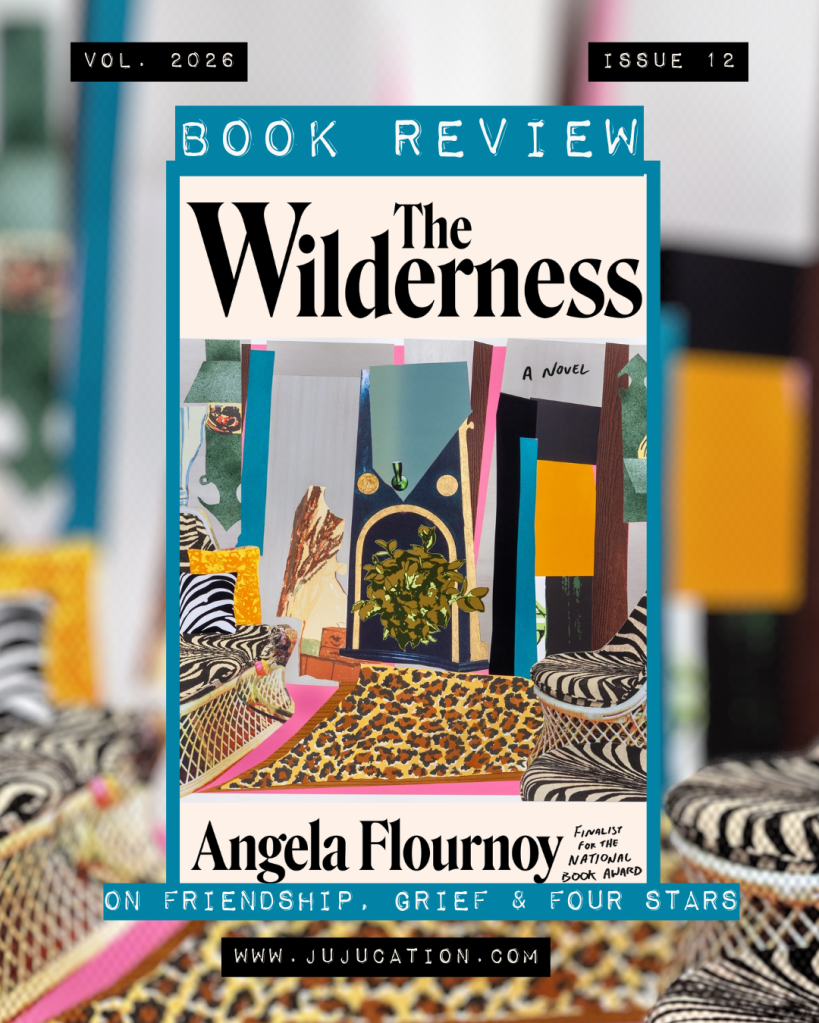
I picked up The Wilderness expecting something in the neighborhood of Waiting to Exhale. Four friends, big feelings, maybe a scene where someone makes a dramatic decision in a parking lot while a Destiny’s Child song plays internally. I was ready, I even had snacks.
What I got was something closer to holding your breath underwater and not being entirely certain when you’re coming up.
Angela Flournoy’s second novel is a friendship story, yes. But it’s the kind that reminds you friendship is not a comfort mechanism. It’s a choice you make over and over, against increasingly bad odds, while the literal climate is trying to kill you. I finished it a little wrung out and, oddly, grateful. That combination is the book’s whole thesis, actually.
What You’re Walking Into
The novel opens in 2008 with Desiree, 22 years old, accompanying her diabetic grandfather to Europe so he can die on his own terms. Which is not the warm prologue you’d expect, and Flournoy knows exactly what she’s doing by starting there.
Desiree is estranged from her older sister Danielle, still carrying her mother’s death like a stone in her coat pocket, and not entirely sure who she is outside of her grief. From that opening, we move between five women across roughly two decades: Desiree, Nakia, Monique, January, and Danielle orbiting at the edges of the central group. They are figuring out careers, love, what it means to want things when the economy keeps rearranging the floor beneath you.
And all of this happens while wildfires are no longer news, just weather. While political volatility is background radiation. While the question “do I want to have children in this world” has stopped being rhetorical.
The stakes are intimate. The backdrop is enormous. Flournoy makes you feel both at once.
What Makes This Book Stand Out For Me
1. The climate isn’t a metaphor. It’s a condition.
Wildfires and political chaos don’t arrive as dramatic set pieces. They accumulate the way they actually do in life, which is slowly, without narrative consideration for your personal timeline. This is more frightening than any disaster novel I’ve read because it is just quietly, relentlessly accurate.
2. Friendship is treated as labor, not decor.
This is not a book where the women save each other in the nick of time and then everything softens. There are real resentments, real failures, real stretches of distance that don’t resolve with a phone call. Flournoy is honest about how friendship in adulthood can feel like a plant you keep forgetting to water and then feel guilty about. She’s also honest about why you keep going back to it anyway.
3. Every woman has a real ambition problem, not just a love problem.
Nakia is trying to build a Black-owned restaurant under economic conditions that are actively hostile. Monique is chasing visibility as a librarian-blogger and discovering that attention has costs she didn’t budget for. January is contemplating whether blowing up her stable life counts as bravery or just expensive impulse. These are 21st-century dilemmas with actual weight and not plot mechanics dressed up as character development.
4. The narrative structure reflects how memory and identity actually work.
Later in the book, the prose shifts from third person to first and back again, deliberately, to show how collective stories and individual perception keep rewriting each other. It is technically ambitious and emotionally disorienting in exactly the right way.
What Parts Stayed With Me
The opening chapter is working so hard it should need a sit-down, but it doesn’t. The image of Desiree traveling toward her grandfather’s chosen death while carrying her own unprocessed losses sets a tone that the rest of the book earns, rather than simply inherits.
The friendship dynamics are specific in the way that only feels right when a writer really knows her characters. Not only that but also the dynamics of female friendships. These women have real warmth and real friction, sometimes in the same sentence. Nobody is purely the supportive one or purely the difficult one. Everyone is taking turns.
The moment the book tilts gently speculative, where the world starts to feel slightly more off-kilter than straight realism allows, is genuinely unsettling. And not because anything dramatic happens, it’s because you recognize it.
What This Book Is Actually Arguing
I didn’t devour this book in one sitting, sometimes it took me days before I picked it up again. I accessed feelings that felt familiar and yet foreign. And made me contemplate.
That loyalty to people is harder, stranger, and more necessary when everything around you is unstable. That ambition is sometimes self-preservation and sometimes just a very sophisticated form of running away, and it is not always obvious which you’re doing. That the friendships you built in your 20s were not designed to carry the full weight of who you become, and yet somehow, imperfectly, they do.
Underneath all of it, a question the book doesn’t answer directly but leaves sitting in your chest: what does it mean to grieve something that hasn’t finished dying yet? A relationship. A climate. A version of a country. A version of yourself you were still figuring out when things got hard.
Who Should Read This / Who Can Skip
Read it if:
- You have complicated, long-term friendships you’ve never fully been able to explain
- You want literary fiction that doesn’t pretend the personal and the political are separate rooms
Skip it if:
- You need plot momentum and a satisfying resolution in the traditional sense
- Time jumps and shifting perspectives make you want to close the book and never open it again
- You’re specifically looking for comfort without the complexity
The Bottom Line
The Wilderness is not a warm hug. It’s more like a long walk with someone you trust enough to be quiet with. The middle section occasionally has the speculative elements suggesting more than they deliver, and the structural ambition runs slightly ahead of the emotional payoff in places. These are real observations, not complaints designed to seem balanced.
But Flournoy writes about Black women’s interiority, their ambitions and their grief and their complicated devotion to each other, with a precision that is genuinely rare. This is a book that takes seriously the question of what we owe each other when the world stops being reliable. It doesn’t have an answer. That’s exactly the point.
Rating: 4 out of 5 stars. The star I’m withholding is for the middle section, which occasionally asks me to hold a lot of structural complexity without giving me quite enough emotional ground to stand on. The four I’m giving are for everything else, including the fact that I thought about this book in the shower three days after finishing it, which is my actual metric.
What’s the book that made you feel less alone about the state of the world, without pretending everything’s fine? I’d genuinely love to know in the comments. And if you want more reviews like this one, the newsletter goes out most months, occasionally on time.


