
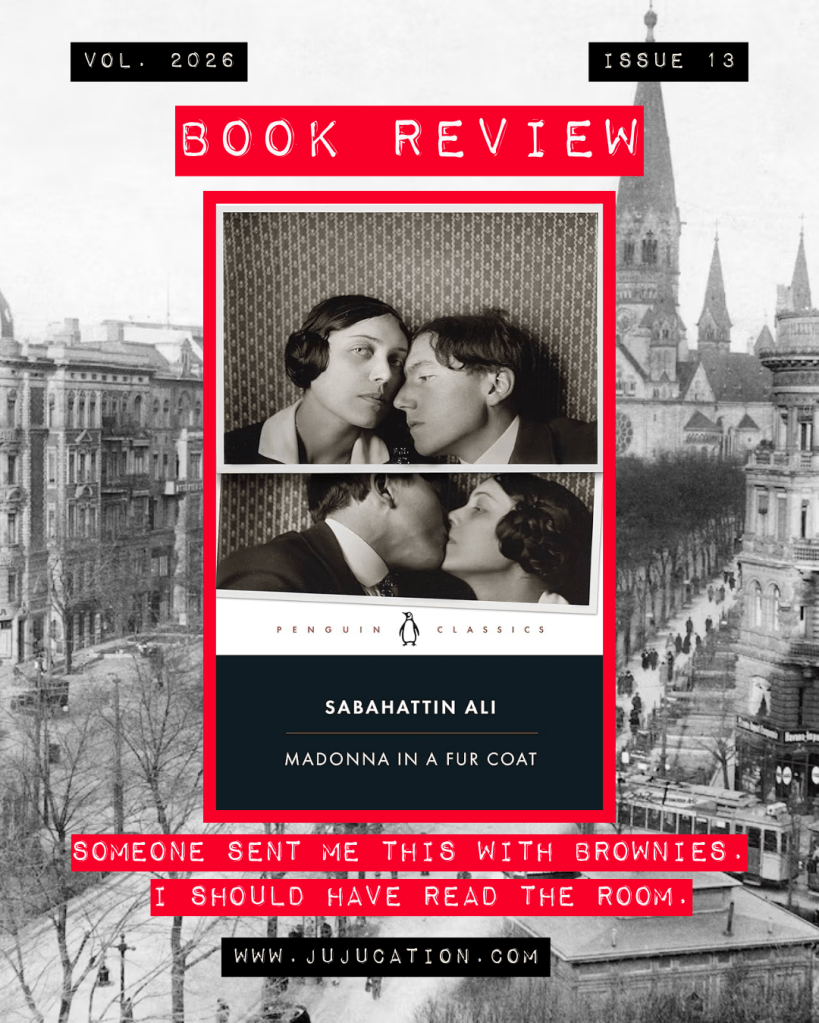
The Friend Who Knew What She Was Doing
There are books people lend you and books people deliver. This was the latter, a delivery. A care package, specifically: brownies, a small bottle of perfume, and Madonna in a Fur Coat tucked in like it belonged in that company. No explanation beyond “it’s about longing.”
Here’s the thing I realised about that combination. Brownies are comfort and memory and someone’s kitchen at a specific hour of the afternoon. Perfume is the most ruthless sense-memory trigger known to humanity, bottled and gifted. And then a novel about longing, sitting right between them like it was always going to be there. The whole package was practically a thesis statement. I just didn’t read it carefully enough before I said thank you.
When I started reading, I was expecting the kind of literary longing I’m used to: pretty, a little performative, the sort that wears good shoes and quotes Rilke. What I got instead was the specific, chest-pressing weight of a life that contained exactly one great love and then just… continued. For decades. Without it. I put the book down a few times not because it was slow but because it kept brushing up against feelings I had filed under “resolved” and apparently had not resolved at all. I thought those feelings had retired. They had not retired. They had been quietly waiting in the break room this whole time.
Some people just know what a person needs. I’m still not sure whether to be grateful or suspicious.
The Setup (No Spoilers, I Promise)
An unnamed narrator meets Raif Efendi at an Ankara office and cannot figure out what to make of him.
Raif is forgettable in the way that worn furniture is forgettable: present, functional, apparently without interior life. Then the narrator finds Raif’s journal. Inside it: Berlin in the 1920s, a painting of a woman in a fur coat, the woman herself, and a relationship so private and so precisely observed that reading it feels slightly like trespassing.
Maria Puder is the painting’s artist and the novel’s beating heart. She is independent in the way that made other characters deeply uncomfortable, which is to say she had opinions and she kept them even under social pressure. She doesn’t perform softness. She argues. She tests Raif. She refuses to be idealized, which is notable because Raif very much wants to idealize her and she won’t let him, and that refusal is actually what makes him love her more.
What happens between them is quiet, specific, and devastating in the way that only real things are.
What Stood Out For Me
1. The love story runs on recognition, not chemistry. Raif and Maria don’t fall for each other in the way that romance novels have trained us to expect. They recognize each other. There’s a difference, and the novel knows the difference, and it uses it carefully. What they share is the particular relief of being seen without having to perform a version of yourself first. That’s the thing the care package was really warning me about, I think. Not longing for a person, exactly but the onging for being known.
2. The frame narrative does real work. The structure could easily be a gimmick: older man, younger narrator, discovered journal. But Ali uses it to argue something. The narrator teaches the reader to look twice. To understand that the people who seem most ordinary may be carrying the most. That structure is not decorative, but it is actually the whole point.
3. The tragedy is built from silence, not plot. In this book, there is no villain. There is no dramatic confrontation. The story falls apart in the way that real things fall apart: through small miscommunications, through assumptions, through the failure to say clearly enough what you mean. The reader can see the gap between what each person believes and what actually happened. It is excruciating in the most measured, the most precise way possible.
4. The gender dynamics are quietly subversive. Maria is not a muse. Raif is not dominant or conquering. The roles are genuinely reversed: she is self-possessed and decisive while he is passive and overwhelmed by feeling. The novel doesn’t comment on this loudly. It just lets it be true and watches what that does to both of them.
What I Loved
The painting as a recurring object. It starts as an obsession and becomes a symbol without ever stopping being an actual painting. Ali doesn’t make it mystical. He makes it useful. Raif keeps returning to it because it gives him a place to put feelings he hasn’t named yet. Which is, genuinely, what good art does.
Maria refusing to be a romantic fantasy. Every time Raif tries to project something onto her, she corrects him. Not unkindly, but firmly. It’s one of the most honest depictions I’ve read of what it costs a woman to keep insisting on her own reality in a relationship where the other person finds her reality inconveniently complicated.
The moment I put the book down and stared at the ceiling. There is a section where the narrator reflects on all the people he has passed every day who were carrying entire private worlds he never thought to ask about. I read it at 11pm on a Tuesday and then sat there for an embarrassingly long time thinking about everyone I had ever dismissed as unremarkable. So that was a fun evening for me.
The prose pacing. It is slow in the way that a long exhale is slow. If you’re in the right mood, it makes you feel like relief.
What This Book Is Really About
It is about what happens when you experience the fullest version of yourself and then, through bad timing or miscommunication or plain bad luck, can’t get back there. Raif doesn’t fall apart dramatically. He just dims. He becomes, to the outside world, exactly the forgettable clerk that the narrator first assumes him to be. The novel asks: how many people around us are in that state right now? How many ordinary lives are secretly monuments to one unhappened thing?
It is also about communication as a survival skill rather than a nicety. Not the buzzy kind of “communication is important in relationships” that gets embroidered on pillows, but the specific, terrible cost of not saying clearly enough: this is what I feel, this is what I need, please don’t interpret my silence as indifference.
And it is, quietly, about art. About the fact that a painting once led a man toward the truest version of himself. And what it means when life leads him away from it.
Who Should Read This / Who Can Skip
Read this if:
- You like love stories where the tragedy is psychological, not circumstantial
- You’re in the mood to feel something you thought you’d safely finished feeling
- You think “quiet” and “devastating” can coexist in the same book
- You want a novel that treats an ordinary clerk’s interior life with the same seriousness as any hero’s
Skip this if:
- You need plot momentum to stay engaged
- Happy endings are not optional for you (valid, fully valid)
- You’re currently in a fragile emotional state and cannot afford to be unexpectedly wrecked on a Tuesday
- Introspective, memory-heavy fiction tends to make you check your phone
The Bottom Line
This is a slim book with a long shadow. It is not perfect: the pacing in the early Ankara sections is genuinely slow, and if you’re not willing to sit with that, the Berlin chapters won’t arrive quickly enough to save it for you. But if you give it the patience it asks for, what you get in return is a novel that argues, quietly and convincingly, that the most extraordinary emotional lives often belong to the people you would never notice twice.
The care package made sense by the end. Brownies because you’ll need comfort. Perfume because the whole book is basically a sense memory you didn’t ask to have. And the novel because some things need to be passed between people rather than just recommended. I am now giving this to at least two other people, so that they too can be blindsided on an otherwise unremarkable weeknight.
Let’s Talk About It
Have you ever received a book recommendation delivered with such specific accompanying objects that you should have known something was coming? Which book was it, and were you ready? Drop it in the comments. I’m also curious: did you find Maria more or less sympathetic than Raif? I know where I stand, but I want to hear arguments.
If you want more of this in your inbox, the subscribe button exists and it is right there. No pressure. But also, I do this every month, and sometimes the books are even more dangerous than this one.

 jujucation.com