
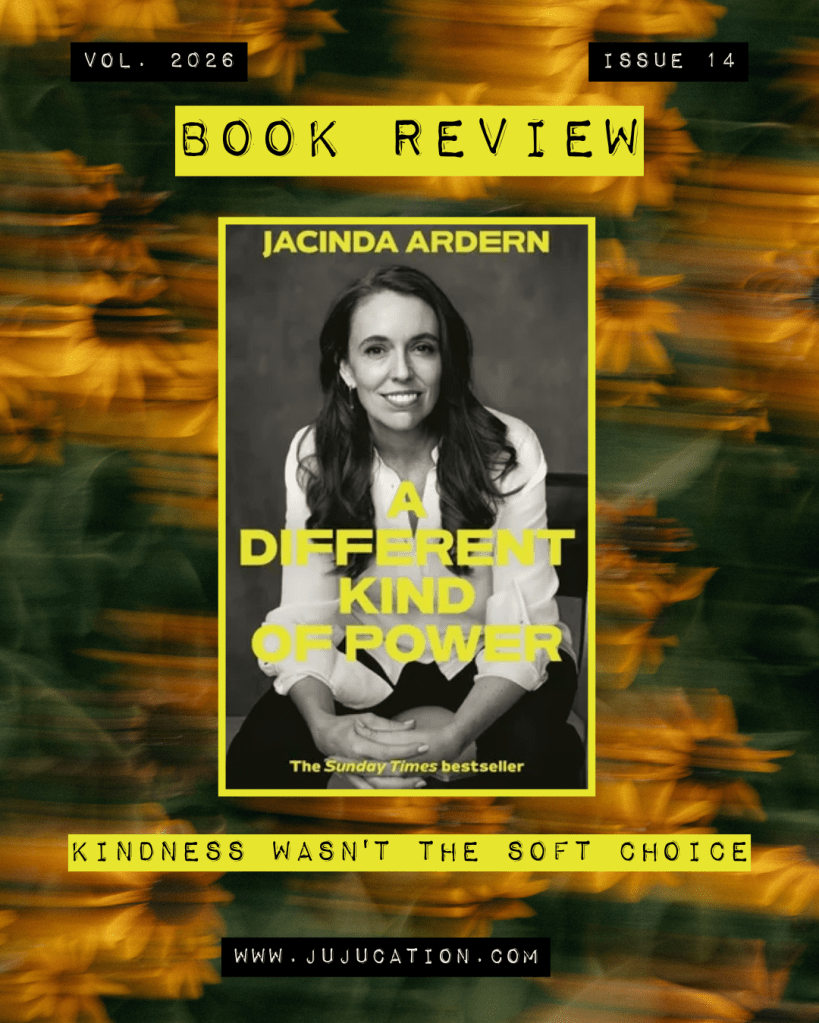
I picked this up expecting to feel vaguely inspired and then set it down.
That is the honest version. I had a whole plan. A nice quiet read about a politician I already admired, a cup of tea going cold beside me, maybe a few pleasantly uplifting passages I’d screenshot and then not do anything with. The adult equivalent of watching a TED talk and feeling briefly like a better person.
Instead I spent my Saturday morning walk slightly stunned, listening to a woman managing morning sickness between coalition negotiations, and realised with some discomfort that the thing I found most moving was not her courage or her grace under pressure. It was that she kept doubting herself. Loudly. In the book. On purpose. And somehow that was the braver thing.
A Different Kind of Power is Jacinda Ardern’s first full memoir, published in 2025, and it is genuinely not what the category usually promises. It is not a score-settler. It is not a triumph arc with a tidy lesson at the end. It is the account of a fundamentally decent person doing an almost impossibly hard job and asking, throughout, whether she was the right person for it. Which is, it turns out, the kind of question that makes someone exactly the right person for it.
The Setup
She becomes New Zealand’s prime minister at 37, weeks after being asked to lead her party. She is also pregnant. She does not know either of these things will be true at once when the chapter begins. The prologue hands you the image immediately: election night 2017, a pregnancy test, and the collision of two kinds of waiting. It is a very good opening. It earns itself.
From there, the book moves chronologically through a small-town Mormon childhood, university years, years as a junior staffer absorbing other people’s politics, and then the sudden, vertigo-inducing ascent. The chapters on the Christchurch mosque attacks are devastating in the way that restraint makes things more devastating, not less. The COVID chapters are exhausting in a way that feels correct. By the time she resigns, you understand it not as failure but as the only logical outcome of a person who gave more than the job had any right to ask for.
What Stood Out For Me
1. She is honest about the gap. Every politician memoir has a version of “we tried our best against impossible odds.” Ardern’s version includes specific admissions: the things her government didn’t fix, the promises that hit the wall of coalition politics, the moments she wishes she’d pushed harder. That gap between values and outcomes is where most political memoirs lose their nerve. She doesn’t flinch from it.
2. The imposter syndrome is not the arc. The book is not a story of overcoming self-doubt. It’s a story of governing alongside it. She makes a case, implicitly and occasionally explicitly, that the leaders who feel certain are often the dangerous ones, and that relentless self-questioning, when you actually use it to listen harder and invite challenge, is a working leadership tool. This reframe is genuinely useful and not something I expected to get from a political memoir.
3. Compassion gets examined, not just celebrated. The Christchurch response, wearing hijab to visit grieving communities, the “They are us” statement, the swift gun reform, could easily be rendered as an inspirational highlight reel. Ardern insists instead on the cost of those choices, the political risk, the security complexity, the question of whether empathy scales into policy. Kindness as a hard choice, not a soft default. It reads differently.
4. The resignation chapter is the most useful one in the book. She doesn’t dress it up. A health scare, the accumulated weight of years under surveillance, the honest admission that she no longer had enough left. She frames leaving as responsibility rather than failure. The phrase “a full tank” appears, and it is one of those quiet lines that lodges somewhere uncomfortable because you know you’ve ignored the same thing.
What Stayed With Me
The prologue structure. Two kinds of waiting, side by side. Perfect.
The childhood chapters, which are unhurried and domestic and full of small ethical crossroads, her father navigating police work with integrity, her church community shaping a moral framework she would later outgrow and keep simultaneously. These chapters do the quiet work of explaining why she leads the way she does. Most political memoirs skip them. This one earns them.
The Christchurch sections. I am not going to pretend I didn’t put the book down. I did. I needed a minute.
Her self-deprecating humor, which appears sparingly and therefore works. She is funny in the way that people are funny when they are also very tired and extremely aware of the absurdity of their situation.
What This Book Is Really About
It is about what we are willing to see. That is Ardern’s actual thesis, underneath the leadership memoir scaffolding: that empathy is not a feeling but a discipline, and it requires you to actively choose whose pain counts as real. The Christchurch response worked, to whatever degree it worked, because she was willing to see. The burnout happened because she kept seeing and kept going.
It is also about the archetype. Every page is in quiet conversation with the image of the strong, invulnerable, usually male leader who never doubts and never wavers and definitely doesn’t need to stop. Ardern’s entire career is an argument against that archetype, not by being its opposite, but by being visibly capable and visibly human at the same time.
The question the book leaves in your chest is something like: what would I be willing to give, and would I know when to stop?
I am still working on that one.
Who Should Read This / Who Can Skip
Read it if:
- You lead anything, formal or informal, and feel like you’re making it up
- You’re interested in women’s leadership without wanting a self-help framework attached
- You liked Becoming but wanted the subject to be the one making the actual decisions
- You find the Christchurch response genuinely interesting and want context beyond news coverage
- You are thinking about burnout in your own life and want a non-clinical account of what it looks like at an extreme
Skip it if:
- You want a tell-all with political drama and named enemies
- You are here for policy analysis in any technical depth
- You find measured, reflective prose slow and would prefer something with more momentum
- You’ve already decided you find Ardern overrated and are looking for confirmation
The Bottom Line
This is not a perfect book. The middle sections lose a little momentum, and there are moments when the self-reflection tips slightly toward the meditative when you want a sharper edge. Readers who came for political intrigue will leave disappointed. It is, deliberately, not that book.
But as a sustained argument that decency and self-doubt and radical empathy are not liabilities in leadership but are, in fact, the whole point, it is unusually convincing. It works because Ardern is not performing humility. She appears to actually have it, which in a political memoir is rarer than it should be.
Let’s talk about it. The theme that stayed with me longest was the one about knowing when to stop, and how rarely we treat that as its own skill. Has a book ever made you reconsider something you thought was weakness? Drop it in the comments. And if you want more reviews like this, you know where to find me.


