
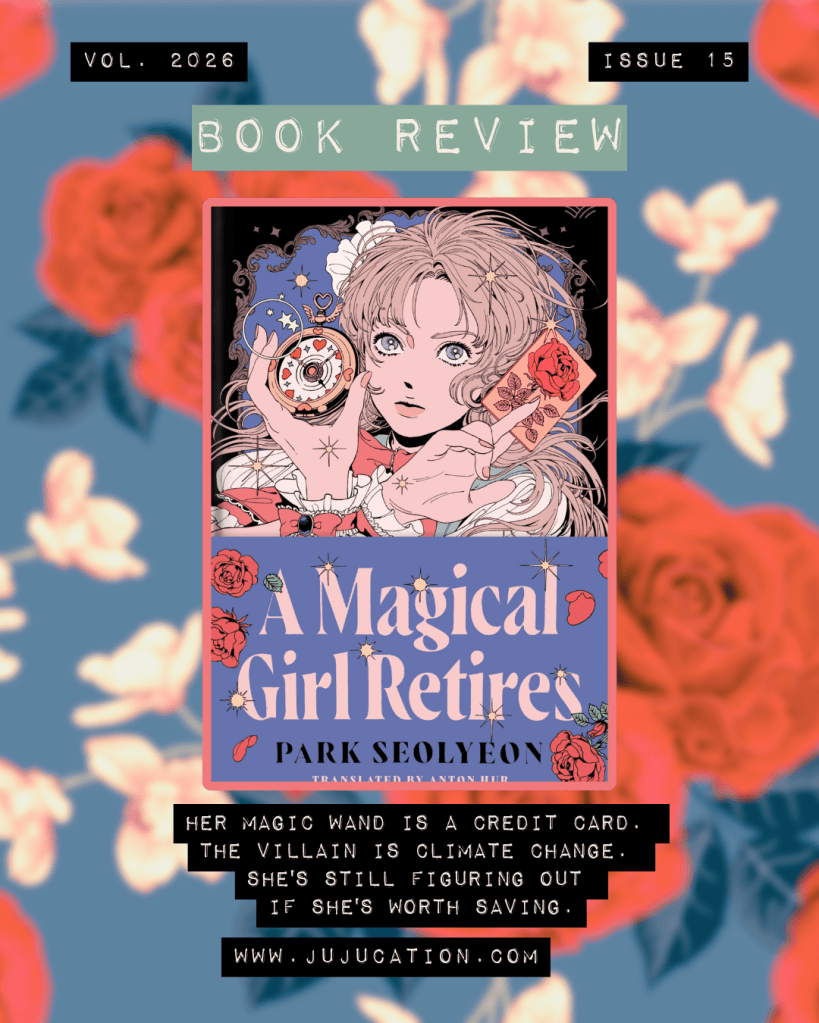
Intrigued by the cover, I picked up A Magical Girl Retires expecting exactly one thing: a Sailor Moon reference in literary fiction clothing. Something to read in an afternoon, a little sparkle, a little whimsy, a book that leaves you feeling vaguely charmed and not at all changed. I had been doing serious reading. I had earned something light.
I was half right.
Park Seolyeon gave me the Sailor Moon reference. She also gave me a book about a woman standing on a bridge in Seoul who cannot afford to live and cannot quite manage to die, and the absurd, precise grace of what comes after that moment. This is not a book that will leave you vaguely charmed. It will hand you a small, improbably heavy object and say: carry this for a while.
This is notable for a 176-page book I read in one sitting, in a palm-sized Nomad Edition that fit inside my jacket pocket. It did not feel small at all. Long after I read the last page, I am still carrying the story.
On Park Seolyeon and the Man Who Translated Her
A Magical Girl Retires is Park Seolyeon’s English-language debut. Park is a decorated Korean literary novelist, born in 1989, the recipient of the Yi Sang Literary Prize and the Hankyoreh Literary Award, among others. Her other work spans historical fiction and contemporary social critique and they all share one preoccupation: the people nobody writes about. Women, the elderly, sexual minorities, basically the voices that get excluded. This book is her most playful. It is not her lightest.
The translation is by Anton Hur, who has said he doesn’t translate books, he translates authors, and who specifically sought out Park Seolyeon because he considers her a crystalline stylist whose work he had wanted to render in English for years. His previous translations include Cursed Bunny by Bora Chung, a National Book Award finalist. The voice in this book is not an accident of translation. It was a deliberate artistic collaboration, and it shows.
What Actually Happens
She is 29. She has credit card debt she cannot pay. She lost her job during the pandemic. She has no close friends, no family left nearby, no obvious future. She is on Seoul’s Mapo Bridge at night, trying to decide. Then a girl dressed all in white appears and tells her she is the greatest magical girl of all time.
Here is where you expect the story to begin, and it does, but not the way you are expecting.
Being the greatest magical girl of all time involves: a job fair. A union. Classes. A talisman that turns out to be a credit card. International cooperation with other magical girls, each managing their own jurisdiction and their own disaster. The enemy is not a monster. It is not an intergalactic war. It is climate change.
Our protagonist does not immediately discover she is secretly competent. She does not get a breakthrough where her powers crystallize. She does not get a costume upgrade. She gets a to-do list. She is still in debt. She still has low self-esteem. She still is not sure she is worth saving.
The book lets her stay in that uncertainty. That is the kindest and most honest thing it does.
What Makes This Book Different
1. It subverts the chosen-one narrative without mocking it. Most books that play with “you are destined for greatness” do one of two things: lean into it fully, or deconstruct it with a sneer. Park does neither. She takes the narrative seriously enough to ask what being chosen would actually cost, practically and emotionally. The answer is: everything you already had to spend just to survive, and then more after that. There is no sneer. There is only the question: what if being special doesn’t look like being special?
2. The credit card is not a joke. It is the sharpest image in the book. A magic wand that is a credit card, given to a woman already drowning in credit card debt, to defeat climate change. The humor is in the specificity. The grief is in the specificity. Park holds both at once and doesn’t resolve them. That is the right call.
3. It is genuinely interested in collective action. The union subplot is not background texture. It is the argument. One magical girl cannot fix climate change. The book knows this. Its answer to “what do we do when the problem is bigger than any one person” is not despair and is not a tidy resolution. It is: organize. Show up. Pool your power. The ending is not triumphant in the conventional sense. It feels like something that might actually be possible, which is rarer and harder than triumph.
4. It knows when to stop. At 176 pages, this book does not overstay its welcome. Most writers given this premise would fill three hundred pages with worldbuilding and backstory and subplots. Park trusts her premise to carry its own weight. She gets in, earns the emotional landing, and leaves before you want her to. That restraint is its own kind of craft.
Things I Loved
The unnamed narrator. Writing the entire book in first person without ever naming the protagonist sounds precious until you feel it land. You slot yourself into the situation without being asked. You don’t notice until it’s too late and you’re already inside her head, standing on that bridge, wondering if you would have jumped.
The illustrations. Each chapter opens with a manga-adjacent panel by Kim Sanho, and they earn their place. They are not decoration. They mark each shift in the protagonist’s understanding and let the book be playful in ways the prose can’t always accommodate.
The relationship between the protagonist and Ah Roa. Whether you read it as a queer love story or a deep destined friendship probably says something about you. Both readings work. Both leave something warm in your chest when the book ends.
This line: “The reason magical girls exist is because they needed their power the most. In other words, before a magical girl awakens her powers, she’s the weakest person in the world.”
I put the book down when I read that. I stared at the ceiling. It made me think what has my weakness taught me about myself that my strength never could? I continued to ruminate on that.
What This Book Is Really About
This book is about the gap between what you thought your life would look like at 29 and what it actually looks like. It is about the specific humiliation of being told you are special while your credit card is declined. It is about how power doesn’t show up looking like power, and how you almost always have to save yourself before you can do anything else for anyone.
It is also about this: what we owe each other when the problem is too large for any one person to fix. Climate change is the villain, but the real question is older than that. What do you do when the world is ending and you are one person with a credit card and low self-esteem? You find the union. You show up. You do your part of the thing.
Park Seolyeon is not naive about this. She doesn’t pretend the problem gets solved. She pretends, briefly and very precisely, that it might. That pretending is the gift the book gives you.
Who Should Read This / Who Can Skip
Read this if you:
- Grew up watching Sailor Moon and have since acquired credit card debt or an existential crisis or both
- Are tired of destiny narratives that treat being chosen as a gift rather than a demand
- Want to understand what contemporary Korean feminist literature sounds like without starting with something that will destroy you
- Read Kim Ji-young, Born 1982 and wanted the next chapter
- Appreciate when a translator’s craft is as visible and intentional as the author’s
Skip this if you:
- Need forward plot momentum and a villain you can actually confront
- Have zero cultural context for magical girl anime and don’t want to arrive mid-conversation
- Want rich, detailed worldbuilding and a fully realized fantasy system
- Find 176 pages insufficient investment for the emotional commitment
The Bottom Line
This is a small book carrying something large. It will not give you the catharsis of a conventional fantasy ending. It will not let you forget that climate change is real and that one magical girl, however powerful, cannot reverse it alone. What it will give you is the specific comfort of a book that sees the particular exhaustion of being alive right now, does not look away from it, and still manages to suggest, without being cheap about it, that showing up anyway is worth something.
The weakest point is honest: the plot is thin enough that readers looking for propulsion will feel its absence. The world-ending threat is deliberately diffuse, and some readers will feel cheated. That’s a fair complaint. It’s also, depending on who you are, a feature.
The strongest point is the truth of it. The credit card wand. The unnamed narrator. The union. The ending that is not triumphant and is somehow more moving for that.
Read it on a long commute, in the smallest jacket pocket you own, in an edition that fits your palm. Then sit with it for a while. It earns the silence.
Rating: Not putting a number on this one. Not because I can’t decide, but because this is not a book that wants to be ranked. It wants to be read.
Tell me something: A Magical Girl Retires is a book about being the chosen one and also being in debt. What ordinary object do you carry every day that might, under the right circumstances, be your magic wand? Drop it in the comments. I will read every answer very carefully.


