
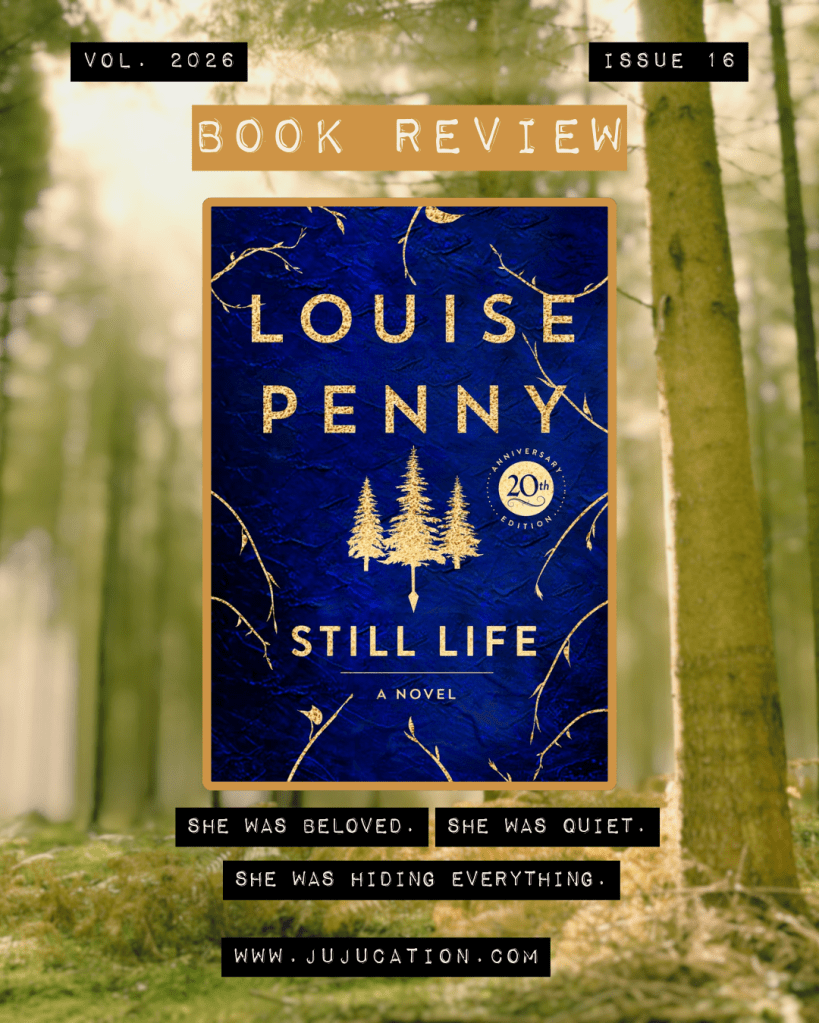
Nobody tells you. That’s the thing nobody tells you. You pick up what appears to be a perfectly reasonable cozy mystery set in a small Quebec village, you are expecting some snow, a mildly interesting corpse, maybe a nice soup, and then you surface nineteen books later having rearranged your entire reading schedule around a fictional community that does not exist on any map and yet somehow feels more real than several places you have actually visited.
I had no idea. Zero. I thought I was just reading a book.
Looking back now, having read most of the books in the Gamache series, I can see exactly where it started. The moment the door opened. I did not notice at the time because I was too busy thinking I was just doing some light recreational reading on a weeknight, which is genuinely one of the funniest things I have ever believed about myself.
This is the review I could not have written when I first finished it, because I did not yet know what it had started.
A Debut That Already Knew Its Own Heart
Still Life was published in 2005. It is the first book in the Chief Inspector Armand Gamache series, which now runs to nineteen novels and is, frankly, a threat to anyone with a reading list and limited self-control. For a debut, it is almost aggressively certain about what it wants to be. Not a thriller. Not a procedural in the cold, institutional sense. Something quieter, which is exactly why it gets under your skin in ways the louder books never quite manage.
If you have never read Penny before, start here. If you have already burned through the series and looped back to the beginning, you will see something I didn’t see the first time: how completely formed the whole vision was from page one. She was not figuring it out as she went. She knew.
What Actually Happens (The Version That Doesn’t Ruin Anything)
Jane Neal is found dead in the woods outside Three Pines on the morning after Thanksgiving. She was retired, beloved, the kind of woman a small town files neatly under “sweet older lady, no complications.” It looks like a hunting accident.
It isn’t.
Chief Inspector Gamache arrives from Montreal with his team, and what follows is less a race to catch a killer than a slow act of excavation: who was Jane, really, underneath the version of herself she showed the village? Because it turns out she had an entire interior life, an entire artistic life, kept in rooms nobody thought to look in. The emotional stakes are not “will justice be served.” The stakes are whether this town, which believed itself to be kind, was actually paying attention to anyone at all.
That question is what has you reading at eleven-thirty on a work night making very poor decisions about sleep.
What Makes This Different From Every Other Village Mystery
1. The detective is the moral argument. Gamache does not solve things through tricks, flashes of genius, or a suspiciously convenient secret from his past. He solves things by paying attention. By treating every person he interviews as if their inner life is worth taking seriously. In a genre where detectives are usually defined by their damage or their eccentricity, Gamache is defined by his decency, and Penny has the nerve to frame that as a superpower. The wild thing is that she is completely right.
2. Three Pines is a character with strong opinions. This is not backdrop. This is a whole ecosystem with its own social contracts, its own quiet cruelty, its own capacity to let someone disappear inside a role too small for them while everyone stands around feeling like a good neighbour. Penny asks whether a community that calls itself warm can actually be kind. Three Pines has to answer for itself. The verdict is complicated.
3. Art is treated as evidence. Jane’s paintings, kept secret her whole life, are the actual key to the case. This is Penny doing something genuinely interesting: what people make privately, without an audience, without approval on the line, is often the truest record of who they are. The crime is partly solved in a gallery. I thought about this for an unreasonable number of days.
4. The pacing is deliberate, and it earns it. Mostly. This is not a fast book. Some readers will call that slow and they are not entirely wrong. I would call it confident. Penny trusts that you will care about the people before she needs you to care about the plot. The mid-section tests that trust occasionally. She mostly makes good on the deal. I say this having immediately bought book two the moment I filed my one complaint about it, so interpret that how you will.
Things I Actually Loved
Ruth Zardo, foul-mouthed poet, spiritual aggressor, the most honest person in any room she has ever entered. She appears in relatively few pages and takes up enormous space. She is the character who made me put the book down and stare at the wall because I needed a moment. I needed a whole moment. She is currently living rent-free in my head and I have stopped expecting her to leave.
The food. I know how this sounds. I want you to know I am serious. Penny writes about what people eat and cook and serve each other with the same attention she gives to grief. The bistro. The smell of the kitchen. The specific weight of a meal shared between people in winter in Quebec. It is not a footnote. It is how she makes Three Pines feel like somewhere you could actually put your coat down.
The moment Jane’s paintings are finally seen. Really seen, by the right people, for the first time. This is the emotional center of the book and Penny earns it without announcing herself. It made me think about every person I see regularly and have never quite looked at. That is the kind of fiction that follows you out the door and keeps walking.
Clara Morrow’s quiet subplot about artistic self-doubt. It runs parallel to Jane’s story and never waves its hand to say look, I am a theme. Penny trusts you to catch it. That restraint is its own kind of craft.
What This Book Is Actually About
It is about the cost of making yourself smaller than you are. Jane Neal spent her life creating work she kept in private rooms, maybe because she wasn’t sure it was ready, maybe because showing it meant handing people something to judge, probably both. The village thought they knew her. They knew a very well-maintained impression of her, which is a different thing entirely.
The question Penny leaves sitting in your chest is not “who killed Jane Neal.” It is: what are you keeping hidden because you’re not sure it’s ready yet? And what would the people who love you find if they actually went looking?
She plants that question and then walks away. You carry it yourself. Into the commute, into Tuesday, into whatever version of your ordinary life comes next.
Who Should Read This / Who Can Skip
Read it if:
- Atmosphere and character matter more to you than plot velocity
- You want a detective whose primary skill is listening
- Small-town settings with real texture are genuinely your thing
- Ann Cleeves, Elly Griffiths, or Tana French already live on your shelf
- You are prepared to be quietly wrecked and somehow feel fine about it
Skip it if:
- You need a plot twist every thirty pages or the whole thing collapses
- High-adrenaline pacing is the point and everything else is filler
- Grief-heavy content is not where you are right now
- Hate language in a historical context is a hard stop (there are anti-gay slurs; Penny takes them seriously rather than sanitising them, but they are present and worth knowing about)
- You want your mystery to stay safely procedural and not ask anything of you personally
The Bottom Line
Still Life is not a perfect book. The mid-section pacing will lose some readers before the payoff lands, and the mystery itself is more contained than the later Gamache novels, which might feel underwhelming if you come in expecting complexity. Also, if you arrive hoping for classic whodunit mechanics, you will spend the first fifty pages waiting for the book to become what you expected. It is not going to.
What it is, is a debut that already knew exactly what it cared about: humane detective work, a community held up as a moral mirror, and a quiet, persistent argument that paying attention to other people is not a soft skill. It is the skill. Everything that makes the rest of this series worth rearranging your life for, which I say from experience, is already present in these first 320 pages.
I did not know that when I finished it. I thought I had simply read a very good book. I was not wrong. I was just not seeing the whole picture yet.
Which book completely blindsided you? The one you picked up thinking it was one thing, and it turned out to be something that quietly reorganised your entire relationship with a genre? I need to know I’m not alone in this. Ruth Zardo is unpacking boxes in my head and I have a feeling she’s planning to redecorate.


