
A note: I’m playing catch-up on my monthly reading recaps, so yes, we are currently in February while the calendar has firmly moved on. I read these books. I have feelings about them. The feelings did not expire. Onwards.
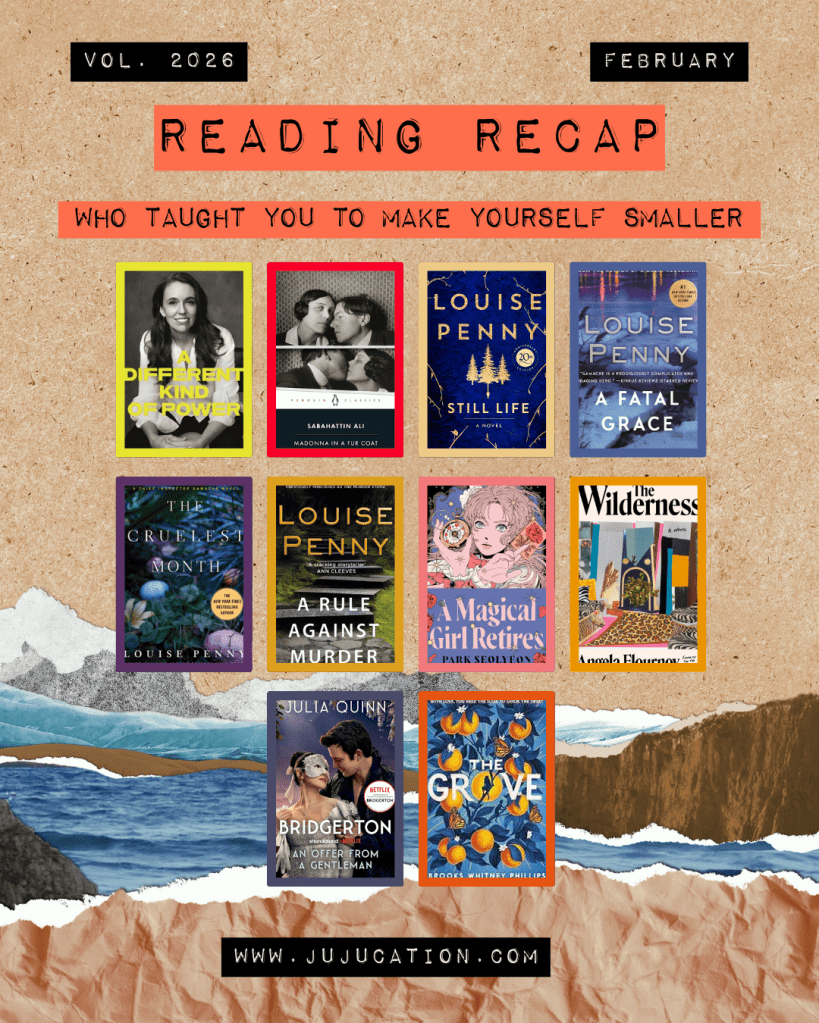
This is supposed to be a reading recap.
It isn’t.
Ten books. 3,100 pages. At least three nights where I told myself I’d stop at the chapter break and did not stop at the chapter break and felt no guilt about this whatsoever, which probably says something about me that I’m not ready to examine in public.
We tell ourselves stories in order to live. I happen to tell myself I’m going to stop at the chapter break. Neither story is true. Both of us cope.
Somewhere around the third Gamache novel I noticed what I was actually doing. Not reading for pleasure. Not reading for the aesthetic, which I curate carefully and which does not include “aggressively disheveled person eating Cheetos over a hardcover at eleven forty-five pm.” Reading the way you pull at a thread when you don’t fully know what’s attached to it and suspect you should probably stop and don’t.
The question, when I finally found it underneath all the murders and the longing and one very cheerful magical girl: What happens to people who don’t fit the space they were given?
Ten books. One question. My subconscious had opinions and did not consult my calendar.
What February Actually Was
The stats look reasonable. Forty percent cozy mystery. Twenty percent literary fiction. One memoir, one historical romance, one YA novel, one book that defies easy categorisation and I mean that as a compliment because it is increasingly rare to encounter a book that doesn’t know what shelf it belongs on and doesn’t care.
The stats give no indication of the person who read four murder mysteries back to back with the focused intensity of someone who found something warm and was not moving until physically relocated. They do not explain the Sunday evening I spent eating toast and feeling genuinely giddy about a broke millennial discovering magical powers, which is not the response of a dignified adult but is, I think, the correct response.
I had a reading plan. I mention it only so you understand what I’m telling you when I say it did not survive contact with February.
My subconscious, as it turns out, is a better reader than I am. She had a whole agenda. She simply didn’t share it with me in advance, which is exactly the kind of behavior I’d call a red flag in anyone else.
The Books
🌺 Madonna in a Fur Coat | Sabahattin Ali
Classic Literary Fiction | Paperback | tr. Maureen Freely & Alexander Dawe
Here is what this book is supposed to be: a quiet Turkish novel from the 1940s. A period piece. A curiosity. Something you pick up because someone called it a classic and you want to know why, and you expect to find out why in a mild, appreciative way, and then put it down and feel culturally enriched.
Here is what it actually is.
A book about longing so precisely rendered you feel it in your body. Not your heart, which is where longing gets assigned in lazier prose, but lower, somewhere around the ribs, pressing. The kind of longing that doesn’t resolve. That isn’t trying to. The kind that a sentence can recreate in a reader eighty years after it was written, which is either a miracle or extremely inconsiderate, depending on whether you’re the one holding the pencil.
The clerk is quiet and pays attention to things in a way his world keeps trying to tell him is weakness. Maria is extraordinary in the specific way women in 1940s fiction almost never get to be extraordinary: fully herself, contradictory, not softened for readability. She tells him she is completely open, like a man. Written eighty years ago. Still landing.
What the novel is really asking, underneath the love story and the portrait that outlasts everyone who stood in front of it, is what it costs a society to reward ego and punish tenderness. The sensitive ones suffer most not because they’re weak, Ali argues. Because they’re paying attention.
I sat with this book at midnight in what I can charitably describe as an undignified position and I marked sentences in pencil and I did not stop. There is a version of me who has her life together. She was not there that night. I think she was already asleep like a person with sense.
Read this if you’ve ever kept a feeling the way you keep a coat you never wear but can’t make yourself give away. If Turkish literature is a gap in your reading life, start here. This is the right door and it will absolutely wreck you and you will thank me later.
🕵️ Still Life (Gamache #1) | Louise Penny
Cozy Mystery | Digital
Let me tell you what cozy mystery actually is, because I think it gets undersold by people who haven’t met one at the right moment.
It isn’t the absence of darkness. It’s darkness held inside a container that doesn’t let it swallow everything. Three Pines, the fictional Quebec village at the heart of Louise Penny’s Gamache series, is almost too beautiful to be true. Artists and good wine and people who chose each other deliberately, which is harder than it sounds and which Penny understands completely. The evil that lives there is, because of all this, more devastating than it would be anywhere bleaker.
And then there’s Gamache.
He is not a detective who solves puzzles, though he does that too. He’s a detective who cares. Who treats every death, even the ones nobody is grieving, as though the dignity of the person who died still matters. He doesn’t make speeches about this. He simply practises it, quietly, across a whole series, and you watch him do it and something happens in you that you didn’t entirely budget for.
I went in with a list of things to accomplish in February. I am telling you about this list only so you understand what it means when I say I have no idea what was on it. I abandoned it somewhere around chapter eight. I felt nothing.
The plotting occasionally strains. Some revelations land harder than others. I’m putting this in so you don’t feel betrayed later by my obvious enthusiasm. It isn’t perfect. You will not care. You will be on book three before anyone who lives with you has noticed the cereal situation.
Read this if you want a mystery that makes you feel held rather than just spooked. You’ve been meaning to start this series for years. Still Life is the one. This is your sign. I mean it this time.
⚡ A Fatal Grace (Gamache #2) | Louise Penny
Cozy Mystery | Digital
The most hated woman in Three Pines is electrocuted during a curling match.
Everyone has a motive. Everyone is relieved. The real mystery isn’t who killed CC de Poitiers.
It’s whether cruelty in the victim changes how much grief we owe the dead.
Penny’s answer, delivered through Gamache, is no. We owe it regardless. He treats her death like it matters even when the village is visibly, quietly relieved. He doesn’t explain this. He just does it.
I grew up being told you had to earn empathy. This book disagreed with me forty times and I let it.
Read this if you’ve ever known someone impossible to love and felt the complicated relief of their absence. This book will not let you off the hook for that feeling. I don’t mean it as a warning. I mean it as an invitation.
💀 The Cruelest Month (Gamache #3) | Louise Penny
Cozy Mystery | Hardcover
A séance. A haunted house. Someone dies of fright, or doesn’t, quite. T.S. Eliot and gothic Quebec and secrets buried so long they’ve become structural.
“It’s our secrets that make us sick.”
By book three I was attached to Three Pines the way you get attached to a place you’ve never been and cannot fully explain to anyone who asks. This is the embarrassing part of a reading fixation: eventually you have to describe it to someone and watch them try to care. I stopped trying to explain it. I just kept reading.
What Penny understands, and uses, is that the safest-looking places are where secrets fester longest. Warmth is not the absence of rot. It is sometimes the condition that lets it spread.
I did not sleep enough in February. I am reporting this as a fact, not a complaint.
⚔️ A Rule Against Murder (Gamache #4) | Louise Penny
Cozy Mystery | Digital
Gamache on vacation. A luxury inn. A family reunion. A sculptor’s legacy and the particular violence of inherited money deciding who deserves to exist.
Penny earns the locked-manor setting. Uses the claustrophobia deliberately. The family feels real enough that their cruelty lands with weight rather than melodrama, which is harder than it looks and which lesser writers blow every time.
Also: Reine-Marie Gamache shows up with wine and perfect timing and an energy I can only describe as “woman who has absolutely no time for any of this” and she deserves her own novel and I have opinions about this that I will continue to share with anyone who will listen.
✨ A Magical Girl Retires | Park Seolyeon (tr. Anton Hur)
Fantasy/Contemporary | Paperback
160 pages. One sitting. Toast. A level of personal giddiness that I will own without apology.
A broke, depressed Korean millennial discovers she’s inherited magical girl powers. Sailor Moon if Sailor Moon had credit card debt and a complicated relationship with hope and was doing her best, which is the most relatable sentence I’ve written in recent memory.
The premise is absurd. The book is fully committed to the premise. This is, it turns out, all you need.
Park Seolyeon is asking what happens when you stop waiting for a reason to show up. When the world hasn’t given you great odds and you show up anyway, for it, in spite of it, because the alternative is worse. It’s funny until it isn’t, then it is again. The ending lands somewhere quiet and real without announcing itself like some books do, standing at the door with a suitcase full of meaning and waiting for applause.
It was exactly the right book for a Tuesday evening between heavier things. Sometimes that’s the whole job.
Read this if you grew up on magical girl anime and now spend Sunday mornings worrying about your credit card statement and sea level rise simultaneously. Written with you specifically in mind. I’m fairly sure of it.
🎧 A Different Kind of Power | Jacinda Ardern
Memoir/Politics | Audio
I listened to this on walks. Her voice, narrating her own story, which removes a layer of interpretation you didn’t know you were applying.
What Ardern argues, through example more than thesis: leadership doesn’t require armour. You can lead in the direction of who you actually are rather than who the role assumes you should be. Self-doubt and empathy and knowing your limits aren’t flaws to manage around. They’re data. They’re useful. The people telling you otherwise are, she suggests gently and professionally, wrong.
She also stepped down when the job stopped fitting. That part matters more than the memoir quite says, maybe because she’s still close enough to it that saying so would cost her something. But it’s there. The fact of it. What it means: sometimes the most honest thing you can do is leave.
She stumbled into politics, she says, largely driven by a profound sense of obligation. A whole personality in nine words. I stopped walking. A woman behind me nearly ran into me. I felt no guilt.
Read this if you’re exhausted by politicians who seem constitutionally incapable of being human. Or if you’ve been told your whole career that you’re too sensitive for the room. Ardern would like a word.
🌿 The Wilderness | Angela Flournoy
Literary Fiction | Hardcover
Twenty years of Black women’s friendship. Which is to say: twenty years of the map changing, the distances shifting, the question of who you are to each other when neither of you is remotely the person you were when you started and you both know it and you keep showing up anyway.
Flournoy writes friendship the way it actually works. Not fixed. Not solved. A wilderness you keep getting lost in and finding your way back through, and the finding-back isn’t triumphant, it’s just true.
She holds the central relationships honestly rather than resolving them, which is harder than resolution and more true and the kind of choice most novels don’t make because it asks more of the reader and most writers aren’t confident enough to demand it.
💎 An Offer From a Gentleman (Bridgertons #3) | Julia Quinn
Historical Romance | Digital
Cinderella. Masquerade ball. Regency class anxiety wearing silk gloves and trying not to sweat through them.
Every reading month needs a book that asks less of you while the other things settle. This is that book, and I mean that without condescension, because the palate-cleanser book is a genuine service. Sophie spends the novel convinced she doesn’t deserve love that acknowledges her in daylight. The book’s real work is dismantling that belief one reluctant dance at a time, patient and warm and occasionally maddening.
It isn’t perfect. The pacing strains in the middle. Characters make choices they’d have seen through more quickly if the plot didn’t need them not to. I’m telling you this so you go in prepared. What it is: warm, competently romantic, exactly right after four murders and one devastating Turkish novel and an audiobook that made me stop on a footpath.
Sometimes you need a book with a guaranteed happy ending. There is no shame in this. Quinn delivers. You’re welcome.
🍑 The Grove | Brooks Whitney Phillips
YA Historical Fiction | Hardcover
Two sisters. A 1960s Southern farm. A secret. A friendship across the color line that neither society nor family will leave alone.
The grove is real, a physical place, and also the thing you can’t stay in and can’t fully leave. Phillips writes quietly. The historical specificity is there because it has to be, because nothing about this story works if you soften the context, not as decoration. The ending is open, which some readers will find unsatisfying and which I think is exactly right, because some things don’t resolve. You just keep growing through them, or around them, or you don’t, and the not-resolving is part of the truth.
Read this if you want YA that earns its emotional weight slowly, honestly, without shortcuts or false comfort.
The Thing I Didn’t Know I Was Looking For
I figured it out somewhere between Gamache treating an unloved woman’s death like it mattered and the Turkish clerk keeping a memory the way you keep something you can’t use and can’t release. That’s when the thread pulled tight enough to see.
Every book this month was, in some form, asking the same thing: What do you do when the world tells you who you are isn’t enough for the space you’re trying to occupy?
Ardern, refusing to perform toughness she didn’t feel. Maria, refusing to be legible on anyone else’s terms. Sophie, slowly unlearning the belief that she only deserves love that hides her. Gamache, insisting on dignity for people no one else is grieving. The Magical Girl, showing up for a world that gave her limited reason to. Even Three Pines is an act of refusal. A place full of people who chose kindness consciously, in full knowledge of what it costs, and kept choosing it.
I didn’t plan this. Something in me knew what it needed and it kept picking books until the answer had enough weight to actually land. Reading months are never quite as random as they look. You’re always asking something. The books are always answering. The work is figuring out what the question was.
I have now been asked this question ten times by ten different books in one calendar month. My subconscious, I think, felt I wasn’t listening.
She was not wrong.
What I’m Still Sitting With
Madonna in a Fur Coat is still with me. A few weeks out, sitting in the same place it landed. I’m not trying to resolve it into a lesson. Some books don’t want to be lessons. They want to be carried.
Somewhere between Ardern narrating her own story and a magical girl showing up for a world that hadn’t earned her yet, I think I remembered something I forget on a fairly regular basis and have to keep relearning, which seems inefficient but appears to be the system: visible isn’t vain. Taking up space isn’t a character flaw. The cost of making yourself small to keep the peace is paid by you, and only you, and it doesn’t stop being paid just because nobody’s keeping track.
Not a conclusion. More like something I needed to hear at the right volume, which is apparently louder than I thought, which is apparently ten books loud.


