
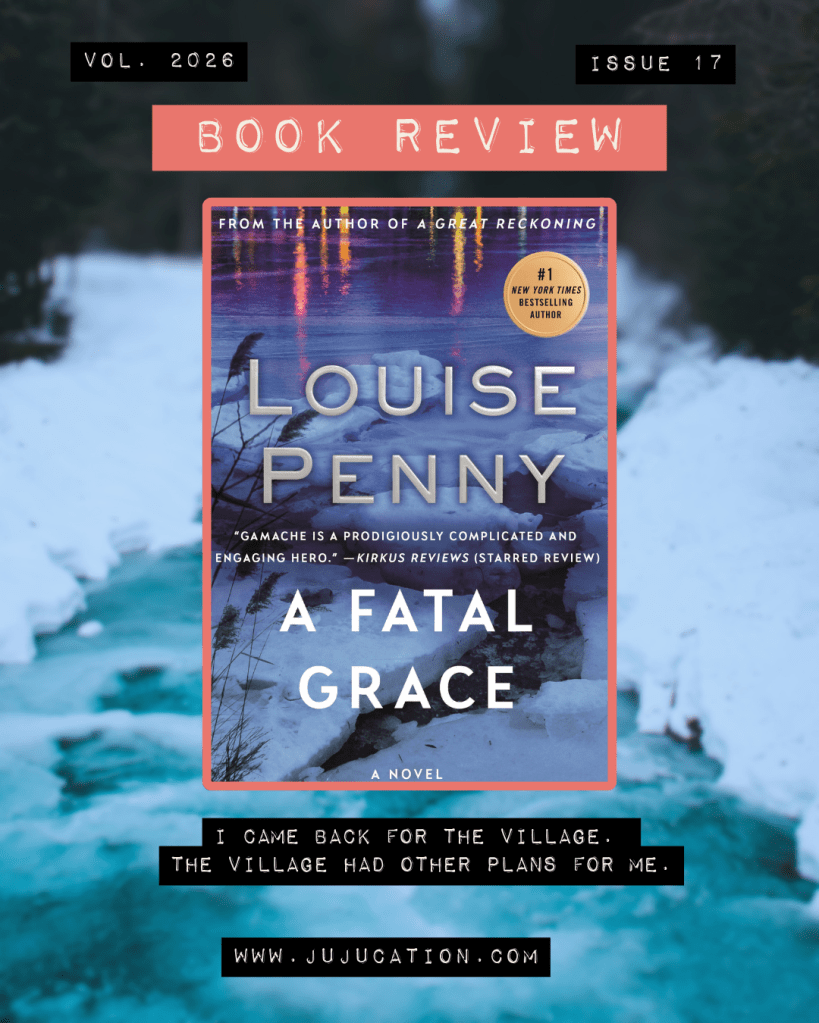
Nobody warned me this was going to escalate. That’s the thing I want to say upfront. Still Life was supposed to be a standalone reading experience, a good book I had finished and filed warmly under “recommend to everyone.” Instead it turned out to be the first chapter of a much longer personal story in which I systematically cancelled plans, apologised to my unread shelf in a tone that convinced neither of us, and accepted that Louise Penny now has significant scheduling authority over my life.
A Fatal Grace is where I stopped pretending I had any control over this.
I came back for Three Pines. I came back for Gamache and the team and Clara and Myrna and Ruth, especially Ruth, who is currently in her second month of occupying rent-free space in my head and has started moving furniture. I came back because Still Life had done something I did not expect a first-in-series mystery to do, which was make me care so much about a fictional village that the actual mystery felt almost beside the point.
What I did not come back for was a slow, precise, deeply uncomfortable argument about the damage done by people who are never told they matter. I got that anyway. Louise Penny included it without asking. The Christmas setting was seasonal misdirection and I fell for it completely.
Context and What You Should Know Going In
A Fatal Grace is the second Chief Inspector Armand Gamache novel, and it demonstrates what a writer can do when she no longer needs to introduce her world. Still Life builds Three Pines with communal warmth and grief running underneath. This one takes the same village and shows its shadow. The setting is technically the same. The temperature is different.
If Still Life was a slow, trust-building opening handshake, A Fatal Grace is Penny reaching across the table, looking you in the eye, and asking a considerably more uncomfortable question. She does not wait for you to be ready. She correctly assumes you are not going to be.
What Actually Happens
CC de Poitiers is wealthy, polished, and so comprehensively loathed that the central question of the novel is not who killed her but who managed to wait this long. She has built a career selling emotional serenity to people while being privately contemptuous of almost everyone she has ever met. She arrives in Three Pines for Christmas and is murdered during a public event in front of a crowd of people who are, if we are being honest, a crowd with motives.
Gamache investigates, which means Gamache listens, and watching him listen is both soothing and faintly alarming because you start to realise that his method would also work on you. Parallel to this: a beggar found dead in Montreal whose identity will matter more than expected. The two threads converge slowly. What they reveal is not a dramatic conspiracy but something sadder and more recognisable, which is the long, compounding damage done by a person who treated contempt as both a philosophy and a management strategy.
By chapter three I was taking notes in the margin about emotional invalidation. This was not what I had scheduled for a Tuesday evening.
What Makes This Different From What You Might Expect
The victim is the most interesting character. CC de Poitiers is monstrous and compelling in equal measure, and Penny is precise about her cruelty without making her cartoonish. She eventually makes the argument that CC’s behaviour has a source, without using that source as an excuse. It is a difficult line to walk. Penny walks it without wobbling.
Calm is treated as a moral question. CC sells a philosophy of emotional control. The book quietly, methodically dissects the difference between genuine equanimity and the suppression of feeling that dresses itself up as peace. If you have ever found self-help language faintly unnerving without being able to explain exactly why, this novel will hand you the diagnosis.
The investigation is emotional before it is forensic. Gamache’s most important detective skill is noticing what people are not saying and what they need to protect by not saying it. This is a model of intelligence I found both admirable and, on reflection, slightly threatening.
The child. I cannot say much without wrecking it. Crie, CC’s daughter, is one of the more quietly devastating fictional children I have encountered, and what happens to her over the course of this novel is handled with a restraint that makes it more painful, not less. I was not prepared. You will also not be prepared. There is no preparing.
Things I Actually Loved
The cold is physical. Not Christmas-card cold. Not cozy-sweater cold. Actual Quebec January cold that has opinions about you and commits to them. Penny earns her setting the hard way, which is to say she describes it until you feel it in your joints.
Every character has a full life behind them. Nobody in Three Pines exists just to serve the plot. The artists, the innkeepers, the poets, they all have histories and wounds and opinions about each other and things they are working through that have nothing to do with the murder. The village feels lived in because these people are lived in. This is harder to pull off than it looks and Penny doesn’t call attention to herself doing it.
The ensemble doing what a real ensemble does. Clara with her ambivalent marriage and stubborn artistic ambition. Myrna with her direct warmth and her professional understanding of what people are actually saying beneath what they are saying. Ruth, who should not work as a character and works completely. Beauvoir adding friction and texture in roughly equal measure. These people function as a community because they function as individuals first.
A late conversation in which Gamache articulates the four things that people in power are afraid to say. I will not reproduce it here. You should find it yourself, on your own couch, at whatever unreasonable hour it arrives. You will put the book down. You will stare at the ceiling. This is the correct response.
The feelings this book left me with. Devastated, oddly grateful, and faintly betrayed by a novel I had technically chosen to read. Those feelings took a few days to settle. Some of them have not settled. I am filing this under “literature doing its job aggressively.”
One honest caveat: this novel moves at the pace of a village. If you are expecting propulsion, manage your expectations early and specifically. The tension accumulates slowly, which is Penny’s method and it works, but it requires a willingness to sit with unresolved discomfort, which is, as it happens, also what the book is about.
What This Book Is Really About
The question A Fatal Grace is actually asking is this: what does it cost a person to never be told they are enough? Not praised, not flattered, not managed. Simply recognised. Acknowledged as real.
The novel proposes that the answer is: a great deal. It makes this argument through CC, through Crie, through the beggar in Montreal whose story ends where CC’s story begins. It makes it without sentimentality and without easy resolution, which is exactly why it stays with you after the book is closed and sitting on the nightstand.
The related argument, which I found equally worth sitting with: performing peace is not the same as having it. There is a kind of performed calm in which emotion is suppressed rather than processed, and the book treats this with clear-eyed suspicion. It made me think about every time I have described myself as “fine” with the confidence of someone whose evidence was extremely thin.
Who Should Read This / Who Can Skip
Read it if:
- You loved Still Life and want to see Penny sharpen her approach considerably
- You like mysteries where motive matters as much as method
- You can sit with a morally complicated victim and resist the urge to tidy it up quickly
- You have a book club and need things to actually argue about
- You have already accepted that your TBR is more of a concept than a plan
Skip it if:
- You want propulsive, action-forward crime fiction
- Cozy means comfortable to you, not complicated
- Slow atmospheric builds make you restless rather than invested
- You are not ready to lose several weekends to a series, in which case I want you to know that I said this, clearly, and whatever happens next is between you and Louise Penny
The Bottom Line
A Fatal Grace is a better book than a cozy mystery has any obligation to be. It uses the genre to do something the genre rarely attempts: make you examine the emotional logic of cruelty, where it starts, and what it leaves in its wake. It is not a perfect book. The pacing will lose readers who need momentum. The resolution is emotionally demanding rather than pyrotechnic. But the things it does well, it does with precision and care.
Gamache is a detective worth spending extended time with. Three Pines is a place worth returning to. And Penny’s central argument, that empathy is a form of intelligence and that people need to be seen before they can be safe, is one that follows you out of the book and keeps going.
This is all to say: begin this series only if you have made your peace with the TBR pile you will be ignoring, accepted that some books are less a reading experience than a quiet annexation of your free time, and prepared something to tell the people you are about to cancel on. A Fatal Grace is book two. It is not the last one. You have been warned. I was also warned. It did not help.
Do you find Gamache’s method of listening more or less unsettling the further into the series you get? And if you have read further ahead: no spoilers, but does Three Pines keep holding up? Tell me in the comments.


