
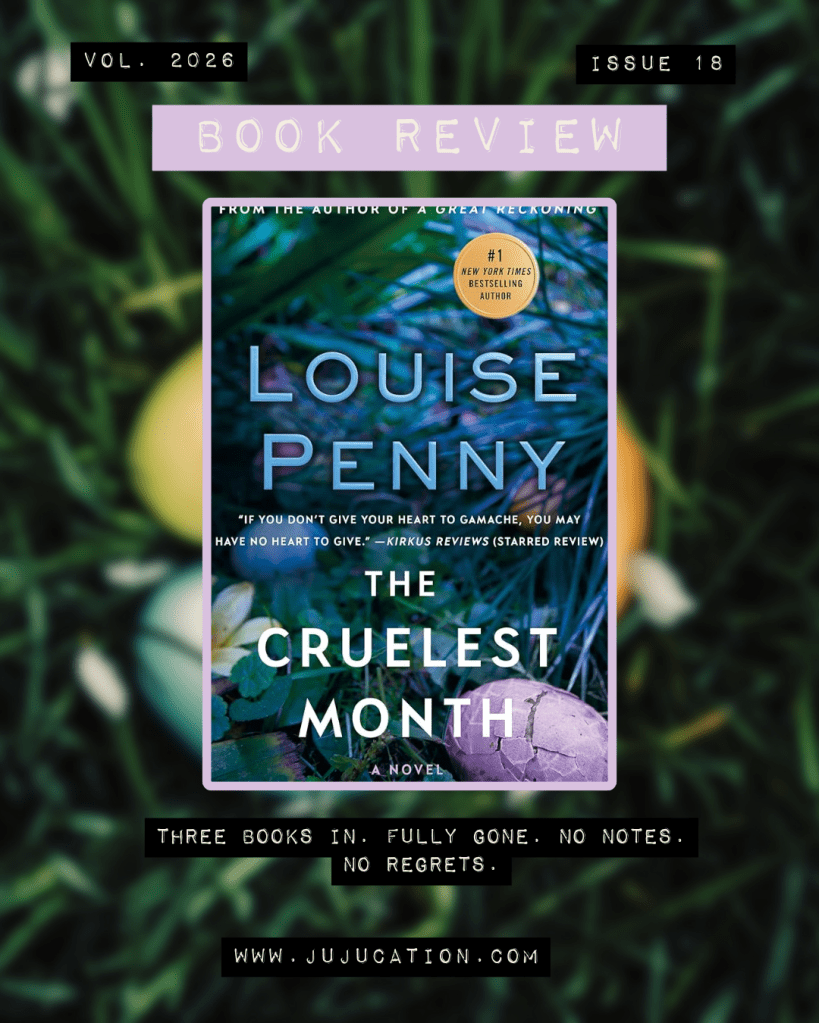
Here is what I told myself after A Fatal Grace: I would take a break. Read something else. Pace myself like a person with working self-regulation and a reading list that is not a cry for help. I had a whole system. A palate cleanser lined up. Very responsible.
I opened The Cruelest Month instead. That same evening. In the same chair.
By the time I noticed, I was sixty pages in and the kettle had boiled twice without me touching it. The palate cleanser is still waiting. I have made my peace with this.
This is what Louise Penny does if you let her. She builds a world slowly and carefully, earns your investment one small true thing at a time, and then, somewhere around book three, you realize the world has become load-bearing. You are not reading to find out what happens. You are reading because you need to check on people you care about, which is a completely normal relationship to have with fictional residents of a village in Quebec.
The Cruelest Month is the book where that shift makes itself official. It is where the series stops being a very good discovery and becomes something you feel genuinely responsible to. And it is stranger and more affecting than I expected, which is saying something, because by this point my expectations were already embarrassingly high.
Where This Sits in the Penny Universe
Louise Penny is shelved under cozy mystery, which is accurate the way calling a long walk a light stroll is technically accurate. The cozy is real. The village is warm. The bistro exists. But Penny is doing what P.D. James was doing: using the mystery form as a container for real questions about envy, grief, institutional loyalty, and the specific cost of protecting things you know are wrong. She is not interested in comfort at the expense of truth, and the books are better for it.
The first two novels establish Three Pines and make you care. This one starts using that care deliberately. It knows what you have already given it and spends it wisely.
The Setup
Easter in Three Pines. The village is performing seasonal optimism with varying degrees of conviction. Above it, on a hill, sits the Old Hadley House: a place with a reputation so established that the villagers have stopped questioning it and started treating it as simple fact, the way you treat a bad intersection or a neighbor who never waves back.
A group of villagers decides to hold a séance there. This is, in retrospect, an extraordinary decision. But grief warps people’s sense of what is reasonable, and the people in this particular group are carrying enough unresolved grief between them to fill a house several times over, which is exactly what they do.
Someone dies. Gamache arrives. And the investigation becomes less about identifying a killer and more about uncovering what everyone in that room was actually reaching for when they sat down together in the dark and called out to the dead.
Running parallel: Gamache’s career is being dismantled quietly from inside the Sûreté. Superintendent Brébeuf, once his closest friend, has allowed jealousy to become a long-term project. He feeds information to Gamache’s enemies with the patient satisfaction of someone who has stopped wanting success for himself and started wanting failure for someone else. Gamache holds both pressures without collapsing under either. Watching him do it is its own kind of lesson.
A Word on the Séance, from Someone Who Would Not Have Been in That Room
I want to be transparent about this because it is relevant to how I read the whole setup.
I practice centering prayer. For those unfamiliar: you sit still for twenty minutes, choose a sacred word as an anchor, and every time a thought surfaces, you gently return to the word. That is the whole practice. No ritual. No summoning. No candles unless you simply like candles, which I do, separately, as a craft.
The point is: I am in the business of quieting interior noise, not amplifying it. The idea that I would additionally invite presences in from outside the room is genuinely funny to me. I cannot manage the ones already competing for attention inside my own head. The dead will have to wait. There are forms. There is a queue.
But this is also why the séance scene unsettled me in the way it did. The people in that room are not reckless. They are desperate. Grief makes people reach for any door that looks like it might open, and Penny understands that with enough specificity that the whole thing reads as deeply human rather than plot-convenient. The horror is not that something supernatural might appear. It is that these people are so unresolved that they would try this at all.
What Makes This Book Different
1. The two storylines are the same argument. The village murder and the Sûreté betrayal are not two plots sharing one book. They are the same question asked twice: what does envy look like when it is given enough time and privacy to become a plan? The killer and Brébeuf do not mirror each other exactly, but they rhyme. By the final chapters, you realize Penny has been making a single point from two directions the whole time. The structure is doing real thematic work.
2. Gamache’s method is not a device. It is the moral center. He listens. He waits. He sits with people until they say the thing they have been circling. This sounds passive. In practice, watching Penny write it, it reads as a form of courage. Most people in positions of authority fill silence because silence is uncomfortable. Gamache holds it because he knows something will come into it. I think about this more than I expected to, and not just about detective fiction.
3. The Hadley House is a symbol that earns itself. The house represents what communities do with the things they know are wrong but cannot yet face: they reference them, discuss them, walk around them, and leave them alone until the avoidance itself becomes dangerous. Penny is not subtle about this. She does not need to be. Sometimes a thing is true enough that stating it plainly is sufficient.
4. This is where the series asks real questions of its characters. The warmth of Three Pines has always been genuine. This book tests whether it holds under actual pressure. It mostly does, but there is cost involved, and Penny does not look away from the cost. The cracks are not plot texture. They are moral reckonings. They matter.
What I Loved
Ruth Zardo, always, without qualification. The village poet is one of the finest recurring characters in contemporary mystery fiction and I am prepared to defend this at length. She is difficult and sharp and her scenes operate at a slightly different emotional frequency from everything around them. She represents something Penny understands that many writers miss: the most apparently impossible person in the room is usually the one who has simply stopped performing patience she does not feel. I find this very relatable.
The séance scene, pacing and all. I read it on a Saturday afternoon in full Singapore daylight with the fan on and still felt something close to cold. It is unsettling the way a very honest conversation is unsettling: not because anything impossible happens, but because everyone in the room is exposed.
Gamache and Beauvoir. Their dynamic deepens across the series, but this book has scenes between them that stopped me. They disagree. They protect each other. They are, without any announcement, exactly what the novel keeps arguing for: loyalty that has been chosen deliberately and is honored at actual cost. The word “partnership” barely covers it.
The seed metaphor. Gamache believes every murder has a history. A seed, he calls it, something planted long before it becomes visible. I set the book down after that line and did not pick it up for several minutes. It is true in a way that goes well past detective fiction, into the way I think about people, about harm, about the long arc of unaddressed things. It is also directly relevant to why I find bibliotherapy compelling: because stories surface what has been growing in the dark. But that is a longer conversation.
What This Book Is Really About
Envy, taken seriously as a structural problem rather than a personal weakness.
Penny does not soften Brébeuf. She shows the mechanics in full: how resentment repurposes memory, how it turns history into grievance, how it makes a person redefine success as someone else’s failure. It is not presented as sympathetic. It is presented as clear, which is more useful and considerably more uncomfortable.
Underneath that is something I keep returning to in my own reading and thinking about books: community requires a kind of honesty that is harder than warmth. Three Pines works because its people have agreed, mostly, to see each other. Not to perform acceptance. To actually look. The Hadley House, the séance, the murder, all of it asks what happens when even a good community keeps walking past the thing it does not want to confront. The answer is not comfortable, and Penny does not pretend otherwise.
The question the book leaves is not who did it. That resolves. The question that follows you is: what have you been walking past, and for how long, and at what point does leaving it alone become a choice you are responsible for?
Who Should Read This
- You are already in the series, in which case this is not a real question
- You want a mystery with genuine atmospheric weight and enough breathing room to feel it
- You want grief and jealousy handled with precision rather than sentiment
- You are willing to be affected by fiction and not particularly embarrassed about it
Who Can Skip
- You need pace and forward momentum as a baseline requirement; this book is unhurried by design
- You prefer a single, clean narrative thread
- Séance settings genuinely unsettle you in a way that would overshadow everything else
- You have not read Still Life and A Fatal Grace and are not planning to; the emotional payoff here depends on what the earlier books built
The Bottom Line
The Cruelest Month is the book where the Gamache series becomes something you are committed to rather than charmed by. The mystery is satisfying. The character work is better than satisfying. The argument Penny is making, about envy and community and what we allow to fester rather than face, lands with the kind of quiet persistence that sits with you into the following week and occasionally longer.
It is not without patience requirements. The middle third earns its length but asks for your cooperation. The séance element works or it does not, and Penny commits to it fully regardless of your comfort. But as a piece of series fiction, this is the inflection point. The moment the world starts costing something. I think those are always worth reading all the way through.
Rating: 4.5/5 stars The book that made me take Gamache’s philosophy seriously as a philosophy. I did not see that coming and I am not complaining.
Let’s Talk
Gamache’s idea, that every murder has a seed, planted quietly long before anything breaks, has stayed with me in ways that are not strictly about mysteries. Which fictional detective’s worldview has genuinely changed how you see something? Tell me in the comments.


