
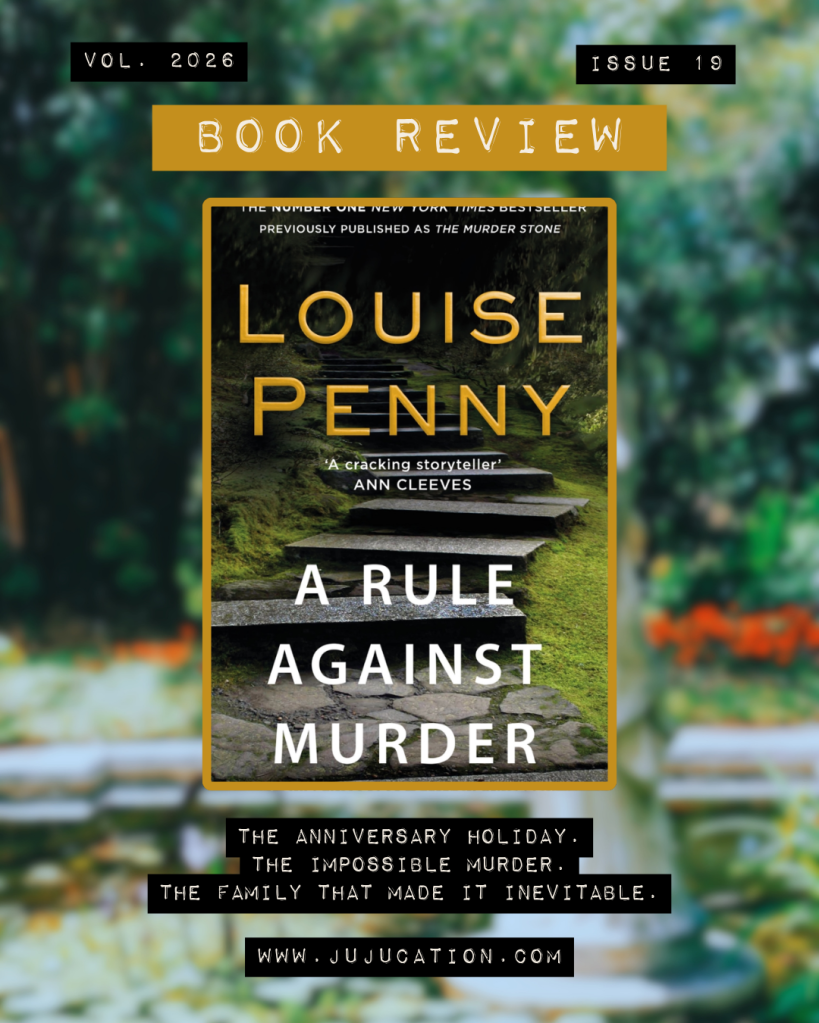
Here is what I have learned after four books: Armand Gamache cannot go anywhere without someone dying near him. Not in Three Pines. Not in a remote inn tucked into the Quebec wilderness. Not on what is supposed to be a quiet anniversary trip with the woman he loves. A man this emotionally intelligent, this patient, this genuinely good at listening, and the universe keeps responding by dropping bodies at his feet. Or, in this case, dropping a several-hundred-kilogram stone statue on top of one.
I did not feel sorry for him. I felt vindicated. Because by book four, I have accepted that Three Pines and its gravitational pull on tragedy is not a quirk of the series. It is the whole argument. Beauty and violence share the same postcode. Gamache knows this. He just keeps hoping.
That is, I think, the most human thing about him.
Where This Fits in the Penny Universe
A Rule Against Murder is the first book in the series to physically leave Three Pines, and that departure is doing real work. The village has been our controlled environment, our familiar ensemble, our little emotional laboratory. Here, Penny strips that away and drops Gamache into a luxury inn with strangers he did not choose, a family that makes the most difficult Three Pines residents look emotionally evolved, and a murder that initially looks impossible. The shift feels deliberate. By book four, we know who Gamache is in his home territory. Now Penny wants to know, and wants us to know, who he is when everything comfortable is removed. The answer, it turns out, is: exactly the same. Which is either deeply reassuring or quietly devastating, depending on your relationship with consistency.
The Setup
Gamache and Reine-Marie check into Manoir Bellechasse for their anniversary. It is the kind of inn that functions as a fantasy of a certain kind of life: impeccable, serene, tucked into Quebec’s Eastern Townships with a quality of light that makes you feel like you have made better choices than you have. Also staying at the inn is the Finney-Morrow family, there for a reunion that no one seems to actually want. There is a cold matriarch. There are adult children performing various flavors of resentment. There is Julia, the estranged one, who has managed to marry someone even the family cannot stand. There is Peter and Clara, yes, those Claras and Peters, which means Gamache is not quite as far from Three Pines as he thought. And there is Bean.
Bean is ten years old, belongs to Marianna Morrow, and is presented throughout the novel without a specified gender. Not as a plot point. Not as a mystery to be solved. Just as a child who is exactly who they are, in a family that has spent generations telling its members who they are allowed to be. Bean wanders through the book with a quiet, specific dignity that made me put it down twice.
Then a storm comes. A massive stone statue topples onto Julia Morrow. What follows is the question of how anyone moved that statue without being seen, and the slower, more unsettling question of which member of this family had enough rage stored up to try.
What Makes This Book Different
1. The locked-room puzzle is a container for something bigger. Penny gives us a genuine mechanical mystery here: a statue that should not have moved, in weather that should have made movement impossible, witnessed by no one despite a full house. The solution, when it comes, is elegant and specific. But Penny is never really interested in the mechanics. She is interested in what kind of life builds up enough pressure to result in this. The locked room is the surface. The dysfunction is the door.
2. Bean is one of the most quietly radical characters in the series. There is no announcement. No explanation. No character stops to process Bean’s presentation or offer their opinion on it. Bean simply exists, observes, and occasionally says something with the particular accuracy of a child who has learned to read rooms out of survival. In a novel about how families enforce identity through cruelty, a character who refuses to be assigned one is not incidental. It is the argument.
3. The Morrows make Three Pines look like a therapy retreat. Every family in Penny’s world carries damage. But the Morrows are a specific kind of cold: the kind that presents as manners. Their cruelty is dressed in good breeding. Their contempt is delivered with complete composure. Charles Morrow, the dead patriarch, is felt on every page despite never appearing in the novel, which is Penny’s way of showing you exactly how the most powerful member of a family continues to run things long after they are gone.
4. Gamache’s own ghosts show up. We get, in this book, more of Gamache’s interior than we have had before. His relationship with his own father. The way love withheld in childhood becomes a wound that either hardens into resentment or is, very deliberately and at great cost, transformed into something else. The Morrows are not just suspects. They are mirrors. Gamache looks at them and sees what he could have been, and chooses again, consciously, not to be that.
Things I Loved
Bean. Every single scene. The refusal to explain. The trust Penny extends to the reader to simply accept a child who does not conform and find them, as they are, entirely whole.
The inn itself. Penny writes Manoir Bellechasse as a place where beauty is not incidental but structural, where the aesthetic is a kind of argument about what life could be. Then she puts a murder in it. The contrast is not ironic. It is honest.
Reine-Marie as counterweight. The Morrows are what marriage looks like when love has been replaced with performance. The Gamaches are what it looks like when it hasn’t. Penny never makes this a speech. She just keeps showing us the difference.
The sugar under the statue. I will not say more. But when the solution arrives, it is so simple and so brutal and so specific to the particular kind of meticulous resentment a person can build over years that it almost made me laugh. Almost.
Beauvoir doing his job. He is becoming, book by book, someone I trust. That trust is being built slowly and I respect the pace.
What This Book Is Really About
It is about what happens to children when love is made conditional. Not withheld entirely, because that would at least be legible, but rationed, offered as reward and withdrawn as punishment, administered as control. The Morrow children are adults now. They have money, houses, lives, opinions. They are still, every one of them, waiting for their father’s approval, which will never come because he is dead and never would have come anyway. The tragedy is not the murder. The tragedy is the forty years before it.
Penny is asking, as she always is, what we do with the damage we’ve been given. Do we pass it on with the same wrapping paper, or do we stop, look at it clearly, and decide to put it down? Gamache has done the second thing. It has cost him something. The novel is honest about that cost. And it suggests, without sentimentality, that it was worth it anyway.
That is the question it leaves in my chest. Not who killed Julia Morrow. But whether any of the people who shaped us into who we are have any idea what they actually made.
Who Should Read This
- You’ve read books one through three and you’re ready for Gamache outside his habitat
- You are interested in how families enforce silence and call it love
- You find psychological complexity more compelling than procedural mechanics
- You have been in a room with people performing togetherness and felt the particular exhaustion of it
- You want a character like Bean to exist in fiction and in the world
Who Can Skip
- You need Three Pines and its ensemble to feel grounded in this series (come back after)
- Family dysfunction as subject matter hits too close right now
- You want the mystery to be the main event
The Bottom Line
A Rule Against Murder is the book where Penny proves the series can hold its weight outside its home base. The mystery is clever. The family portrait is devastating. Bean is a small, quiet revolution tucked into 336 pages without a press release. It is not the warmest entry in the series, because warmth is not always what’s needed. Sometimes you need a book that looks at a cold family and says: I see exactly what happened here. So does Gamache. So will you.
The inn is beautiful. The company is terrible. That’s the point.
Rating: 4.5 out of 5 stars Half a star off only because the killer’s final reveal resolves a little too cleanly for the emotional mess that precedes it. But the mess is very good.
Let’s Talk
Have you ever read a character who simply refuses to be explained, and felt relieved by it? I’m thinking about Bean long after finishing this one. And if you’ve met a fictional family that felt uncomfortably close to a real one, I want to know which book broke the seal.

 jujucation.com