
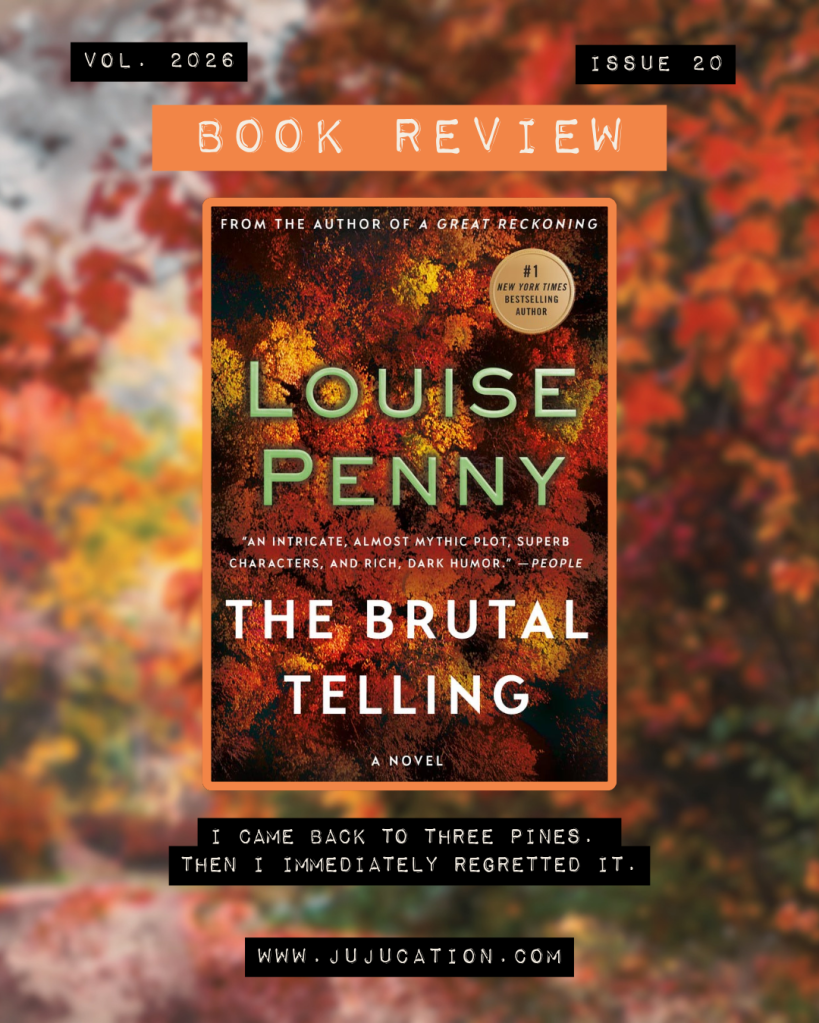
Coming back to Three Pines after A Rule Against Murder felt like exhaling. I knew the bistro, the village green, the particular quality of light Penny gives to a Quebec autumn. I settled in. I was ready.
I should have known better.
There is something Penny does that I have started to recognize as a pattern and keep falling for anyway: she hands you the thing you wanted, the return, the familiar, the warmth, and then she makes you watch it turn. The Brutal Telling opens in Three Pines. My Three Pines. And within a few chapters I was reading with the specific dread of someone who has walked into a room and recognized, too late, that the furniture has been rearranged around a trapdoor.
I am not going to tell you what is in the trapdoor. What I will tell you is this: Louise Penny really went there. And I loved it, even as I resented it completely.
Where This Fits in the Penny Universe
The Brutal Telling is book five, and it lands differently from its predecessors in a way that marks a clear shift in what this series is willing to do. The first four books establish Three Pines as a place worth loving: flawed, yes, melancholy in places, never fully innocent, but still somewhere you’d want to live inside your imagination. This book starts pulling at the seams. It doesn’t destroy the village, but it asks what it costs to maintain a place that feels this safe, and who pays that price quietly, over years, in the dark. If Still Life introduced us to Three Pines and The Cruelest Month deepened it, The Brutal Telling is the book that tests it. It is the darkest entry so far, emotionally and structurally, and it is probably the best one.
The Setup
A man is found dead in Olivier’s bistro. No identification. No obvious cause of death. No clear connection to anyone in the village, except that the body was moved there, which means someone brought him, which means someone in or near Three Pines knows more than they are saying.
Gamache arrives, which means the village has to open itself up to scrutiny again. And this time it is not a convenient stranger who draws suspicion first. It is someone we know. Someone the village knows. The investigation fans outward from the bistro into the surrounding woods, into a hermit’s cabin stocked with extraordinary and inexplicable things, into old histories and recent choices and the specific kind of loyalty that people in small communities develop when they’ve decided to protect one another regardless of what that protection actually costs.
The question is not just who did it. The question is: what do you owe the people you love, and what happens when the answer turns out to be less than you thought?
What Makes This Book Different
1. Penny implicates someone you like. Not a suspect you are meant to suspect. Someone from the village you have been rooting for across multiple books. The investigation forces you to sit with real discomfort about a person you thought you understood, and Penny gives you no comfortable way out of it. That is harder to pull off than it sounds, and she earns it.
2. The Hermit is one of the series’ best inventions. A man living in total secrecy in the woods outside Three Pines, surrounded by inexplicable wealth, with no name anyone can confirm. Penny builds his life retrospectively, through objects and stories and other people’s memories, and the picture that emerges is genuinely haunting. He is not a plot device. He is a person, and understanding him takes almost as long as understanding the murder. There is something he made, by hand, that holds an entire story inside it. I will say no more. You will know it when you reach it.
3. Shame is the real engine. Previous books have dealt with jealousy, grief, ambition. This one is specifically about what shame makes people do: how it deforms relationships over years, how it breeds secrecy, how it can make someone capable of things that look completely out of character if you don’t understand what they’ve been quietly living with. Penny treats this with more psychological precision than I expected from a village mystery, and that precision is what makes the ending hit the way it does.
4. Gamache is wrong. Not catastrophically, not in a way that costs someone their life. But he follows a thread that feels solid and it turns out to be something else. This matters because Penny has spent four books establishing him as someone whose instincts you trust, and then she shows you that trust is also a kind of limitation. He is still the moral center of this series. He is just also, for a significant stretch of this book, incorrect. I appreciated that more than I expected to.
A Personal Aside
There is a scene in The Brutal Telling involving a gathering where everyone in the village is present, all performing normality, all aware that something is very wrong, and all doing the social work of pretending things are fine while communicating through glances and silences that they are not. I read it during my lunch break and spent the rest of the afternoon thinking about the number of stakeholder meetings I have sat through that operate on the exact same principle. The mystery at the center is different. The mechanism is identical. Everyone knows. Nobody is saying. Some of us are even taking notes on a dashboard about it.
Things I Loved
The cabin and everything in it. Penny plants something early in that cabin that takes the whole novel to pay off. When it does, you will want to go back and reread. I did not, but only because I had the next book waiting.
Gabri in this book. He is always warm, but here his warmth has a cost attached to it and you feel the weight of that without Penny ever underlining it. He carries something in this novel that he should not have to carry, and she lets him do it quietly.
The pacing of the reveal. Penny earns the ending. It does not drop from the sky. Everything was already there. I just did not see it, which is simultaneously embarrassing and the highest compliment I can pay a mystery writer.
Ruth, in the background, being Ruth. She is always doing something in the corner of a scene that would be the most interesting thing in any other book. Here she is just texture. It is exactly right. This village contains multitudes.
What This Book Is Really About
It is about what we become when we decide to manage our shame privately, over years, without ever letting anyone close enough to help carry it. The murder is almost secondary to the question underneath it: what happens to a person, slowly, when they live with something they cannot admit?
Penny is not asking this abstractly. She is showing it in a character’s choices, in the specific texture of how they move through the world, in the relationships they maintain and the ones they subtly corrupt. By the end, you understand that the brutality in the title is not only about the crime. It is about what it costs to carry a secret. The whole village has been unwittingly organized around one person’s inability to face something true about themselves, and that is a deeply unsettling idea, dressed up in beautiful autumn light.
I think about this in relation to why I believe books matter, not because they give us answers, but because they give us names for things we could not articulate before. I did not have a clean word for “the harm that accumulates around a secret that is never spoken” before I read this book. I do now.
Who Should Read This / Who Can Skip
Read this if:
- You have read at least the first three Gamache books and feel at home in Three Pines
- You like mysteries where the emotional resolution hits harder than the plot resolution
- You have the patience for a slow build that pays off completely
- You want to be genuinely, humblingly wrong about who did it
Maybe skip this if:
- You want light and cozy with no real darkness. This one has real darkness.
- You are new to the series. The emotional gut-punch of this book requires investment in the village. Starting here would be like walking into the third act of a play.
- The content warnings matter to you: animal abuse, psychological abuse, anti-gay bias. These are not gratuitous, but they are present.
- You want a fast-paced thriller. This one earns its pace. Not everyone will want to wait for it.
The Bottom Line
The Brutal Telling is the book where I understood that Louise Penny is writing something more serious than I initially gave her credit for. It is a mystery. It is also a novel about shame, community, loyalty, and the specific violence of being truly known by someone who then chooses what to do with that knowledge.
The pacing is occasionally slow through the middle section, and a subplot involving the new arrivals at Hadley House takes a little longer to connect to the central investigation than it probably needs to. But the ending earns every slow page. I did not see it coming. I have been thinking about it since.
Before You Go
If you have been reading this series: did this one change how you think about Three Pines? And if you have ever been completely wrong about a murderer in a mystery novel, I would genuinely like to hear about it, so I can feel less alone in my failure.
Full review is here. If you want to know when the next one goes up, subscribe and I will come to your inbox without the fuss.


