
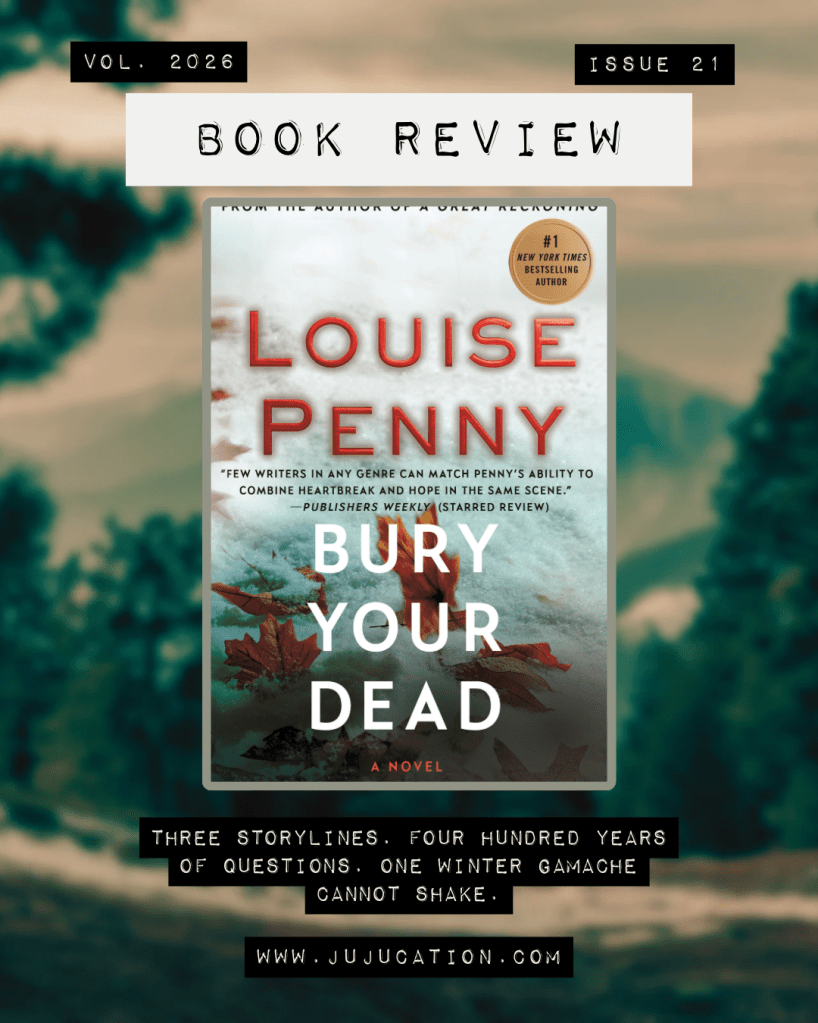
Here is what n obody tells you about reading a long mystery series: at some point, the mystery stops being the point. You have watched these people long enough. You know how Gamache holds his coffee. You know the particular silence that falls over Three Pines when something is wrong, and you have learned to feel it before Penny names it.
By book six, I was not arriving at Bury Your Dead to find out who did it. I was arriving because these are my people now, and I had questions.
What Louise Penny delivered instead was something I genuinely did not see coming: three storylines running simultaneously, none of them simple, all of them rhyming thematically in a way that should feel constructed but does not. Treasure hunting. Murder. History that refuses to stay archived. And threaded through all of it, Reine-Marie, Gamache’s wife, finally given enough space to be a fully realized person rather than a beautifully rendered background detail.
I finished this book and sat very still for a while. That is usually how I know something worked.
Where This Fits in the Penny Universe
Bury Your Dead is book six, and it is a register shift. The earlier novels build the world: Three Pines, the team, Gamache’s particular brand of moral seriousness, the way this series understands that a village can love you and lie to you in the same breath. The Brutal Telling pushes hard on that last idea. This one arrives in its aftermath and asks what happens to a man who had to act on incomplete truth. If the first five books are Penny building a house, this one is her showing you the foundation, cracks and all.
The Setup
Gamache is in Quebec City during Winter Carnival. He is not there to enjoy himself. Something went badly wrong in an operation that we only learn about in fragments, scattered across chapters, and the fragments are doing most of the emotional work. He is shaken in the way careful people get shaken: quietly, methodically, in ways they are not entirely ready to name.
Into this arrives a murder at the Literary and Historical Society, an institution that has spent generations holding English-speaking Quebec’s cultural memory together with good intentions and drafty ceilings. A scholar has been killed. He was obsessed with finding the burial site of Samuel de Champlain. Quebec City in winter, a centuries-dead Frenchman, a very recently dead academic, and a detective who is not sure he trusts his own judgment anymore.
Meanwhile, back in Three Pines, Beauvoir is reopening the case from The Brutal Telling. New evidence. Old questions. The possibility that the conviction was wrong, and that people in the village knew something and chose silence over disruption.
Three storylines. One question: what do you do with the dead you cannot stop thinking about?
What Makes This Book Different
1. The structure is genuinely ambitious, and it earns it. Penny is braiding three timelines and two active investigations, which could easily become a mess. It does not. The Champlain thread, the fresh murder in Quebec City, and the Three Pines reopening are all asking the same question in different languages: whose version of events becomes history, and what does it cost to let the wrong version stand? The structure is not just clever. It is doing argumentative work.
2. History is not decorative here. A lot of literary mysteries use historical context as atmosphere, something pretty to set the scene. Penny uses Quebec’s English-French tensions as something closer to a character. The Literary and Historical Society exists because English-speaking Quebecers needed somewhere to keep their identity when the political ground kept shifting under them. That is not backstory. That is the whole point. The tension between what a community preserves and what it quietly revises runs through every storyline simultaneously.
3. Gamache is allowed to be wrong. This is the one that got me. The earlier books give us Gamache as a deeply humane authority figure, someone whose judgment you trust even when the evidence is thin. Bury Your Dead removes that safety net. He made a call. People were hurt. He does not get to be simply competent here, and Penny does not let him off with a tidy redemption arc. The moral accounting is more uncomfortable than that, and it makes him more interesting than he has ever been.
4. Reine-Marie. I will be honest: by book four, I had quietly accepted that she would mostly be a warm, loving, largely off-page presence in Gamache’s life, present enough to demonstrate what a good husband he is. Bury Your Dead corrects this, and I found myself a little embarrassed by how grateful I was. She is smart and perceptive and slightly wry, and she loves Gamache in a way that is also clear-eyed about who he actually is. The scenes between them are the emotional spine of the Quebec City storyline. This is the Reine-Marie I had been waiting for without knowing I was waiting.
A Personal Aside
I should admit that I came to this book mid-week, between two consecutive meetings that required everything in me. My brain was running on about 40% capacity and the remainder was resentment.
Louise Penny handed me a man standing in a Quebec winter, surrounded by ice sculptures and centuries-old guilt about a dead French explorer, and I felt something in my chest do what it had not done in three days, which was let go.
There is something specifically restorative about a mystery that trusts you with complicated history. Not because it is educational in any formal sense. But because it says: here is a problem that is real and tangled and has been sitting unresolved for four hundred years. You have time. Sit with it. The dashboard can wait.
It can and it did.
Things I Loved
The way the Champlain obsession is treated seriously, not as eccentricity. One scholar’s conviction that he knows where a man is buried, and the willingness of others to believe him, is played as a genuine human need. To locate something. To make the past legible. To stop the thing from being lost. That interpretive generosity is very Penny.
Beauvoir in Three Pines without Gamache. He is irritable and wrong about almost everything at first, and watching him slowly shift is genuinely satisfying. He starts the book dismissing the village entirely and ends it having learned something about the value of actually paying attention. That is a good character arc, delivered without announcement.
The pacing of reveals across three storylines. Penny knows exactly when you have relaxed, and she uses that knowledge with precision. The timing feels like someone who has been doing this for a long time and has no interest in being polite about it.
Reine-Marie and Gamache just talking. No crisis. No exposition. Two people who have been married long enough to know how the other thinks, and who still choose to think out loud together. I did not know how much I needed to see that until I had it.
What This Book Is Really About
Louise Penny is asking, plainly and without flinching, what we owe the dead. Not sentimentally. Not as a ghost story. As a civic and moral question.
Samuel de Champlain’s bones may or may not be somewhere under Quebec City. A scholar died looking for them. Olivier may or may not have been correctly convicted. Gamache may or may not have made the right call in the operation that is haunting him. Every thread in this book is asking the same thing: when we close a case, name a verdict, write the history, are we actually done? Or are we just choosing the version of events we can live with?
The answer Penny arrives at is uncomfortable. We are usually choosing the version we can live with. And that is not nothing. But it is also not truth.
I think about that a lot. What stories we reach for because they are true, and what stories we reach for because they hold.
Who Should Read This
- Readers already committed to the series who are ready for it to get heavier
- Anyone who likes mysteries that treat history as a live thing, not a backdrop
- People who have been quietly waiting for Reine-Marie to matter
- Readers who finished The Brutal Telling with questions still running
Who Can Skip, or Postpone
- Anyone coming to Louise Penny cold: start with Still Life, not here
- Readers who want a clean, single-mystery arc with no detours
- Anyone currently depleted by complicated feelings: this book will add to the pile, not ease it
The Bottom Line
Bury Your Dead is the book where Penny stops being careful with Gamache and starts being honest with him. That shift changes the register of the whole series going forward. It is not the most immediately satisfying book in the sequence (that is still Still Life for me, the one that set the terms), but it is probably the most structurally ambitious. The three-storyline braid works. Quebec City in winter is specific and cold and alive in a way that makes Three Pines feel like a different country. And Reine-Marie finally gets to be a person.
One honest caveat: the historical thread occasionally outpaces the emotional one. If Quebec’s political identity is not already interesting to you, some of those passages will test your patience. They did not test mine, but I want to be fair about that.
Let’s Talk About It
Is there a character in a long series you did not realize you were rooting for until they were finally given room? Drop it in the comments. I am genuinely curious. And if you want to follow the series reviews in order, subscribe so you do not miss the next one.


