
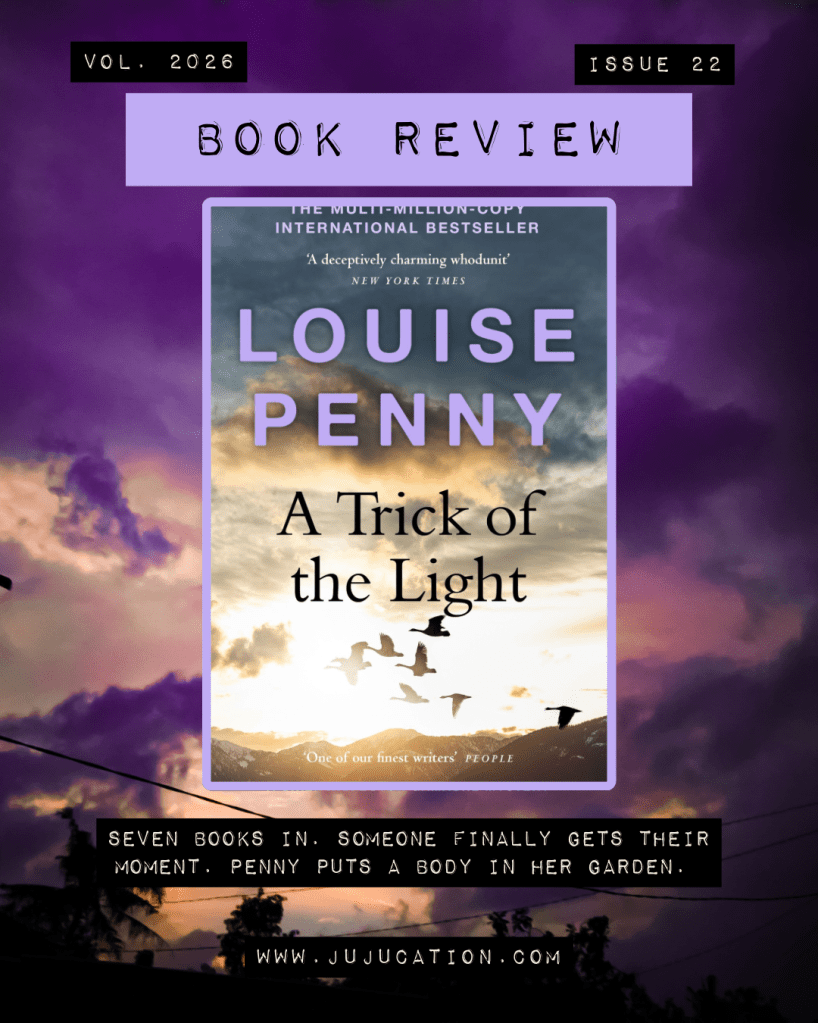
There is a particular kind of emotional investment that happens somewhere around book five of a long series. You stop reading the characters and start watching them the way you watch people you actually know: with preferences, with stakes, with the specific impatience of someone who has been paying attention for a long time and has opinions about how things should go.
By the time I opened A Trick of the Light, I had been watching Clara Morrow be afraid of her own talent across six previous novels. Six books of her making extraordinary work in a village no one can find on a map, of her standing slightly sideways to her own potential, of her being funny and perceptive and quietly certain the world would eventually confirm her worst suspicions about herself. I had been waiting for her moment the way you wait for a friend who keeps almost believing in herself to finally, actually, do it.
She got her moment. Her first solo show in Montreal. The room loved her work.
Louise Penny celebrated this by putting a body in her garden before the champagne glasses were dry.
This is what I mean when I say this is not a cozy mystery series. It is a series about what it costs to finally be seen. The murder is almost beside the point. Almost.
Where This Fits in the Penny Universe
A Trick of the Light is book seven, and it arrives directly after Bury Your Dead, which spent most of its pages asking Gamache to carry almost unbearable personal weight. This novel redistributes the grief. Clara takes on the central emotional burden. Beauvoir starts to accumulate something quietly terrible. The village gets a crime that requires it to look at what it chose not to know. If Still Life was an introduction and Bury Your Dead was a reckoning, this book is about what happens when you keep going after the hard thing: the settling, the complications of survival, the discovery that arriving somewhere you wanted to be does not mean you are safe there. In terms of register, it is less procedural than some earlier entries and more interior. Penny is increasingly interested in what her characters are carrying. This book shows that interest at its most precise.
The Setup
Lillian Dyson was once Clara’s closest friend. Then she wrote a review of Clara’s student work so savage it functioned less as criticism and more as demolition. Their friendship ended. Lillian went on to build a career as a feared art critic, which is what happens when someone discovers that cruelty can be a professional skill. More recently, she had been in AA, trying to make amends to the people she had hurt. She showed up in Three Pines the night of Clara’s exhibition opening. She was found dead in Clara’s garden the next morning.
Gamache arrives, as he always does, quietly. He asks questions that sound too simple until they unspool into something much larger. What he finds is not just a murder with a list of suspects but a portrait of a woman who spent years doing damage, then spent her final years trying to undo it, and did not quite get there. The investigation becomes an excavation of old injuries, AA communities, hidden artistic work, and the specific grief of people who are not sure whether they owed the dead woman forgiveness or whether she owed them more time.
What Makes This Book Different
1. The victim deserves the grief. Lillian Dyson is not an easy character to mourn. She was unkind in a sustained and specific way. She used professional authority as a weapon. Penny gives her a full interior life posthumously anyway: through her family, her recovery work, her secret paintings, until the reader is doing something genuinely uncomfortable, which is grieving someone they prepared themselves to dislike. That maneuver is hard to execute and Penny executes it without reaching for sentimentality once.
2. Clara’s success is not a resolution. The novel understands something quietly devastating about achievement: it does not fix what was already broken. Clara gets her triumph and immediately discovers that success has its own loneliness. The people who love her do not quite know how to stand next to her new status. The displacement between her and Peter is almost imperceptible at first, which is exactly how real marital erosion works. It is not a fight. It is a series of silences that take up more and more room.
3. Gamache and Beauvoir. Their dynamic has always been the series’ emotional spine, but in this book it begins to show strain. Beauvoir is carrying something that the investigation keeps pressing on. Watching Gamache notice this and refuse to look away is one of the more quietly devastating things in the novel, and one of the more honest portraits of what it looks like to love someone who is not ready to be helped.
4. The forgiveness question has no answer. Penny asks, through Lillian’s AA arc, whether the demand for forgiveness can become another form of control. She asks whether the people we’ve hurt owe us the relief of forgiving us. And then she does not give you a resolution. Which is the right call, and also the kind of call that leaves the book sitting in you for days after you’ve put it down.
A Personal Aside
I want to say something about the hermit from The Brutal Telling for a moment, because I think he is part of why Lillian hit me as hard as she did.
The hermit was a man who had been so badly frightened by the world that he hid from it completely, surrounded himself with beautiful things no one would ever see, and died alone. I found that devastating in a way that was difficult to articulate. And I think that grief traveled with me into this book, because by the time Penny started revealing who Lillian Dyson actually was, how she had spent her recovery years making private, sincere paintings while publicly destroying other people’s sincere work, I was already primed to feel the specific sadness of a person who contains more than their worst behavior.
This is what the series has been doing, very gradually and very deliberately. It has been training me to extend my empathy in directions I was not originally planning to go. For someone who is working toward bibliotherapy practice, this is not a small thing. Books that make you feel genuinely sorry for people you were prepared to resent are doing something real. They are practicing something with you.
I sat with Lillian for a while after I finished. I think about her occasionally still.
Things I Loved
Lillian’s secret paintings. The detail that she had been making her own sincere, private art while demolishing the sincere art of others is one of the most psychologically honest things in the book. People contain more than their worst behavior. Penny keeps insisting on this, book after book, and she keeps finding new ways to prove it.
The AA sequences. Recovery in fiction tends to be either inspirational or melodramatic. Penny treats it as ordinary, practical, and morally unfinished. The people in Lillian’s AA circle are not symbols. They are people trying to manage something very difficult, with inconsistent results. That is the right register.
Gamache listening. He is not the brilliant-detective-in-a-room type who dazzles everyone into a confession. He is a man who pays attention as a moral practice. Watching him do this, specifically with the people who knew Lillian during her recovery, is the most persuasive argument the series makes for empathy as investigative methodology. And for empathy as a life methodology, frankly.
Beauvoir. The way his pain accumulates in this novel, quietly, sideways, not announced, rhymes with what comes for him in later books. If you are already ahead in the series, you will be reading these scenes with a specific kind of dread. If you are not: read carefully.
What This Book Is Really About
It is about the gap between who you were and who you are trying to become, and whether the people you hurt while you were the first person have any obligation to help you become the second.
Lillian Dyson tried. She got into recovery. She started making amends. She was doing the work, as people say, in a way that sounds tidy and is actually very messy and slow and morally ambiguous when you look at it closely. And Penny does not let that arc be triumphant. She keeps asking whose needs the amends are actually serving. She asks what happens when forgiveness arrives too late, or not at all. She asks whether the person doing the amending has any right to feel wronged when the person they hurt is not ready to receive them.
She does not answer these questions. She just holds them up until you feel their weight.
Three Pines, in this book as in all the others, does not fix anything. It pays attention. That turns out to be the most moral thing it can do.
Who Should Read This / Who Can Skip
Read this if:
- You are already in the Gamache series and you have been waiting for Clara
- You want a mystery that gives its victim a full interior life rather than a function
- You like recovery and addiction handled with honesty rather than drama
- You believe forgiveness is complicated and you want a novel that agrees with you
- You read Tana French, Ann Cleeves, or Deborah Crombie
Skip or postpone if:
- You need a fast, puzzle-forward mystery with minimal emotional backstory
- Addiction and recovery material is difficult for you right now
- You have not read the earlier books. Start with Still Life. The payoffs here depend on having met these people before.
The Bottom Line
A Trick of the Light is the kind of mystery novel where solving the crime is almost secondary to understanding everyone involved in it. It has the familiar pleasures of Three Pines: Gamache’s moral intelligence, the village’s texture, Penny’s insistence on treating community as something that has to be actively built rather than passively inherited. And it adds something harder. The forgiveness question does not resolve. Clara’s triumph does not save her marriage. Beauvoir’s pain is not acknowledged, which means it compounds.
The one soft flaw: the case resolves slightly faster than the emotions do. The plot ties up more neatly than the people, which is true to life but can feel slightly asymmetrical as you read. It is a small complaint. The novel earns its ending. It earns it with specificity, not comfort, which is the only currency I trust.
Rating: 4.5/5 Half a star off because the ending closes faster than the feelings do. The other four and a half are non-negotiable and I will not be taking questions.
I want to ask you something before you go: has a book ever made you feel genuinely sorry for someone you were fully prepared to dislike?
Full review at the link in bio. If you are new here and you are wondering whether to commit to this series: yes. Start with Still Life. Meet them properly.

 jujucation.com