
I have a recurring fantasy that is embarrassing in its specificity. In it, I wake up slowly, with no alarm. I meditate. I potter around a garden in the early morning before the heat sets in, doing something gentle and useful with my hands, talking to plants I have kept alive through sheer affection rather than any actual competence. I read for hours without guilt. Nobody needs anything from me before noon. There are no meetings, no dashboards, no one needs me.
I do not have a green thumb. I have killed succulents, which are plants specifically designed to survive neglect, which says something about the gap between my gardening fantasy and my gardening reality. But the fantasy persists. The version of me who tends things slowly and lives at a quieter frequency is very convincing in my imagination.
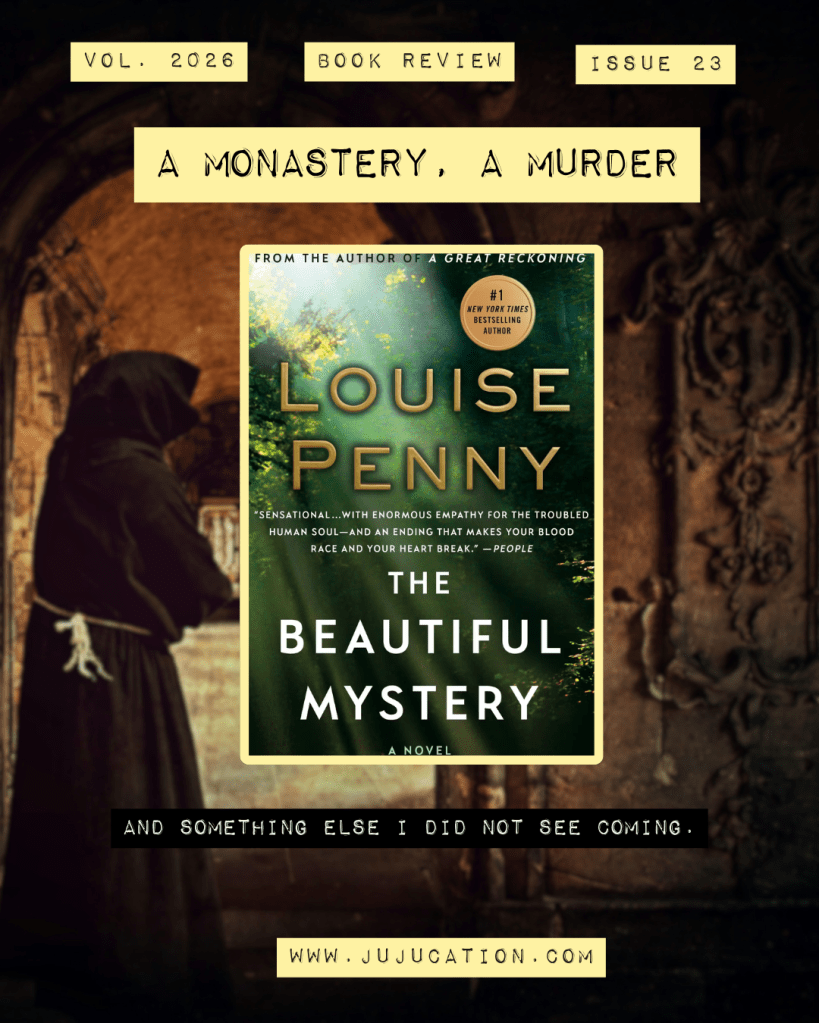
So when Louise Penny placed Gamache inside a cloistered Quebec monastery for book eight of this series, I did not just find it interesting. I felt something closer to recognition. Here was a community that had built the whole architecture around the life I keep imagining: silence, rhythm, work done with the hands, days shaped by bells rather than notifications. A place where the pace was not something you negotiated but something you surrendered to completely.
And then somebody murdered the choir director.
I finished this book at eleven at night and sat with it for a while in a way I have not had to since Still Life. Not because of the murder. The murder, honestly, I half-saw coming, which is a personal first in eight books. Because of something else. Something Penny does quietly, in the margins of the investigation, that I did not notice until it had already happened.
She is very good at that.
Where This Fits in the Penny Universe
The Beautiful Mystery sits at book eight and by this point Penny has earned the right to do something structurally unusual. She takes Gamache almost entirely out of Three Pines, which if you have been following this series feels like being told everyone you care about is staying home. Saint-Gilbert-Entre-les-Loups is the whole world of this novel: closed, pressurized, and deeply strange. It is the most self-contained book in the series so far and also the most thematically deliberate. But “self-contained” turns out to be a slight misdirection. Because what Penny is actually doing in this book is planting something inside the series. By the end, you feel the roots of it even if you cannot yet name the plant.
The Setup
The monastery of Saint-Gilbert-Entre-les-Loups is the kind of invented place that feels specific enough to be real. I went and checked. It is not real. I was briefly and disproportionately sad about this.
A community of monks who have taken a vow of near-total silence has accidentally become world-famous for their recordings of Gregorian chant. They did not want the fame. They wanted the silence, the rhythm, the removal from everything the modern world insists you participate in. This is one of the novel’s best tensions: a community that sought to disappear from the world has been pulled back in by the beauty of what it created in the quiet.
Then the choir director turns up dead and Gamache and Beauvoir are summoned into this closed circle. The investigation is limited by space, by rule, and by the fact that everyone is a suspect and everyone is also, technically, a man of God. Beauvoir is immediately at war with the acoustics and everything the place represents. Gamache, characteristically, is listening for something else.
What neither of them is fully listening for is what is happening between them.
What Makes This Book Different
1. The setting is doing thematic work, not decorative work. Penny could have picked any isolated location for this mystery, but the monastery is not backdrop. The silence is the subject. The chant is the evidence. The spiritual architecture of the place shapes every interrogation, every small act of betrayal. It is the most tightly integrated setting in the series so far and it earns every slow, pressurized page.
2. Music is central, not peripheral. The Gregorian chants are not atmosphere. They are a symbol of what this community has built, what it has sacrificed, and what it is willing to protect at any cost. By the halfway point I had looked up what Gregorian chant actually sounds like. I then lost an hour. Entirely intentional in retrospect. The music matters to the themes in a way that is hard to articulate without spoiling, but Penny makes beauty feel dangerous in this book, which is not an easy thing to do.
3. Gamache is asked to do his hardest thing in a place supposedly built for his hardest thing. His strength has always been listening. Sitting with discomfort. Not rushing to conclusions. The monastery, in theory, rewards all of this. In practice it is full of people who have made silence into a weapon, and the gap between those two facts is where the novel lives. What the book quietly reveals, in its last act, is that being good at something is not the same as being protected by it.
4. This is where something breaks. I am not going to tell you what. Partly because spoilers, partly because the not-knowing is part of how this book lands. What I will say is that Penny has been building something between Gamache and Beauvoir across eight books, a partnership with its own specific weight and its own specific vulnerabilities, and by the end of The Beautiful Mystery you feel a crack in it. Thin as a hairline fracture. Real as a structural failure. I did not see it coming. I should have. It was in the silence the whole time.
A Personal Aside
The monastery lifestyle fascinated me before I even opened this book. That is worth saying plainly.
There is something about the monastic idea that I find genuinely compelling, not religiously, or not only religiously, but as a design for living. The bells that mark the hours. The manual work. The gardening, the cooking, the making of things with hands as a form of prayer or at least as a form of presence. The deliberate removal of everything that is not necessary. I fantasize about a version of this regularly. A quieter life. A slower frequency. A garden I somehow manage not to kill.
What Penny does is take that fantasy and hold it up to the light very carefully. The monastery is beautiful. The lifestyle is genuinely compelling even on the page. And it is also, beneath the bells and the chanting and the rhythm of the hours, a place where human needs have been compressed into a very small space with no adequate outlet. Where resentment has nowhere to go. Where the gap between the ideal and the actual has been accumulating for years in the silence between the prayers.
My retreat fantasy survives this novel, but it is more honest now. I would probably still kill the garden. And I would definitely have opinions that needed somewhere to go by day three.
Things I Loved
The monastery details. Penny has done the research and it shows without announcing itself. The routines, the hierarchy, the specific texture of a life lived that deliberately, it all feels inhabited rather than described. This is the rare fictional place I mourned when I confirmed it does not exist.
The way the chanting functions. Not as background. As beauty, as evidence, as identity, as grief. There is a quality to how Penny writes the music that makes the silence after it feel almost unbearable. I believed every word of it.
Beauvoir in this setting. He is not built for monasteries and he knows it and the monastery knows it and it is briefly very funny and then gradually something else entirely. Penny uses his discomfort here with more intention than I registered while reading. The intention only becomes clear at the end.
Gamache’s restraint. In a novel built around what is left unsaid, his instinct to listen rather than press feels like the book finally playing entirely to his strengths. And also, in hindsight, like a man who is very good at noticing things in strangers and perhaps less practiced at noticing them up close.
I guessed the culprit. A small, private victory I am recording because eight books of being surprised deserves a counterpoint. I got the murder right and missed the thing that actually mattered. The precision was irrelevant. Penny won.
What This Book Is Really About
Peace that has to be enforced is not peace. It is a choice someone is making, possibly at cost, possibly at someone else’s expense.
The monastery looks like a community that has achieved something close to the life I keep imagining: structured, quiet, hands in the dirt, days shaped by something larger than a to-do list. And in some ways it has achieved it. The chanting is genuinely transcendent. But the murder reveals what that transcendence costs: the suppression of doubt, the silencing of ambition, the particular quiet violence of being unseen inside a community that demands you be seen only as a function.
Penny is asking, carefully and without sentimentality, what happens to human needs that have nowhere to go. She places those needs inside men who have vowed to want nothing, and then watches, with her usual combination of warmth and ruthlessness, to see what breaks first.
But she is asking the same question, more quietly, about the two men investigating the case. What happens when the needs of a partnership have also been quietly accumulating in the silences between them. What happens when trust is something you have been assuming rather than tending, the way I assume my plants will survive without being watered and am consistently surprised when they do not.
The murder gets solved. Something else does not.
I read books because I think they are the best technology we have for sitting inside someone else’s unspeakable need and not flinching. This one is very good at that. It is also very good, it turns out, at making you flinch for a completely different reason than you expected.
Who Should Read This / Who Can Skip
Read this if:
- You are already in the Gamache series and want the one that feels most like a meditation with a fracture running through it
- You have ever romanticized a quieter, more deliberate way of living and want a novel that takes that fantasy seriously and then examines it honestly
- You are prepared to have your heart do something unexpected in the last thirty pages
Skip this if:
- You need Three Pines. The village is almost entirely absent and you will miss it more than you think.
- You want pace. This is slow in the best way, but it is slow.
- You are new to the series. The emotional weight of what happens here requires eight books of history. Do not shortcut it.
The Bottom Line
This is one of Penny’s most formally ambitious novels and one of her quietest. It works because she trusts her setting completely and because she is doing two things at once: solving a murder and dismantling something I had grown very comfortable believing was solid. The one real cost is the absence of Three Pines, which the novel earns but which still costs it some warmth.
That warmth is replaced by something else entirely. Something I am still sitting with.
Rating: 4.5 out of 5 stars. I solved the murder and completely missed the thing that broke my heart. The precision was irrelevant. Penny won.
Have you ever finished a mystery and realized the crime was never the part that actually got you? Tell me in the comments. Full review is at the blog, link in bio.
If you want more, the subscribe button is quiet and entirely undemanding. Given the book, that feels appropriate.


