
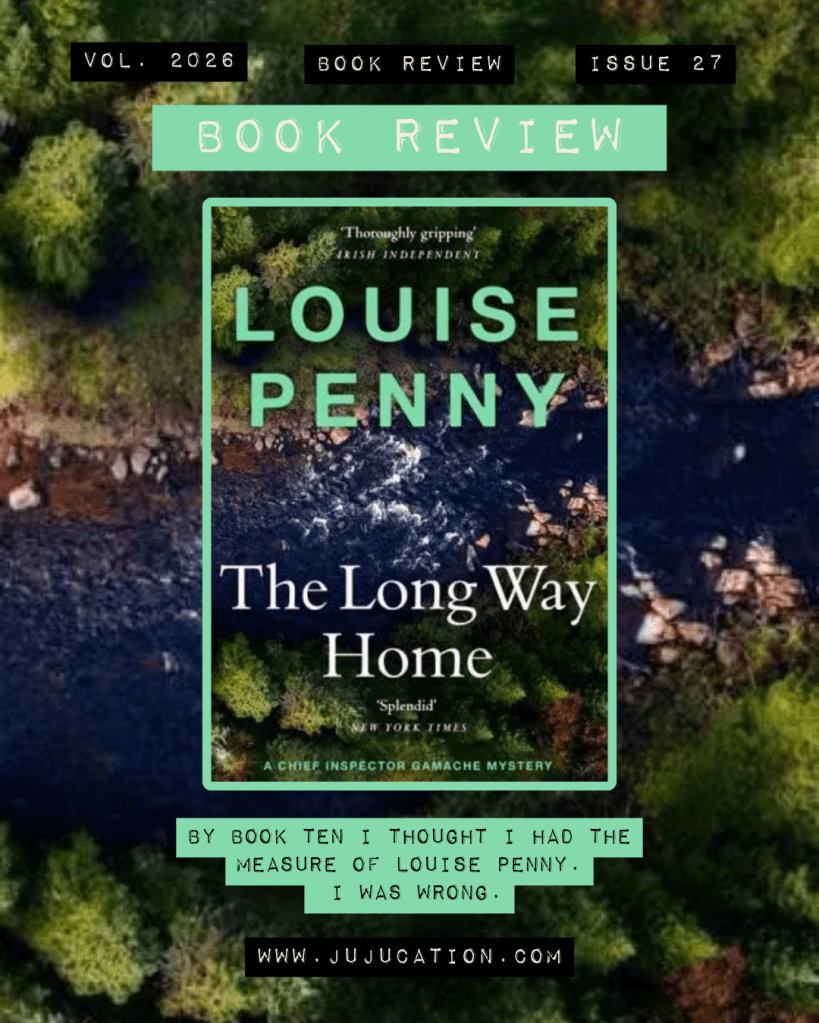
I Thought Book Ten Would Be the Recovery Book
By book ten, I thought I had the measure of Louise Penny.
I had made it through nine books of increasingly precise emotional devastation. I had survived How the Light Gets In, which is what happens when a writer who has been building something for nine books finally detonates it, and which I will not describe further except to say it should come with a recovery protocol and possibly a licensed professional on standby. I arrived at The Long Way Home with the specific confidence of someone who has already been through the hard part.
This is what I told myself. I said: this one will be the exhale. The quiet recovery book. The slow, meditative one after the explosion. I made tea. I settled in.
Penny does not do gentle. She does quiet, and then she takes something from you anyway, and the thing she takes in this one you will not see coming because you were too busy congratulating yourself on surviving book nine.
This is a review of The Long Way Home, book ten in the Chief Inspector Gamache series, which you should read only after books one through nine, and which I am reviewing from the position of someone already ten books deep and fully past the point of maintaining critical distance about these characters.
Where The Long Way Home Fits in the Gamache Series
The Long Way Home is a deliberate gear change after the operatic intensity of book nine. If How the Light Gets In was Penny at full orchestral volume, this is a string quartet in a room above a bistro at dusk. The mystery here is not procedural and the stakes are not institutional. One man is missing. His wife is worried. Gamache, retired and visibly fragile, agrees to help. The book sits closest in spirit to Bury Your Dead (book six), which was also an interior journey dressed as a mystery, and it will divide readers along the same lines: those who want Penny to move the plot forward, and those who understand that in this series, the plot was always the people.
A Missing Husband, A Fragile Detective, and a Journey North
Gamache has retired to Three Pines. Every morning he sits on the village bench with a book that belonged to his late father, a bookmark placed by that father still inside it, and he reads up to the bookmark and stops. He cannot make himself go further yet. He is healing at the pace that healing actually moves, which is slower than any of us plan for and quieter than most books would bother to render.
Clara Morrow’s husband Peter should have returned. A year ago they agreed to separate for twelve months, after which Peter would come back and they would evaluate the marriage. The year has passed. Peter has not come back. Clara doesn’t know if he is lost, hiding, or dead. She asks Gamache to help find out. And Gamache, still fragile, says yes, because that is who he is. A small group of them travel northward through Quebec’s artist communities: Gamache, Clara, Myrna, Jean-Guy, following the trail of a man who had been quietly dismantling and rebuilding himself as a painter under the influence of a charismatic and unstable teacher, chasing something called the Tenth Muse.
What they are actually chasing is the question of what jealousy does to a person over time. The answer, delivered with Penny’s characteristic refusal to be comforting when honest would serve better, is not a reassuring one.
Why This Mystery Feels Different from the Others
- It is a novel about jealousy written with more sympathy for the jealous than they probably deserve.
Peter Morrow is not a villain. He is a talented man who loved his wife and quietly resented her brilliance for years, and then one day her work eclipsed his entirely, and he could not find a way to hold both things at once: love and resentment, in the same body, aimed at the same person. Penny does not resolve this into something neater. She leaves it exactly as complicated as it is. That refusal to simplify is what makes Peter’s eventual fate so genuinely difficult to sit with.
- The pacing is a structural argument, not a failure.
This is a slow book. The clues come through conversations and art and the specific silences that open up in long car journeys through unfamiliar country. If you read it as a thriller it will frustrate you. If you read it as a character study shaped like a road trip, the pacing is the point. Penny is asking you to take the long way home alongside her characters. That is a request, not an accident.
- The setting does emotional work, not just atmospheric work.
Quebec’s artist communities, the rugged Charlevoix coastline, the desolate outpost by the St. Lawrence where everything resolves: these are not backdrop. The landscape mirrors what is happening internally with every character. In this book, where the detective procedural is stripped back and the interior world is foregrounded, the wilderness carries weight that would otherwise belong to plot mechanics. It earns it.
- The bookmark is not a small detail.
Gamache reads to his father’s bookmark and stops. Every morning. He has been doing this since the opening pages. When he finally turns past it at the end, it is not described with great fanfare. It does not need to be. If you have been paying attention, you will feel it the way you feel a door closing quietly in another room. That is Penny at her best: the understated thing that turns out to be everything.
Things I Loved
The Myrna and Clara friendship. These two women have been friends across ten books and Penny has earned every single beat of their dynamic. The scene where Myrna simply stays with Clara without offering solutions is better emotional writing than most novels manage as their entire central thesis.
The letter that never arrived. Peter wrote a letter explaining his delay. It did not get there. The whole architecture of Clara’s year of grief and confusion rests on a failure of postal logistics and the story she told herself about his silence. I thought about this detail for days. It is completely ordinary and utterly devastating.
Gamache’s helpfulness as a form of self-healing. He is not well. He knows it. He helps Clara anyway. The act of doing so moves his own recovery forward in a way that sitting still alone could not. Penny makes this argument quietly and correctly, without underlining it.
Professor Massey as the dark mirror of Peter. Two men, the same flaw, at different stages of its progression. Peter still has love and community to anchor him. Massey has only the wound. Penny’s decision to make Massey the villain rather than Peter is careful, generous, and accurate about how much love can hold a person back from their worst self.
What This Book Is Really About
It is about what happens when you tie your identity to your output and then the output changes on you. It is about whether love survives the discovery that you have not been entirely kind. It is about isolation as the condition that removes the mirrors that would otherwise catch you before you become your worst self.
And it is about the bookmark. About the specific moment when you are healed enough, or brave enough, or simply exhausted by the effort of staying still, to turn the page past the thing you have been protecting yourself from. Penny does not tell you healing is linear. She does not tell you it has a fixed destination. She tells you that there is a moment when staying still becomes a choice you are making rather than a wound you are honoring, and that recognizing the difference is how you find your way home.
I thought about this more than I expected to, given that I started this book believing it would be the easy one.
It is not the easy one.
Who Should Read This / Who Can Skip
Read it if:
- You’ve read books one through nine and you’re ready for Penny to slow down and ask a harder question
- You care more about what jealousy does to the jealous than about how the crime was committed
- You have ever had a creative identity crisis and wanted a novel that takes it seriously without being precious about it
- You trust Penny enough by now to follow her somewhere uncomfortable at a pace she has chosen, not you
- You found Bury Your Dead (book six) satisfying for similar reasons
Save for later if:
- You’re new to the series. Please start with Still Life. This will mean very little without the nine books of emotional investment behind it
- You want plot momentum, twists, and procedural urgency. This is a road trip, not a thriller
- Bury Your Dead (book six) left you cold for similar reasons
Final Thoughts: A Slow Burn That Earns Its Emotional Payoff
The Long Way Home is not Penny at her most propulsive. The mystery is real but thin, and there are stretches through the artist communities where the book is more interested in emotional weather than forward motion. For certain readers, that will be the problem. For me, ten books deep, it was the point.
What the book does with jealousy and artistic identity and the cost of loving someone whose success reminds you of your own limits: this is genuinely good literary fiction. The ending earns its devastation. The bookmark earns its symbolism. Myrna earns every scene she is in, as she always does.
The middle section runs a little long. The villain’s unmasking, while thematically coherent, is not especially surprising. But Penny has never been in the business of surprising you. She is in the business of making you feel the truth before you can argue with it.
That she manages it again in book ten is exactly what I came for.
My Rating: 4.25/5
Earns its slowness by filling it with something real, even when it tries my patience in the middle stretch.
Let’s Talk Gamache
If you have made it to book ten in this series: what did it do to you? And if you are just starting out, Still Life (book one) is a real mystery, a gentle entry point, and nothing that follows it will be quite like it, which is entirely the point. Full review is here. Tell me where you are in the series. I want to know.


