
My thanks to Times Reads Publishing for providing a review copy of What Happens in the Dark by Kia Abdullah.
If this review convinces you to spend several hundred pages questioning your assumptions, revising your judgments, and briefly losing faith in your ability to assess human character, you can find the book through Times Reads Publishing’s stockists and retail partners.
As always, all opinions, courtroom gasps, moral reversals, and strong feelings about cliffhangers are entirely my own.
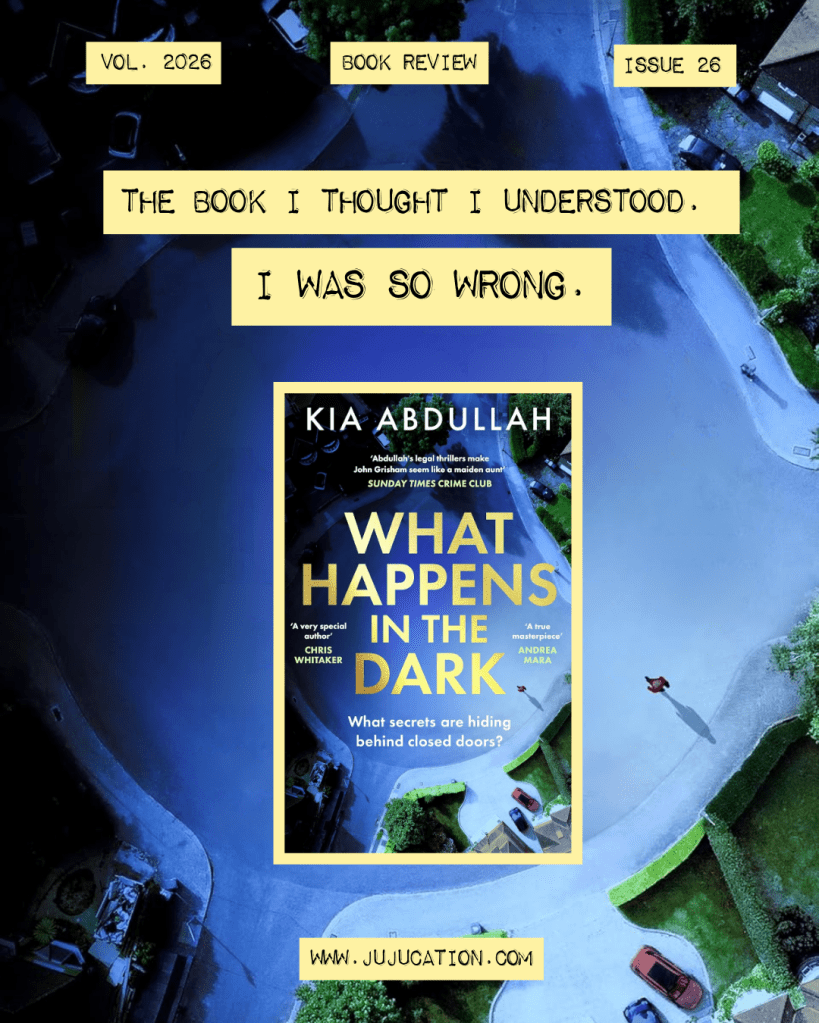
I Thought I Was Getting a Thriller. I Got a Mirror.
I picked up What Happens in the Dark thinking: courtroom drama, twisty plot, maybe a glass of wine and an early night. The kind of read that’s basically popcorn with a spine.
I did not get an early night.
I got 400 pages that kept repositioning where my sympathies were supposed to sit, like someone pulling a chair out from under me every time I got comfortable. By the time I reached the courtroom twist, I had betrayed my own moral compass about four times and was no longer certain I could be trusted with jury duty. Good. That’s the point.
Kia Abdullah does not write thrillers that let you off the hook. I should have known this. I’ve read her before. And yet.
Where This Sits in Abdullah’s Work
If you’ve read Take It Back or Next of Kin, you already know what you’re signing up for: legally precise, socially brutal, emotionally honest crime fiction that is technically a thriller but functions more like a controlled explosion in a room full of comfortable assumptions. What Happens in the Dark continues that tradition and then extends it, because this time it’s the opening of a trilogy. Which is either great news or a threat, depending on your feelings about cliffhangers. (Mine are complicated. I’ll get there.)
The Setup, As I Would Tell It to a Stranger on the Bus
Lily Astor has the kind of life that lives on mood boards. Breakfast TV presenter. Beautiful home. Husband with money. Teenage son she loves.
Then she shows up on screen with a black eye, and then bruises on her arm, and the internet does what the internet does, which is speculate loudly and incorrectly.
Safa Saleem, Lily’s childhood best friend, is having a different kind of year. She used to be a respected journalist. Then she wasn’t. Now she writes for a local paper and is one bad month away from real trouble. When she sees Lily’s bruises, she reaches out. Partly as a friend. Partly as a reporter. Mostly as someone who still hasn’t sorted out the difference.
Then police are called to Lily’s home, and there is a body, and Lily is standing there, and she pleads not guilty and then says absolutely nothing.
What follows is both a courtroom thriller and an investigation into what the people closest to us are capable of hiding. The twist in the court case is real. I won’t spoil it. But I will say it made me put the book down, look at the wall, and reconsider everyone I’ve ever given the benefit of the doubt.
What Makes This Book Different
1. It takes silence seriously as a subject. Not just as a plot device. The book is genuinely interested in why women go quiet: what it costs, what it protects, what gets filled in around the silence by institutions, media, and people who think they’re helping. Lily’s refusal to explain herself is not weakness dressed up as drama. It is a choice that the book treats with the weight it deserves.
2. The “Glassman” subplot earns its place. On paper, running two parallel cases risks feeling like padding or a lecture. In practice, the secondary investigation into attacks on elderly Bangladeshi women who won’t report to police because of shame and community pressure works because it’s doing the same thing the main plot is doing, from a different angle. Both stories are about what happens when the system is not actually designed for you. Abdullah doesn’t explain this. She just builds it, and lets you feel it.
3. The friendship is complicated in ways that feel true. Lily and Safa grew up on the same council estate. Now one of them lives in a house with a wine fridge and a husband who can afford a barrister, and the other is counting her expenses. That gap is never dramatised into something neat. It just sits there, in the way they speak to each other, in the silences that are not comfortable. Resentment and love, occupying the same space. That’s harder to write than it looks.
4. One honest caveat. The cliffhanger ending is a promise, not a resolution. If you want your thrillers to close cleanly, this will frustrate you. I knew it was a trilogy going in, so I had time to prepare. Still annoyed. Proceed with informed expectations.
Things I Loved
The courtroom sequences. They move fast and they matter. Each cross-examination shifts something, and not always in the direction you’d expect.
Lily’s backstory. Her alcoholic mother, her hunger to escape, the way professional armour can become indistinguishable from the real personality. I found her genuinely hard to read and that was the whole point.
The moment that made me put the book down. I’m not going to tell you which one because it’s different for every reader, but mine came during the trial and it involved a piece of information I had misread completely. I sat there with the book face-down on my chest feeling like I’d been lied to, which is exactly what good misdirection is supposed to feel like.
The way it handles guilt. Not as a dramatic confession moment. As the thing that quietly erodes people over years, until they make choices that look irrational from the outside but make a terrible kind of sense from the inside.
What This Book Is Really About
This is a book about what happens when the systems designed to protect people don’t work for them. The media. The courtroom. The community. The family. All of them are institutions that run on narrative, and the people with the least power are the ones whose narratives get shaped for them.
It is also a book about the thing we do to women we like. We decide who they are. We fill in the blanks. We make a story that makes sense to us. And then when the real story turns out to be more complicated, we get angry at them for the inconvenience.
Lily’s silence is an act of resistance. The book understands that. I wanted more readers to understand it too, which is why I’m here writing 1,500 words on a Sunday.
The question it leaves in your chest: who do you believe by default, and why?
Who Should Read This
- You love courtroom drama and want it to have something to say beyond “the system works eventually.”
- Domestic noir is your thing, especially when it refuses to make the women neat or explicable.
- You read Take It Back and still think about it sometimes. (Same.)
- You want your book club to have an actual argument. This will deliver one.
Who Can Skip This
- If graphic depictions of domestic abuse and sexual violence are not something you can read right now, please take care of yourself. The content warnings are not decorative.
- If you need your mysteries to have clean endings and clear heroes, this book will frustrate you sincerely. Abdullah is not interested in easy.
- If you don’t want to start a trilogy in progress. Book two will not exist in your hands yet. That gap is real.
The Bottom Line
What Happens in the Dark is a tightly built, morally serious thriller that trusts its readers to handle complexity without being hand-held through it. The dual narrative works. The courtroom sequences land. The friendship between Lily and Safa feels lived-in and uncomfortable in the right ways.
The cliffhanger is a genuine thing, and depending on your temperament it will read as either an exciting promise or an infuriating betrayal. Know thyself.
It is not a perfect book. The Glassman thread, as well-constructed as it is thematically, takes some time to integrate emotionally into the main story. And the final act moves fast in ways that feel slightly breathless rather than inevitable.
But it is a smart, clear-eyed book that knows exactly what it’s doing. That is rarer than it should be.
Rating: 4 out of 5 stars. I would give it five if I could have the next book in my hands right now, which I cannot, and that is the only complaint I am still holding.
Come Talk to Me
If you’ve read it: whose side were you on by the end? Did it change? I genuinely want to know, because I switched mine twice and I’m still a little embarrassed about that.
And if you want more reviews that make you feel personally targeted by fiction, the subscribe button is right there and it doesn’t bite.
Content Warning: What Happens in the Dark contains depictions and discussions of domestic abuse, coercive control, sexual violence, misogyny, trauma, alcoholism, grief, racism, and violence against women. These themes are handled thoughtfully but directly throughout the novel. Please take care if any of these subjects are difficult or close to home.


