
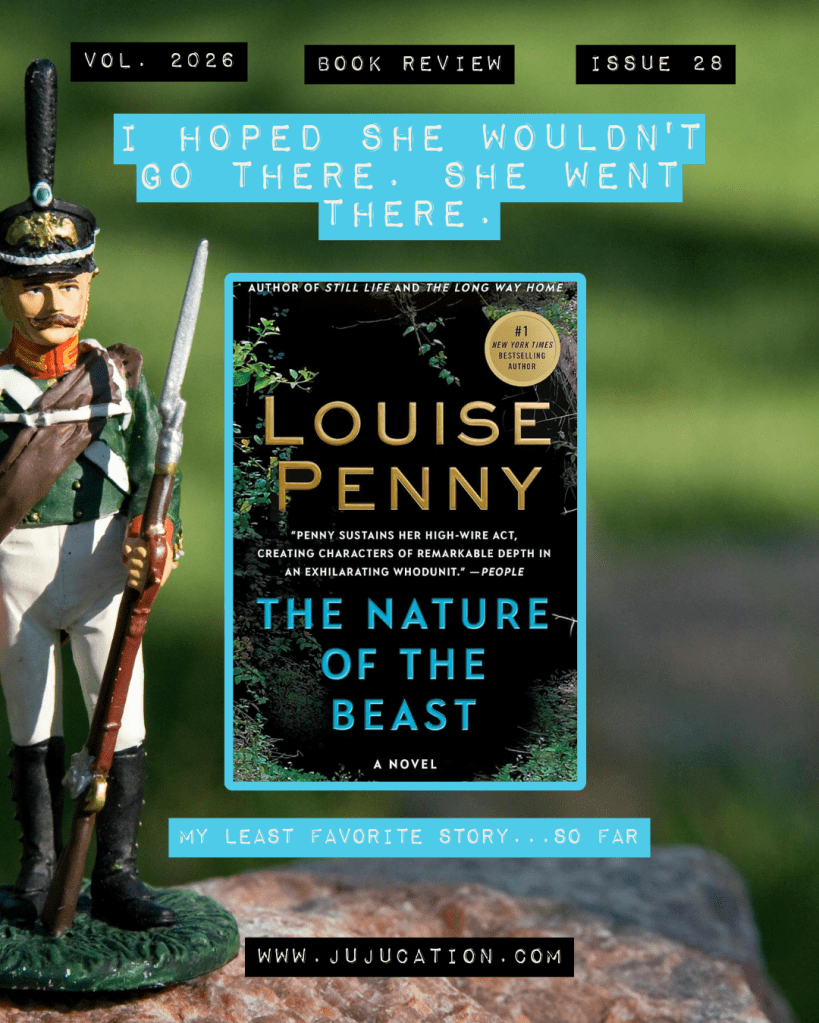
When the Truth Sounds Like Noise
Part of my volunteer work involves sitting with people who have been systematically not heard. People whose truth arrived in a package nobody wanted to open because of the timing, the tone, the history, the body delivering it. You learn fast that the problem is almost never the signal. It’s the receiver.
Laurent Lepage is nine years old and he is the boy who cried wolf. He has told Three Pines about alien invasions, sentient trees, and various forest-based catastrophes with such frequency and conviction that his stories have become ambient noise, the kind the village tunes out the way you tune out a car alarm that’s been going for twenty minutes. When he runs to Gamache with a story about a colossal gun marked with a demonic symbol, the village does what it has always done: it waits for him to stop.
He was telling the truth. Nobody checked.
I want to say something before I get into the full review: I hoped she wouldn’t do this. Louise Penny has built enough trust over eleven books that I followed her into this one without reading ahead, without spoilers, without armor. And then she killed the child. I knew it was coming once the shape of the story became clear, and I still sat with a specific low-grade grief for the rest of the read. That’s not a complaint. It’s what the book earns, and Penny earns it honestly. But I want to name it because pretending it didn’t cost me anything would be a lie, and this review doesn’t do that.
This is book eleven. I have been in Three Pines long enough to know its light in winter, the specific warmth of the bistro, the way Ruth Zardo delivers love sideways so it doesn’t look like love. I came to this book expecting the kind of mystery I had learned to love from Penny: intimate, precise, morally serious. What I got was all of that, plus a Cold War supergun, a serial killer, and a question I am still carrying: what does it cost, exactly, when we decide someone’s voice is probably noise?
The answer is not comfortable. It never is. That’s why I’m still here.
Why This Book Changes the Shape of the Three Pines Series
Books one through nine built Three Pines as a moral refuge, imperfect and occasionally murderous but fundamentally a place where the good life was possible and worth choosing. Book ten, The Long Way Home, pulled Gamache out of institutional authority and into something more exposed: a retired man with no badge, operating on conviction alone. The Nature of the Beast continues that shift and accelerates it. The plot expands to geopolitical scale — Cold War arms dealing, international intelligence, a weapon capable of mass destruction — while Gamache navigates all of it from a village that still has a duck pond and a cantankerous resident poet. The tonal tension this creates is not accidental. It is the argument.
A Child Warned Everyone. Nobody Listened.
Laurent Lepage has been crying wolf for so long that when he finds the real wolf, nobody moves.
The gun he describes is not metaphorical. It is a surviving prototype from Project Babylon, a real Cold War program run by Canadian ballistics genius Gerald Bull, who was building a supergun capable of launching satellites and, less officially, capable of reaching targets from extraordinary distances. Bull was assassinated in Brussels in 1990, almost certainly because he was selling designs to Saddam Hussein. Penny takes this documented history and makes it personal: the man who actually did the intellectual heavy lifting on the project while Bull took the credit and eventually the bullet was Guillaume Couture, late uncle of Antoinette, who lives quietly in Three Pines, which is not quiet for long.
The plans for the completed gun still exist. The only person who knows where they are is John Fleming, a serial killer currently in prison who is delighted to have leverage over the one man he respects enough to want to destroy.
Gamache has to decide whether to use a monster to stop a catastrophe. Penny has never been interested in making that kind of decision clean.
Four Reasons This Mystery Hits Harder Than Most
1. The Cold War History Feels Disturbingly Real
Gerald Bull was real. Project Babylon was real. The assassination happened. Penny doesn’t treat this as a plot convenience. She treats it as a genuine moral inheritance, a loose end from the Cold War that nobody closed, sitting in a forest in Quebec, waiting. That factual spine gives the thriller elements a weight that purely invented stakes rarely manage.
2. John Fleming Remains Terrifying Because Penny Uses Him Sparingly
Fleming appears in relatively few pages and is all the more frightening for it. Penny understands that a monster given too much screen time eventually becomes a performance. His power is in what he knows, what he withholds, and the specific pleasure he takes in watching Gamache navigate an impossible choice. She doesn’t let him monologue his way into being less terrifying.
3. Laurent’s Death Refuses to Become a Plot Device
The case gets solved. The killer gets named. But the grief of a nine-year-old boy whose truth was mistaken for imagination does not get tidied away by the plot. Penny refuses to let the mystery close that wound. It stays open, the way some losses stay open, which is the most honest thing she could have done with it. It also meant I read the last quarter of this book with a weight that the thriller mechanics couldn’t lift.
4. Ruth Zardo Finally Breaks Your Heart in a New Way
This is not a minor thing for series readers. Ruth, the village poet who functions as a grief-calcified Greek chorus across eleven books, is given a glimpse of the younger woman she was before life took what it took. It’s a few paragraphs. It lands like a whole chapter.
The Moment I Realized Penny Wasn’t Going to Save Him
I did not want it to be the child.
I know that sounds naive for a mystery series. People die in these books. That is the premise. But there is a specific kind of dread that sets in when you realize the arc of a story is pointing at a child, and I kept hoping Penny would find another way. She didn’t. She was right not to. The whole point of Laurent is that his death lands the way it does because nobody took him seriously while he was alive, and if Penny had found a way to save him at the last minute she would have softened the very argument she was making. I understand this. I still closed the book for a few minutes and looked out the window at nothing in particular.
My volunteer work involves sitting with people whose signals have been filed away as noise by the systems that were supposed to catch them. Laurent is not an abstraction to me. He is every child I have sat across from who told a true thing in the wrong way at the wrong time to the wrong receiver. Penny didn’t have to go there. She went there because the book required it. I respect that. It still cost me something. Both of those things are true.
The Choices and Characters I Couldn’t Stop Thinking About
Gamache Chooses the Least-Worst Option
Not because it was right. The novel doesn’t argue it was right. Because Penny shows the full cost and lets him carry it without absolution. He makes the call. He lives with it. Nobody congratulates him.
Jean-Guy’s Quiet Act of Moral Courage
Thriller plots usually treat this as a climactic triumph. Penny treats it as what it actually is: a man choosing not to be the kind of person who keeps that kind of power in the world. It’s quiet and it’s enormous.
Why the Bistro Still Matters Eleven Books Later
Eleven books in and I still want to be in that room. Penny knows the warmth is not decoration. It is the argument. The warmth is what makes the darkness matter.
Ruth’s Past Changes Everything
I have loved Ruth for eleven books in the way you love someone who will never be soft with you and is somehow safer for it. Seeing who she was before felt like being handed something I hadn’t known I needed.
The Real Beast Isn’t the Villain
Penny named it carefully. The nature of the beast is not the supergun. It is not Fleming. It is not even the specific evil that killed Laurent. It is the human tendency to decide, systematically and often unconsciously, which signals count as signal and which count as noise. Laurent counted as noise. His truth was perfectly intact. What failed was the collective receiver.
The book also argues, quietly, under all the thriller mechanics, that paying attention is a practice, not a talent. Gamache is good at it not because he is brilliant but because he makes it a discipline. He listens to people others have stopped hearing. He waits. He takes seriously what has been dismissed. In bibliotherapy terms, you’d call this witnessing. Penny calls it the job.
What she leaves you with is the question in both directions: who have you stopped hearing, and who is actually hearing you?
Should You Read The Nature of the Beast?
Read It If…
- You’re reading the series. This is load-bearing for what follows, not optional.
- You enjoy Donna Leon, Jacqueline Winspear, or John le Carré and want something that lives in that moral territory.
- You’re interested in Cold War history and the actual Gerald Bull story. The fictional extrapolation is worth it.
- You want a mystery that argues something about human nature and earns the argument with plot.
Skip It For Now If…
- You haven’t read the earlier books. Fleming’s return requires prior emotional investment.
- The death of a child is a hard stop for you right now. Penny handles it with care, but she does not soften it.
- You prefer tightly contained village mysteries. This one goes wide and some readers feel the stretch.
- You want fast-paced, action-first thrillers. Penny is ruminative. She always has been. That’s the deal.
Final Verdict: Louise Penny’s Most Devastating Lesson About Listening
The Nature of the Beast is not Penny’s coziest book and it’s not trying to be. There are moments where the geopolitical thriller and the village mystery are pulling in slightly different directions and you can feel the seam. The CSIS thread is left deliberately ambiguous in a way that will satisfy some readers and frustrate others. And the victim is a child.
I had hoped she wouldn’t go there.
She went there because the book required it.
She was right.
And I still needed a few minutes at the window when it happened.
That’s not a flaw in the novel. That’s the novel working exactly as intended.
Essential reading if you’re in the series. Not where you start if you’re not. But it might be where you understand what she’s been building all along.
Rating: 4.5 / 5 stars
Half a star off for the moments where the scale strains against the intimacy. Full marks for making me close the book and look out the window like the grown adult I allegedly am.
A Question I’ve Been Carrying Since Finishing the Book
Has an author ever made a choice in a book that you hoped they wouldn’t make — and turned out to be right to make it anyway?
Tell me in the comments. That’s the specific kind of trust a good novelist builds and then spends. I’m still thinking about what it means that I’d follow Penny anywhere, including places I didn’t want to go.
If you’d rather get this kind of thing directly instead of hoping the algorithm is having a good day, the subscribe link is in the footer.
No schedule promises.
Always this honest.


