
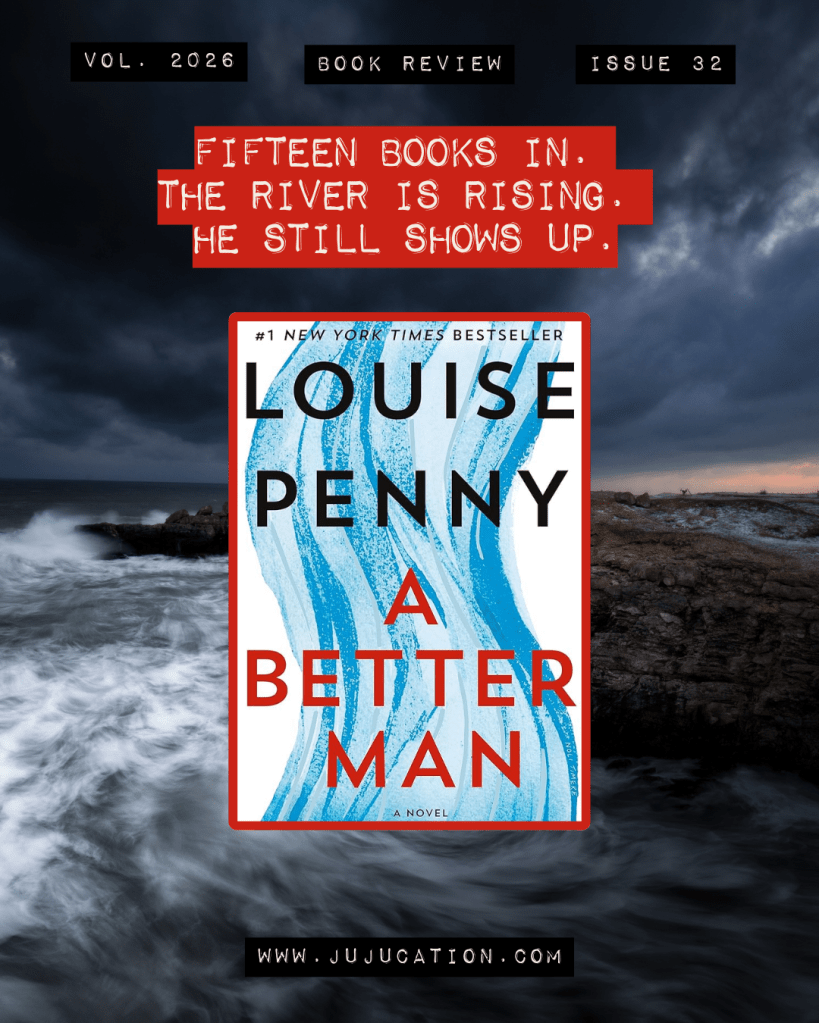
Here is what I know about myself at this point in the Gamache series: I have cried over a fictional dog, I have started using the phrase “the Gamache philosophy” in sentences that are not jokes, and I have read fifteen books set in a Quebec village that does not exist and somehow feels more real than most places I have actually been. This is not who I planned to be. I’m a Customer Success Manager at a cybersecurity company. My days involve dashboards and threat actors and explaining to rooms full of people why they should care about phishing. I need beauty that is not a dashboard. Louise Penny is, apparently, my dashboard antidote.
If you are also fifteen books in, you understand that we are past introductions. You know Three Pines. You have opinions about Clara’s art career. You have accepted Olivier and Gabri as family, the irritating kind you wouldn’t trade. I am writing this review from inside the series, not from the outside looking in, and if you are new here, please start with Still Life (#1) and come back. I’ll wait.
For the rest of us: let’s talk about A Better Man, which is a very good book pretending to be a murder mystery about a missing woman, when it is actually a sustained meditation on what remains of a person when you take everything away.
Where This Fits in the Penny Universe
Book 15 is a recovery. Kingdom of the Blind (#14) was structurally unwieldy in a way that longtime fans largely forgave, because by book fourteen you’ve earned the emotional credit to absorb a stumble. A Better Man returns to what Penny does better than almost anyone in this genre: one tight human tragedy, a small cast with real weight behind them, and Three Pines functioning as both setting and argument. It does not reach the heights of Glass Houses (#13), which remains Penny’s most formally ambitious work and the point in the series where you realize she was always writing toward something. But it more than redeems the wobble of #14, and it does so by doing the most Penny thing possible: stripping away everything extraneous until only the essential question remains. In this case: what do we owe each other when the institutions we built to enforce that obligation break down?
The Setup
Homer Godin contacts the Sûreté because his pregnant daughter Vivienne never arrived at his house. She had been living with Carl Tracey, a potter with a documented history of abuse and the specific malevolent energy of a man who is used to not being stopped. Gamache takes the case despite being technically demoted, sharing a position he held at the very beginning of his career, and being the subject of a coordinated online harassment campaign that the novel depicts with uncomfortable accuracy about how that particular machinery actually operates.
The Bella Bella River is rising.
Penny does something formally smart here: she never announces what the flood represents. It just rises, steadily, throughout the entire novel, eventually threatening Three Pines itself, forcing everyone to drop their investigations and their grievances and fill sandbags together. Then it recedes. And what it reveals when it does is not what anyone expected. She trusts the reader to notice that this is doing double work without underlining it. That trust is one of the things that separates literary mystery from genre mystery, and Penny exercises it with complete confidence.
What Makes This Book Different
1. The demotion is the actual subject of the novel. Most long-running mystery series treat their protagonist’s professional setbacks as temporary inconveniences the plot will eventually resolve. Penny is genuinely interested in what happens to a person’s character when external authority is removed, and she finds, in Gamache’s case, that the answer is: nothing. He is still himself. He takes the unauthorized case. He buys the dog. He shows up. The novel asks whether that kind of consistency is a form of heroism or simply a personality trait, and it is honest enough not to fully answer.
2. The red herring is also a moral indictment. Carl Tracey is obviously abusive and believably monstrous, and Penny leans into the reader’s certainty that he is the killer. She lets us sit in that certainty and find it comfortable. Then she asks us, very quietly, to examine what we were doing when we were that sure. The whodunit resolution is not the point. The point is that she constructed the mystery to demonstrate that our most righteous instincts can make us sloppy thinkers, which is true in mysteries and also in most things.
3. The social media thread is not a subplot. Clara’s online pile-on and Gamache’s harassment campaign run in parallel throughout the book. Penny is not treating internet cruelty as a contemporary nuisance she’s obligated to acknowledge. She is arguing that it is a specific and targeted form of violence, one that operates with perfect plausible deniability, and she makes this argument through two characters we already love without letting the theme overwhelm the story.
4. Fred. Vivienne’s dog, inherited by Gamache mid-investigation, is a formal achievement. A grieving animal who does not understand grief is one of the most efficient emotional delivery mechanisms in fiction, and Penny knew exactly what she was doing when she put him in this book. I have no further comment on Fred. I am simply noting that he is there and that he functions perfectly.
Things I Loved
The moment Gamache buys Fred from Tracey. It is completely outside his purview. It is professionally irrelevant. He just does it, and Penny gives him no internal monologue about why. The action speaks for itself, and she trusts it to. This is the Gamache move: the correct thing, quietly, without ceremony.
Beauvoir as Gamache’s superior. This dynamic is handled with exactly the right ratio of humor to tenderness. There is a scene where Gamache asks permission for something he would have approved in under thirty seconds six months ago, and Beauvoir’s discomfort is so legible it’s almost painful. Almost.
The flood as structure. The river rises in real time across the entire novel, and Penny never once pauses to explain what it means. This is the correct literary decision.
Clara’s smaller paintings and the internet’s inability to tolerate them. The art world is brutal about artists who change direction. Clara’s quiet, intimate new work is not a retreat. It is a refinement. That the internet reads it as failure is the most realistic element in the book, and also the most infuriating.
What This Book Is Really About
Penny is arguing, across fifteen books now and most explicitly in this one, that goodness is not an absence of suffering. It is a practice maintained in the presence of it.
Gamache returns to work humiliated. He takes the unauthorized case. He buys the dog. He holds Homer Godin back from doing something irreversible not because the law requires it but because he understands, with the quiet certainty of a person who has thought about this for a long time, that vengeance will not return what Homer has lost. The thing the law could not do, Gamache does with presence and patience.
The question this book leaves in your chest is not who killed Vivienne Godin. It is: what does it cost to be this kind of person, and do you have those reserves? The honest reader finishes this book and thinks about the last time they had the opportunity to choose the expensive option and what they actually did.
Who Should Read This / Who Can Skip
Read this if you:
- Are already in the Gamache series (this is required reading, full stop)
- Enjoy literary mystery with genuine emotional weight over plot velocity
- Read Ann Cleeves, Peter Robinson, or Tana French and want something with a warmer moral center
- Are interested in domestic violence, grief, or institutional failure handled with intelligence and care
- Need a book that treats you like an adult
You can probably skip it if you:
- Are new to the series. Please start with Still Life (#1). I mean this kindly and completely.
- Need fast, tightly plotted thriller pacing over interior character work
- Are currently raw on domestic abuse themes. The book is not graphic, but it is not gentle either.
- Prefer your mysteries to stay cleanly in genre territory without philosophical detours
The Bottom Line
A Better Man is not Louise Penny’s best book. Glass Houses is her best book, and if you haven’t read it, that’s a conversation for another review. But this is a strong, emotionally honest return after the sprawl of Kingdom of the Blind, and it does the thing that matters most in a long-running series: it makes you care about people you already know in a new way. The flood is well deployed. Fred is perfect. Gamache’s demotion carries the weight it should. The mystery’s resolution is not the point, and Penny seems entirely aware of this.
If you are fifteen books in, you are already going to read it. I’m here to confirm it’s worth the evening.
Rating: 4 out of 5 stars Four stars because it earns genuine emotion without manufacturing it, and one missing star because Penny has written transcendent before, and this is very good, which is a different thing.
Let’s Talk
Which fictional character’s way of moving through the world has stayed with you? Not their story specifically, just the way they are? Mine is apparently a sixty-something Quebec detective and I’ve fully made my peace with that. Would love to know more about yours in the comments.


