
Okay. So. I need you to sit down for this one.
I have reached a point in my mystery-reading career where I am no longer satisfied with simply knowing whether a fictional detective will solve the murder. Apparently, that was too straightforward for me. My brain has decided that the real question is whether this person would be tolerable in a WhatsApp group chat.
This is how I now read books. I will be halfway through a perfectly respectable murder investigation, someone will discover a body in a picturesque English village, and instead of thinking, Who could possibly have done this?, I will find myself wondering, Would Miss Marple use a reaction emoji?
I blame the internet, obviously.
There is something about spending enough time with fictional detectives that eventually makes you start imagining them outside the very specific circumstances in which they were created. We know how they behave when somebody is murdered. We know how they interview suspects, interpret clues, follow people, notice inconsistencies and generally make the rest of us feel inadequate about our observational skills.
But what happens when nothing is happening?
What happens when someone in the group chat says, “Does anyone know if Gerald from downstairs moved my bins?”
That is the question that has apparently been keeping me awake.
I did not choose this line of inquiry. It simply happened to me, the way a raccoon happens to your garbage. One minute everything is fine, and the next there is an animal rummaging through things it absolutely should not be rummaging through.
So I did what any reasonable person would do.
I created a fictional group chat containing eleven fictional detectives.
In my head.
And then I ranked them.
This is not literary criticism. There is no scholarly framework here. Nobody has given me a grant. I have not consulted primary sources, interviewed experts or conducted a double-blind study.
I have, however, read a frankly irresponsible number of mystery novels and developed very strong opinions about how fictional detectives would behave on their phones.
So I think we can all agree that the methodology is sound.
The Case File
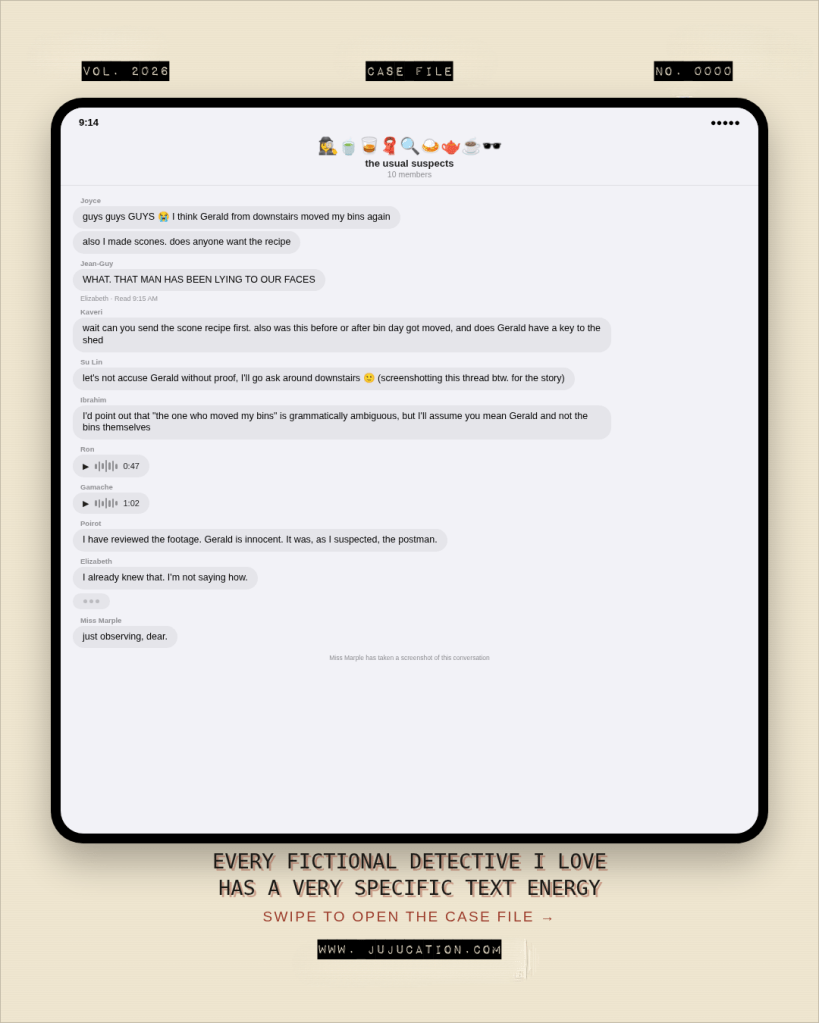
For the purposes of this investigation, let us reconstruct the incident that started it all.
The group chat was called the usual suspects, because subtlety has never been my strongest quality.
It began with Joyce.
Joyce: guys guys GUYS 😭 I think Gerald from downstairs moved my bins again
Joyce: also I made scones. does anyone want the recipe
Jean-Guy: WHAT. THAT MAN HAS BEEN LYING TO OUR FACES
Elizabeth · Read 9:15 AM
Kaveri: wait can you send the scone recipe first. also was this before or after bin day got moved, and does Gerald have a key to the shed
Su Lin: let’s not accuse Gerald without proof, I’ll go ask around downstairs 🙂
Su Lin: also screenshotting this thread btw. for the story.
Ibrahim: I’d point out that “the one who moved my bins” is grammatically ambiguous, but I’ll assume you mean Gerald and not the bins themselves
Ron: 🎙️ Voice Memo · 0:47
Gamache: 🎙️ Voice Memo · 1:02
Poirot: I have reviewed the footage. Gerald is innocent. It was, as I suspected, the postman.
Elizabeth: I already knew that. I’m not saying how.
typing…
Miss Marple: just observing, dear.
Miss Marple has taken a screenshot of this conversation.
At this point, I knew I had a problem.
Because I could see it.
I could see exactly how each of them would behave, and once I could see it, I could not unsee it.
This is one of the strange pleasures of reading a lot of fiction. Eventually the characters become familiar enough that you start filling in the spaces the author didn’t write. You know what they would order at a café. You know who would arrive early. You know who would pretend not to care about birthdays but secretly be touched when someone remembered theirs.
And, apparently, you know who would weaponise read receipts.
A Word on My Highly Scientific Methodology
There was no methodology.
I would like that to be clear from the beginning.
I read the books. I formed feelings. The feelings became opinions. The opinions somehow became a ranking system out of ten. I then spent an unreasonable amount of time defending those rankings to myself, despite the fact that I invented the criteria while sitting on my sofa.
I assessed each detective according to several extremely important questions. Would I actually want them in a group chat? Would they make the conversation better or substantially worse? Would they know when to stop talking? Would they send voice notes? Would they respond to an emergency with useful information or simply increase everyone’s blood pressure?
Most importantly, if the group chat became unbearable, would I be able to mute them without feeling guilty?
Because let us be honest. Friendship is important, community is important, human connection is important.
But so is the mute button.
With that established, here are my findings.
1. Miss Marple | 9/10
Miss Marple is the person in the group chat who makes you forget that silence can be an active form of participation. She would not be one of those people who feels compelled to respond to every message, nor would she send a thumbs-up emoji just to acknowledge that she has seen something. She would simply observe, and I think everyone else would make the mistake of assuming that because she isn’t talking, she isn’t paying attention.
This is an understandable mistake because most of us have been trained to think of silence as absence. If somebody doesn’t respond, we assume they’re busy, uninterested, distracted or dead. We don’t generally assume that they have read the last 87 messages, remembered something someone said three weeks ago and quietly connected it to a completely unrelated detail from Tuesday.
Miss Marple would.
She would allow everyone else to perform their theories. Jean-Guy would immediately accuse Gerald. Joyce would say she didn’t think Gerald seemed like that sort of person because he had once helped her carry groceries. Poirot would object to the lack of evidence and then proceed to solve the entire thing anyway. Ibrahim would become distracted by someone’s incorrect use of “literally.” Miss Marple would sit there, probably drinking tea, watching everyone reveal exactly how little they actually know.
Then, at some completely unreasonable hour, she would send one message.
Miss Marple: Gerald’s wife mentioned the bins last Tuesday.
That’s it.
The group chat would freeze because now everyone has to scroll back. Who mentioned the bins? When? Why? How does Miss Marple remember this? More importantly, why did she notice it in the first place?
That is the thing about Miss Marple. She understands that people reveal themselves through ordinary behaviour. She does not need the dramatic confession or the suspicious footprint in the mud. She notices the little things people assume are meaningless.
I think that would make her both fascinating and terrifying in a group chat. She would also be the person I would be most afraid to lie to. Not because she would call you out immediately. That would almost be easier. She would probably just say, “Oh, I see,” and then continue being perfectly pleasant.
Which is much worse.
I would never test Miss Marple. I wouldn’t even joke-test her. She has time, she has tea, and she has already figured you out.
2. Armand Gamache | 9/10
Gamache would be the person you want in the group chat when everything has gone completely off the rails. Every group chat eventually reaches that point. Someone misunderstands a message. Somebody else gets offended. A third person starts explaining why they are not offended while clearly being extremely offended. Jean-Guy has written something in all caps. Someone has left the group. Someone else has added them back. There are now 63 unread messages and you are seriously considering throwing your phone into a river.
This is when Gamache appears.
He would not rush in. He would not add to the noise. He would probably read every single message before saying anything, which I find both impressive and slightly intimidating.
Then he would send a voice note. Not an unnecessarily long one, not a “listen to this when you have time” 14-minute monologue, but something measured, calm and thoughtful. He would acknowledge what has happened, ask everyone to take a breath, and somehow make the entire group feel slightly less insane.
I think what makes Gamache particularly effective is that his authority does not seem to come from needing to dominate other people. He listens. He makes people feel heard. He understands that being intelligent isn’t particularly useful if you cannot make other people feel safe enough to tell you the truth.
That would make him the unofficial therapist of the group chat, which is unfortunate because I don’t think he signed up for that.
Someone would inevitably message him privately at 11:43pm.
“Can I ask you something?”
And Gamache, because he is Gamache, would answer.
He would probably give thoughtful advice. He would probably ask the right questions. He would probably help you understand what you were actually upset about.
I would hate how effective this was.
He is also the only person in this group I trust to de-escalate Jean-Guy. That alone deserves the nine.
3. Hercule Poirot | 8/10
Poirot would be absolutely unbearable, and I need to establish this before anyone accuses me of being seduced by the moustache.
He would use complete sentences. He would use punctuation. He would probably correct your punctuation. This is already a problem.
Imagine the group chat is actively discussing a suspicious death and someone types, “GUYS I THINK I FOUND SOMETHING.”
Poirot would respond:
“My dear friend, you have indeed found something. Whether that something is relevant remains to be determined.”
Nobody asked. Nobody wanted the linguistic preamble. And yet, somehow, everyone would stop talking and listen.
That is the irritating thing about Poirot. He has earned the right to be annoying because he is so often correct.
He would absolutely send voice notes. They would be structured. There would be sections. “First, we must consider the timeline. Second, we must examine the testimony. Third, there is a small detail which I believe you have overlooked.”
A small detail which, naturally, turns out to be the entire case.
I can imagine everyone in the chat complaining about him while simultaneously waiting for his next message. He would be the friend you roll your eyes at until something actually goes wrong. Then suddenly you’re like, “Okay, Poirot, what do you think?”
And he would know.
Of course he would know.
He would also somehow make you feel slightly embarrassed that you hadn’t noticed the thing yourself.
That is the Poirot experience. You resent him, you admire him, you resent yourself for admiring him, and then he solves the murder.
4. Kaveri Murthy | 8/10
Kaveri would become the group chat’s unofficial project manager approximately seven minutes after being added. Nobody elected her. There would be no discussion. It would simply happen.
Joyce would say, “I think Gerald moved my bins,” and Kaveri would immediately begin asking questions. What time did you notice? Which bins? Where were they before? Who had access to the shed? Was Gerald actually home? Did anyone else see him? Has this happened before? Also, Joyce, you said you made scones. Is that the recipe with buttermilk?
This is the kind of multitasking that makes me tired just imagining it.
Kaveri would never be satisfied with “I think.” She would want to know. Not because she is trying to be difficult, but because she understands that assumptions are how you end up spending six hours investigating the wrong person.
This would be incredibly useful. It would also make me want to put my phone on airplane mode.
There is something slightly intimidating about people who can ask twelve consecutive questions without becoming overwhelmed by their own questions. I am not one of those people. I ask one question and then immediately start worrying that I sounded too intense.
Kaveri does not have this problem.
She would be direct. She would be curious. She would want the facts. And when she finally figured everything out, she would probably explain it in a way that made you realise the answer had been sitting in front of you the entire time.
I would want her on my side. I would also need occasional breaks from her.
Both things can be true.
5. Su Lin | 8/10
Su Lin is dangerous because she looks like the reasonable one. She would be the person replying, “Let’s not jump to conclusions 🙂”
The smiley face is doing a lot of work here.
Because while everyone else is arguing, Su Lin is quietly gathering information. She is asking the neighbours. She is checking dates. She is looking at screenshots. She is probably making notes. She may even have a folder.
The folder is called something innocuous like Neighbourhood Stuff, because she doesn’t want anyone to know that she has created a detailed chronology of Gerald’s movements.
This is what I like about her. She isn’t dramatic about being observant. She doesn’t need to announce that she’s smarter than everyone else. She simply pays attention.
And when the group inevitably discovers that Gerald was innocent, Su Lin will not say, “I told you so.”
She will just send a screenshot.
And isn’t that much more devastating?
I think there is a particular kind of person who appears calm because they have already considered all the possible ways things could go wrong. Su Lin feels like that person. She is not calm because she doesn’t care. She’s calm because she cares enough to prepare.
That is a very different kind of calm.
And honestly, I would probably trust her with my life.
I just wouldn’t send her anything I didn’t want archived forever.
6. Elizabeth | 8/10
Elizabeth would make me anxious. Not because she would be unpleasant. Actually, I think she would be perfectly pleasant.
That is the problem.
She would read everything. She would not necessarily respond. She would not react to every message. She would not tell you what she was thinking.
You could send an entire paragraph explaining your theory and get:
Read 9:15 AM
Nothing else.
Then somebody else would say something completely unrelated, and three hours later Elizabeth would respond:
“That’s interesting.”
Now everyone is scrolling back through the conversation trying to figure out what she knows.
This is a person who has weaponised withholding.
The rest of us tend to think communication means telling people things. Elizabeth understands that sometimes information is power precisely because you don’t give it away.
I would find this fascinating in a fictional character.
I would find it exhausting in a friend.
Imagine telling her something confidential and then wondering whether she already knew it before you told her. I would never survive.
She would also be the person who somehow has access to information nobody else has.
Someone says, “Does anyone know who Gerald’s brother is?”
Elizabeth:
“Yes.”
And then nothing.
That’s it.
No explanation. No context. Just enough information to make everyone else deeply uncomfortable.
She would know everything.
She would tell you almost nothing.
And somehow, from Elizabeth, that’s acceptable.
7. Joyce | 8/10
Joyce is the one I would actually want around all the time.
She would be chaotic. She would send too many messages. She would absolutely use emojis. She would probably accidentally send a photo of her lunch into the middle of a serious investigation.
But she would also make the group feel like a group.
And that matters.
Because fictional detectives can sometimes become so focused on solving the mystery that everyone around them starts feeling like a collection of suspects.
Joyce would remember that people are people. She would ask how someone was doing. She would bring food. She would notice that somebody hadn’t been talking much. And, because she is paying attention in a way that doesn’t look like investigation, she would occasionally notice something everyone else missed.
She might say:
“Oh, Gerald? He told me he was going to the dentist that afternoon.”
And suddenly everyone would stop.
Because Joyce wasn’t trying to solve the case.
She was just chatting.
I think there is something lovely about that. Not every important observation comes from someone standing dramatically beside a crime scene with a magnifying glass. Sometimes you notice things because you are living your ordinary life and actually paying attention to the people around you.
Joyce would be the heart of the group. She would also be the reason everyone stayed.
Because even when the conversation became exhausting, there would always be a message from Joyce asking if anyone wanted scones.
Scones (and other baked goods) are very much welcome.
8. Jean-Guy Beauvoir | 7/10
I say this with affection, but Jean-Guy would be the group chat menace.
He would react immediately. Not after considering the evidence. Not after reading the entire conversation. Immediately.
Someone would write, “I think Gerald might have moved the bins.”
Jean-Guy:
WHAT
Then:
THAT MAN HAS BEEN LYING TO US
Then:
I KNEW SOMETHING WAS OFF
Someone would inevitably ask, “What exactly was off?”
Jean-Guy would not have an answer.
He would have a feeling.
This is the problem with having a detective in the group chat who is also a human being with emotions. He would care deeply. Sometimes too deeply. He would get angry because he thinks somebody has been treated unfairly. He would get defensive. He would say something too quickly.
And then, once he realised he was wrong, he would actually apologise. Which is what I appreciate about Jean-guy.
I think Jean-Guy’s charm is that he is allowed to be imperfect. He can be reactive and stubborn and occasionally spectacularly wrong, but he isn’t incapable of reflection.
He would probably send a message later saying:
“Okay. I overreacted. Sorry.”
And then everyone would accept the apology because, underneath all the shouting, he genuinely meant it.
Of course, three days later, he would do the exact same thing.
But that’s Jean-Guy. He shows that apparently growth is non-linear.
9. Ron | 7/10
Ron does not believe in typing. This is his first offence.
Everything is a voice note. You ask a simple question. He sends 47 seconds.
You brace yourself.
The first 20 seconds are completely unrelated. He starts telling you about something that happened when he was younger, takes a brief detour into a story about someone you have never heard of, laughs at his own memory, and then eventually arrives at the point.
And the point is useful. This is what makes Ron so difficult.
If he were simply annoying, I could remove him from the group. But he isn’t. He has that strange quality some people possess where their brain appears to operate in a completely different sequence from everyone else’s, but occasionally that sequence produces something brilliant.
He would derail conversations constantly. He would accidentally reveal important information. He would probably send a voice note while driving even though everyone has told him not to.
I would mute him.
But I would not remove him.
Because when something actually happened, I would want him there.
10. Jules Maigret | 7/10
Maigret would barely participate.
At first, this might make you think he wasn’t interested. He would be interested. He just wouldn’t see the point of talking for the sake of talking.
While everyone else was developing increasingly elaborate theories about Gerald, Maigret would be watching.
He would be interested in the people, not just the evidence. Not just the timeline. Not just whether someone could have done something. Why would they? What would make a person behave that way? What are they afraid of? What do they want?
Eventually, after the group has produced approximately 900 messages, Maigret would send:
“Why did Gerald move the bins?”
And everyone would stop.
Because that is the question nobody had actually asked.
Everyone had been focused on whether Gerald did it. Nobody had asked why.
That is what I love about good detectives. The best investigations aren’t always about discovering who is lying. Sometimes they are about understanding what makes people lie in the first place.
Maigret would probably find the entire group chat exhausting.
Honestly, same Maigret, same.
11. Ibrahim | 6/10
I want it established that Ibrahim would be useful. He would also make me want to scream.
Someone would be having an actual emergency and Ibrahim would respond with a paragraph explaining that the terminology they were using was technically inaccurate.
Sir.
There is a murderer.
Please read the room.
But then, when everyone is convinced Gerald was at the wrong place at the wrong time, Ibrahim would notice that the timeline doesn’t work. He would point out the discrepancy. He would explain it. At length.
Nobody would appreciate the length. Everyone would appreciate the information. That is Ibrahim’s curse.
He is often right in ways that make him difficult to enjoy. But perhaps there is something useful about that too. Not everyone who helps us is pleasant about it. Sometimes the person who tells you that your theory doesn’t make sense is the person saving you from spending another three hours defending something that was never true.
I would keep Ibrahim in the group chat. I would, without shame, mute him occasionally. I would then unmute him when something serious happened.
This is friendship. Or at least my version of it.
The Final Report
After extensive investigation, questionable methodology and several hours I could have spent doing literally anything else, I have reached my final conclusions.
Miss Marple would know the answer before anyone had properly established the question. Gamache would somehow make everyone feel calmer without ever sounding like he was trying to manage them. Poirot would solve the mystery while making you feel mildly inadequate about your punctuation. Kaveri would ask enough questions to make the truth eventually surrender.
Su Lin would have the screenshots. Elizabeth would have information she was absolutely not going to share. Joyce would bring warmth, baked goods and the one crucial piece of evidence nobody else had noticed. Jean-Guy would accuse the wrong person, realise his mistake and then do something similar again two days later.
Ron would send a voice note that should have been a text but would somehow contain exactly the information everyone needed. Maigret would ask one simple question that would make the rest of the conversation look completely ridiculous. And Ibrahim would tell us all that “murder mystery” is technically redundant.
The more I think about this completely unnecessary exercise, the more I realise that this is probably one of the reasons I love reading mysteries in the first place.
Eventually, fictional characters stop being fictional in quite the straightforward way we imagine.
We spend enough time with them that we begin filling in the gaps.
We imagine what they would be like when they aren’t working. We imagine what they would order at a café. We imagine whether they remember birthdays, whether they text back immediately or three business days later, whether they know how to use GIFs, whether they would send “K” and then wonder why everyone is upset.
And yes, apparently, whether they would be useful in a WhatsApp group chat about suspicious bins.
There is something ridiculous about that, but I also think there is something very human about it.
We read because we want stories, but we stay because we become attached to people.
Even when those people are fictional.
Especially when those people are fictional.
We spend hours with characters who irritate us, impress us, frustrate us and occasionally make us wish we had their observational skills. We start recognising their rhythms. We know how they think. We know what they notice. We know what they refuse to say.
Eventually, they feel familiar enough that we start imagining them beyond the boundaries of the story.
And maybe that is one of the nicest things about being a reader.
A book ends.
The mystery is solved.
The murderer is caught.
The detective goes home.
But our brains, apparently, do not get the memo.
They continue.
They wonder what happened next. They imagine the dinner after the case. They imagine the awkward family gathering. They imagine the detective standing in line at the supermarket.
And, if you are me, they put eleven of them into a group chat and start asking who would be the first person to send an unhinged voice note.
This is perhaps not the most dignified way to engage with literature.
But I have made peace with that.
I don’t have a degree in fictional group-chat psychology. I have a StoryGraph account, an unreasonable affection for mystery novels and the deeply unfortunate ability to turn almost any reading experience into a bit.
So now I want to know about yours.
If you could put any fictional detectives into one group chat, who would you add?
More importantly, who would you mute immediately?
Who would be the person sending 17 voice notes? Who would leave everyone on read? Who would solve the murder before anyone realised there was a murder? And, crucially, who would you trust to bring the snacks?


