
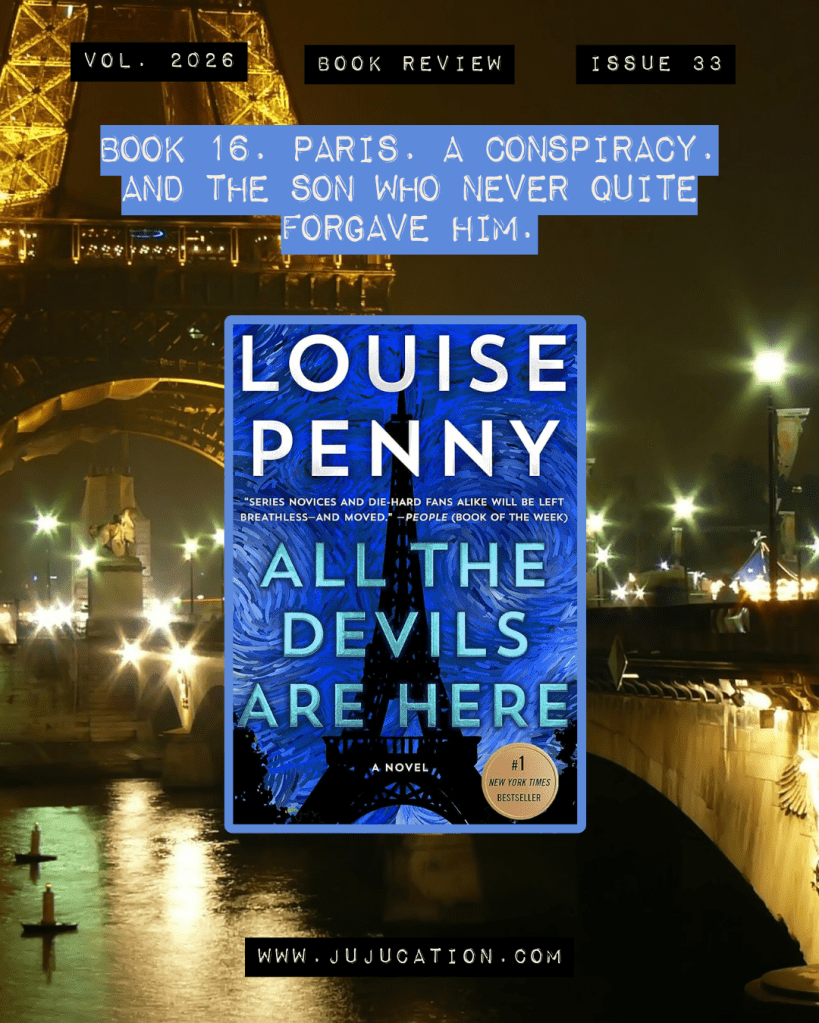
I am not someone who reads mystery series for the mystery. I want you to know that upfront, because it explains everything about why I am sixteen books into the Gamache series and still going, long past the point where Three Pines has stopped being a village in Quebec and started being something I carry around with me like a smooth stone in a coat pocket.
All the Devils Are Here is the sixteenth installment, and Louise Penny does something in it that feels, at this stage of the series, almost reckless: she removes Three Pines entirely. The village is gone. The bistro is gone. Myrna’s bookshop is gone. What remains is the family, dropped into Paris for the birth of a grandchild, which promptly becomes something considerably more complicated than that.
I have been enjoying this series, genuinely enjoying it, in the way you enjoy something that respects your intelligence and doesn’t apologize for having feelings. This one I enjoyed and then sat with for a while after. That is a different experience.
Where This Fits in the Penny Universe
Book 16 is a turning point in register. The earlier books, especially through the first five or six, were pastoral mysteries: Quebec villages, eccentric locals, snow as a character. By How the Light Gets In (Book 9), Penny had expanded into governmental conspiracy and the institutional near-destruction of Gamache himself. All the Devils Are Here inherits that political ambition but filters it through something more intimate: family. It is the most thriller-forward entry in the series, with genuine action sequences and a transatlantic conspiracy, but the engine underneath all of it is a father and a son who have not been honest with each other for decades. This is Penny proving she can write a proper thriller without losing what makes her Penny.
The Setup
Armand and Reine-Marie are in Paris. Daughter Annie and son-in-law Jean-Guy Beauvoir are expecting their first child. Son Daniel, who has always existed at the cool edge of the family warmth, lives in Paris now with his wife and daughters. Armand’s godfather Stephen Horowitz, 93 years old and sharper than most people half his age, is also in Paris. It is, briefly, a gathering.
Then Stephen is hit by a delivery truck and left in a coma, and no one in the Gamache family believes for a moment that it was accidental. What follows is a conspiracy involving GHS Engineering, a rare earth mineral called neodymium that behaves badly under pressure (relatable), a murdered man in Stephen’s ransacked apartment, and a corrupt network that reaches into French law enforcement. Armand is in a foreign city, without his usual resources, with his entire family in the middle of it, and one night to find the evidence before his son Daniel is killed.
Annie goes into labor somewhere in the middle of all this. Penny is not subtle about her metaphors, and I mean that as a compliment.
What Makes This Book Different
1. Paris as disorientation, not glamour. Penny does not write a love letter to Paris. She writes a city where Gamache cannot verify anyone’s allegiances, where his usual support structure is missing, and where beauty and corruption share addresses. It is Hitchcockian in the best sense: beautiful surface, danger underneath, and the protagonist stripped of his usual advantages.
2. Daniel Gamache finally gets a full story. He has been a background presence for fifteen books, the son who remained slightly out of reach. Here, his resentment toward Armand, rooted in a childhood misunderstanding about what his father prioritized, comes to the surface and gets properly examined. The resolution is earned rather than convenient, which means it costs something first.
3. The corporate thriller is actually grounded. Neodymium is a real element. It is used in electric vehicles, wind turbines, and defense technology, and Penny makes the supply chain ethics feel personal by running them through a body in an apartment and a man in a coma. This is not technothiller dressing. It is the mechanism through which greed becomes murder, told at human scale.
4. Jean-Guy’s position is genuinely uncomfortable. He has been working inside GHS Engineering. He is not a villain, but his loyalty is tested in ways that do not have clean answers, and Penny does not give him a clean exit. His arc in this book is the series at its most morally honest about what it means to be inside a corrupt system without knowing it yet.
A Personal Aside
There is a moment in this book where Gamache is in Paris, in a foreign city, with no Beauvoir beside him, no Three Pines to return to, no familiar structures, and he still knows exactly who he is. I read that and thought about my own commute to a cybersecurity company in Singapore where I spend eight hours managing dashboards and escalations, and then come home and light a candle and read about a detective in Quebec and feel, inexplicably, more like myself. The book’s thesis and my reading life are apparently the same thesis. I am choosing not to think too hard about what that means.
Things I Loved
The Daniel arc. Not because it is happy. Because it is true. The specific mechanism of his resentment, a misunderstanding from childhood that was never corrected because neither of them knew how to start, is recognizable in the bones. Penny writes it without sentimentalizing it.
Stephen Horowitz at 93. He is a Shakespearean figure in miniature: wise, wealthy, and quietly at war with something enormous. His backstory, which illuminates the entire conspiracy, is revealed with the patience of someone who has been waiting fifteen books to tell it.
Claude Dussault’s reveal. The novel positions him as a possible villain for long enough that the pivot lands with real weight. It is structural craft more than plot twist, and it works.
The baby arriving during all of this. It should not work. It absolutely works.
Reine-Marie getting to be competent and present. She investigates. She acts. She is not a worried wife standing at the margins. Thank you, Louise Penny.
What This Book Is Really About
Penny has always been writing about the same question: who are you when the structures that support you are removed? Three Pines is not a village in Quebec. It is the answer to that question. It is the proof that you can build a moral home out of chosen people and shared values and very good food, and that this home travels with you.
All the Devils Are Here strips the village away and deposits the Gamache family in Paris, alone, under threat, and asks whether the community they have built holds. The answer is yes, delivered in the birth cry of a grandchild and the resolution of a father-son estrangement that has been accumulating for fifteen books.
The devils are everywhere, in boardrooms and governments and within families. Penny’s argument is that so, stubbornly, is love, and that love does not require a fixed address.
Who Should Read This
Read it if you have read books 1 through 15 and you want the Daniel storyline to finally resolve. Read it if you want Penny writing a genuine thriller without losing her emotional register. Read it if you want Paris made strange and dangerous rather than picturesque.
Wait if you are new to the series. Still Life is the entry point, and the emotional payoff of Daniel’s arc requires the history. Read it out of order and you will get a competent thriller. Read it in order and you will get something considerably more affecting.
Skip it if you are specifically attached to Three Pines as a place. The village is entirely absent. If that is what you are reading these books for, this one will feel like an expensive vacation that is not quite home.
The Bottom Line
This is not a perfect book. The corporate conspiracy machinery requires more patience than the human drama does, and the final boardroom scene leans toward tidy in a way that does not entirely reflect the world Penny has otherwise built. But the Daniel arc is genuinely moving, Paris is rendered with intelligence rather than affection, and the birth-amid-gunfire structural choice that should not work completely does.
It is the best thriller in the series and not the best Penny in the series, and that is not a criticism. It is a description of what she chose to do here.
Rating: 4.5/5 Half a star off for the final third getting slightly mechanical. Every other star fully earned by a father and a son having a conversation sixteen books in the making.

 jujucation.com