
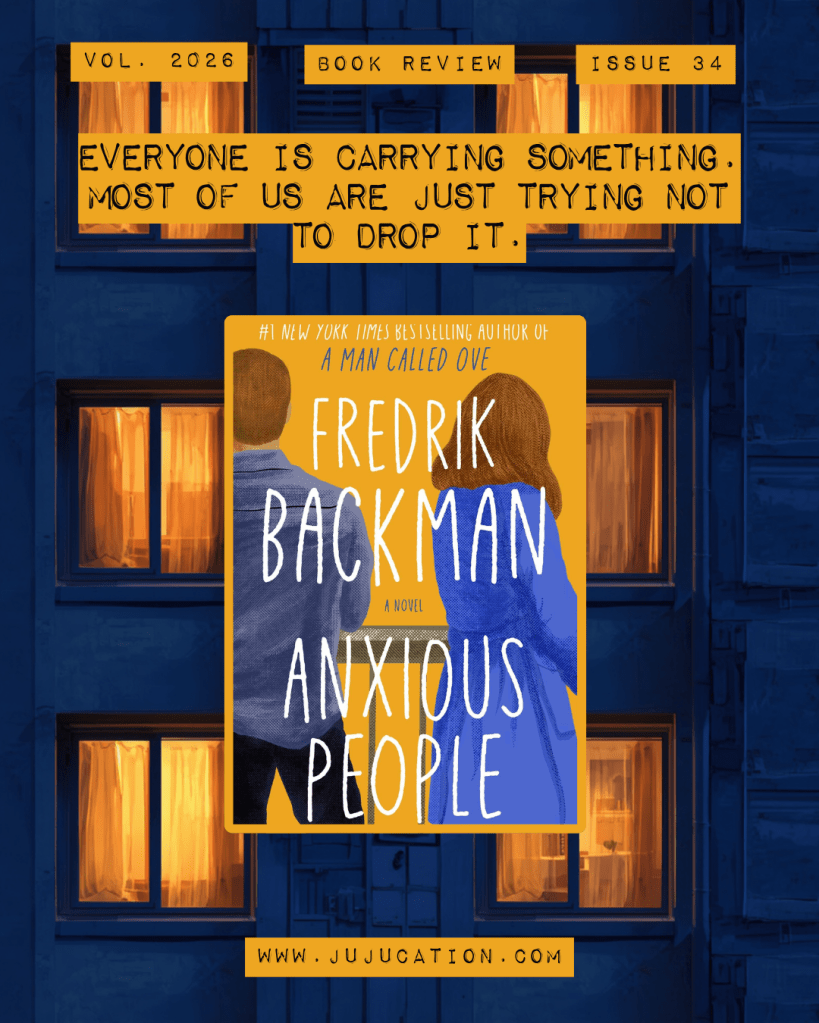
CONTENT WARNING: This book contains a suicide by jumping from a bridge, suicidal ideation, depression, anxiety, divorce, and financial collapse. Please read with care if any of these are tender spots for you right now.
I picked this up because I could feel a slump coming.
You know the one. Where three books in a row don’t land and you start eyeing your shelf like it personally wronged you. My solution to that is always the same: stop gambling on something new and go get something familiar. A book I already trust to work. So I grabbed Backman, made tea, put out snacks, and told myself I’d read twenty pages before bed like a responsible adult with a wind-down routine.
I read until 1 a.m. and finished the whole thing in one sitting. Then I sat in my dark kitchen trying to figure out how a comfort read had ambushed me this badly.
This is not a complaint. It’s a warning.
Where This Fits in the Backman Universe
If you’ve read A Man Called Ove, you already know Backman’s signature move: take a character who looks like a punchline from the outside, then slowly, methodically, show you every reason they became that way until you’re crying about a grumpy old man and his cat. Anxious People does the same thing, except he does it with eight characters simultaneously, jumps around in time while he’s at it, and has a narrator who occasionally stops to editorialize about the internet or the cruelty of mortgage systems. It’s his most structurally ambitious work, and the one that most clearly states what all his books are quietly arguing.
The Setup
Someone tries to rob a bank to pay overdue rent. The bank is cashless. The would-be robber, now panicking in the way only a person who has run out of options can panic, flees upstairs into an apartment viewing already in progress. There are eight people there. The robber has a gun. Everyone assumes the worst.
What follows is not really a hostage situation. It’s more like eight people who were already trapped in their own private disasters getting briefly trapped together in a physical one, which turns out to be the only thing that could have made them honest with each other.
Outside, two police officers, a father and son who have their own unresolved situation going on, try to manage a crisis that keeps refusing to behave like a crisis. When they finally enter the apartment, the robber is gone. No one will say how. The interviews that follow are the spine of the book.
The emotional stakes: guilt, shame, the things you did when you were scared and never got to take back, and whether it’s possible to forgive yourself for them.
What Makes This Book Different
1. The comedy is doing structural work, not just softening the blow. Backman doesn’t use humor as a spoonful of sugar. The absurdity, a man in a bunny suit, the cashless bank, the robber who is more frightened than the hostages, is the actual argument. Life is ridiculous. People are ridiculous. Being scared makes us act in ways we’d find embarrassing in retrospect. That’s not a character flaw. That’s just the condition. The laughs earn the heartbreak because they’re made of the same material.
2. The structure mirrors the theme. The book is nonlinear, told in fragments: police interviews, present-tense chaos, flashbacks, philosophical tangents. You keep getting pieces of the picture without the full frame, which is exactly how we experience other people. You think you know what’s happening, then the perspective shifts, and you realize you were wrong about almost everything. This is not a neat trick. It’s the thesis.
3. It takes anxiety seriously without pathologizing it. The book’s central argument is that “everyone is an idiot” when they’re terrified, not because they’re weak or broken, but because fear makes idiots of all of us. That’s not a dismissal. It’s actually a pretty radical act of compassion, to say: of course you did that. Of course you were that scared. What did anyone expect?
4. The small acts of kindness land hard because they’re specific. It would be easy for a book about connection to go soft and vague. Backman doesn’t let it. The moments that hit are particular: a letter that says four words, an old woman who opens a door, a cop who decides what “doing the right thing” actually means in practice, not in theory. Generosity is shown, not described.
One honest flag: The narrative voice occasionally goes on philosophical tangents about mortgages or the news cycle that feel like Backman working something out for himself. They mostly land. A few of them overstay their welcome. If you’re a reader who likes plot momentum, some of these detours will test your patience.
Things I Loved
Zara. She is introduced as cold, wealthy, possibly monstrous. She is actually a woman who has been carrying a dead man’s letter for a decade because she cannot bring herself to read it. Her arc is the emotional center of the book and Backman earns every beat of it. The moment she finally reads the letter is the kind of scene you’ll remember six months later in the shower.
The robber’s interiority. We spend a lot of time inside the head of someone doing something objectively stupid, and it never once feels like the book is punishing them for it. The desperation is rendered with such specificity that by the time the full picture comes into focus, “criminal” is the last word you’d reach for.
Jim. The older cop. The scene where he makes a quiet choice about what he’s going to let happen is one of the most ethically interesting moments in the book. It’s not triumphant. It just is. That restraint is hard to pull off.
The apartment disappearance reveal. I will say nothing about how the robber vanished. I will only say that when it became clear, I immediately went back and reread two earlier chapters and felt both stupid and delighted.
What This Book Is Really About
It’s about the gap between what we carry alone and what would happen if we didn’t.
It’s about the man who jumped from the bridge, and the banker who dismissed him, and the police officer who tried to stop him, and the way that one moment quietly poisoned three separate lives for a decade, and how the only way out of that is not resolution but honesty.
It’s about systems, specifically, the ones designed for efficiency that leave no room for a person who is just having the worst year of their life. The robber isn’t a criminal. They’re a person who fell through every crack available to fall through, and then kept falling.
And it’s about this: the things we do matter, even when we don’t know they matter. The woman who opened a door. The letter that said four words. The cop who looked the other way. Backman is making a sustained argument that we are not as separate from each other as we pretend to be, and that this is both the terrifying part and the part that might save us.
Who Should Read This
- Readers who loved A Man Called Ove or Britt-Marie Was Here and want more Backman, but more structurally ambitious Backman
- Anyone who has ever done something mortifying because they were scared and has not fully forgiven themselves for it
- Readers interested in mental health narratives that don’t treat the subject as inspirational content
- Fans of ensemble character work, TV bottle episodes, plays where everyone is trapped in a room and the drama is mostly people finally being honest
- People who like to cry and would prefer it to happen somewhere private, like their kitchen at 1 a.m.
Who Can Skip
- Readers who are in a tender place around suicide, particularly death by jumping. This is not peripheral to the book. Handle accordingly.
- Readers who need linear narrative and plot momentum. This one spirals.
- Anyone who finds sentimentality intolerable. Backman leans into the emotional payoff. He earns it, but he does lean.
The Bottom Line
Anxious People is not a perfect book. The philosophical tangents sometimes run long. The structure can feel deliberate in a way that reminds you there’s an author behind the curtain. And there are moments where the warmth tips toward cozy in ways that feel a little easy.
But the things it does right, it does extraordinarily right. The ensemble characterization is flawless. The comedy and the heartbreak work in actual concert, not in rotation. And the central argument, that we are all interconnected in ways we cannot see, and that this means what we do matters, is made with enough specificity and craft that it doesn’t feel like a platitude. It feels like evidence.
I went looking for something comfortable and got a book that quietly rearranged my chest instead. Worst best outcome a slump has ever given me. This is the kind of book that doesn’t make you a better person, exactly, but makes you slightly more inclined to assume you’re missing something about the stranger in front of you. In the current moment, that feels like enough.
⭐⭐⭐⭐½ out of 5 Half a star withheld for the tangents. Full emotional damage delivered as promised.
Here’s what I want to know: is there a character in this book you recognized yourself in immediately, before you were ready to admit it? Because I have thoughts about Zara that I’m not entirely comfortable with, and I think that means the book worked.
If this review convinced you, pushed you over the edge, or helped you decide this isn’t for you right now, I’d love to know. Drop it in the comments. And if you want more of this kind of thing in your inbox without having to remember to check back, the subscribe button is right there and it doesn’t bite.


