
Nonfiction · Epistolary · 112 pages · Penguin Books
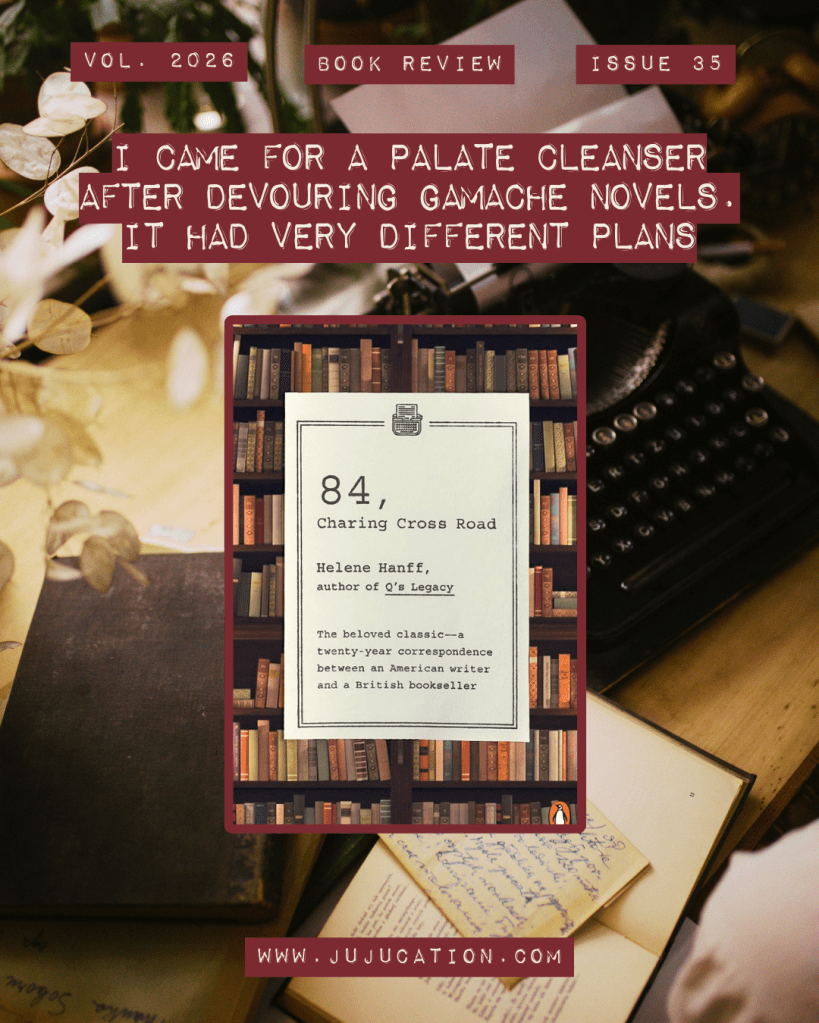
Let me tell you where I was when I picked this up, because context matters and also because I think it explains a lot about my current emotional state, which a therapist would describe as “a lot” and I would describe as “fine, totally fine, why.”
I had just read three Armand Gamache novels in a row. Three. Back to back, in the kind of sustained literary binge that felt very sophisticated until I looked up and realized I had eaten cereal for dinner twice and lost track of what day it was. In between Gamache installments I had also read What Happens in the Dark and The Dinner Party, both of which are exactly as cheerful as they sound. I was, in short, swimming in fictional death, and I needed out.
84, Charing Cross Road is 112 pages of letters between a writer and a bookshop. I picked it up the way you grab a cracker off a cheese plate at a party when what you actually need is to sit down and have a proper meal, not because you want it exactly, but because it’s there and it’s small and it seems manageable. Letters, I thought. How much can letters do to me.
I should say here that I do enjoy epistolary novels. I came to them later than I should have but the format and I have an understanding. What I was not prepared for, having lowered my defenses entirely, was to be ambushed so completely and so quietly by 112 pages I expected to skim. By page forty I was no longer aware of the sofa beneath me. By the last page I was sitting very still in the particular way you sit still when something has happened that you need a minute to absorb, staring at the middle distance, which in my apartment is a wall with a slightly crooked picture frame I have been meaning to fix for eight months.
This book does not announce itself. It does not build to a dramatic confrontation or offer a twist or ask you to gasp. It simply hands you two people and twenty years and trusts you to understand what that means. I came in for a palate cleanser. I got something I am still thinking about.
Helene Hanff spent most of her career writing television scripts and attempting to break into Broadway, with the kind of persistent, grinding near-miss that characterizes a certain type of New York creative life, the one where you are talented and broke and absolutely certain you are one good break away from everything working out. 84, Charing Cross Road was published in 1970 and was her breakout, the book that made her name, which is the kind of irony she would have appreciated: that the most personal, least plotted thing she ever wrote was the one that lasted. If you love her voice here, The Duchess of Bloomsbury Street is the immediate follow-up, a diary of the London trip she finally takes after this book’s success. But 84 is the one. The smallest and the most permanent.
In 1949, Hanff, living in a New York apartment I imagine as approximately the size of a generous walk-in closet and absolutely stuffed with books she has very strong opinions about, writes to Marks and Co., an antiquarian bookseller at 84, Charing Cross Road in London. She wants out-of-print English classics, cheap, clean copies, the kind that don’t make her feel like she’s reading through a fog of someone else’s marginal notes. She gets them. She writes back. Frank Doel, the chief buyer, responds. He is formal in the way of a certain kind of English professional courtesy, careful and correct, while she is immediate and blunt and a little demanding in the specific way of someone who knows exactly what she wants and sees no reason to pretend otherwise.
And then twenty years happen. In letters. Across an ocean. Through a war’s long aftermath and food rationing and erratic finances on both sides and the ordinary texture of two very different lives, the shop on Charing Cross Road and the apartment in New York, connected by the mail and by the books they both loved and by the slow, accumulating weight of being known by someone you’ve never met.
“The letters take weeks to cross the Atlantic. The friendship takes twenty years. Neither of those things feel slow when you’re in it.”
What Makes This Book Different
- The white space is doing everything. These are real letters, curated and arranged for publication, which means we only see the surface, what was written, what was sent, what was kept. Everything else, the deepening, the things left unsaid, the warmth that never gets named directly because neither of them was that kind of person, lives in the gaps between letters. The reader infers. And the inference is devastating in a way that no amount of explicit emotional description could match.
- Frank Doel is not a foil. The easy read of this book is odd-couple comedy: brash American, reserved Englishman, letters ensue. But Doel on the page is something more careful than that. He is a man who gives you the corner of himself and trusts you to understand the whole. His restraint is not coldness. His occasional dry humor arrives like a gift, precisely because he has made you wait for it, and when it comes you feel you have earned something.
- It is a grief book that never announces itself as a grief book. There is a death in this book. It happens off-page, in a few sentences, and the correspondence ends not long after, and there are no extended mourning passages, no processing, no resolution in any therapeutic sense of the word. There is only the absence where the letters used to be, and the reader, and the full weight of twenty years that suddenly have no future tense. It is the most quietly devastating structural choice I have encountered in nonfiction in a long time.
- It argues, without arguing, for a particular kind of reading life. Hanff is fussy about editions. She returns books that disappoint her. She sends her literary opinions to the bookshop unsolicited and at length. The implicit argument running beneath the entire correspondence is that how you read, and what you demand of books, and the standards you hold them to, is not pretension but a form of self-knowledge. I found this mildly irritating and completely correct.
Things I Loved
- Hanff’s voice in the early letters. She writes to a stranger the way most of us only write to people we’ve known for a decade. Immediate. Specific. A little bossy. The kind of person you desperately want to be seated next to at dinner.
- The food parcels. During post-war rationing, Hanff, who is not exactly rolling in money herself, starts sending hams and powdered eggs and nylon stockings to the bookshop staff in London. She does this without ceremony, without making it a thing, without apparently expecting anything except that the people who have been finding her books should not have to go without decent food. The staff write back in the kind of grateful, overwhelmed language that makes your chest do something complicated. Hanff writes back irritated that they’re making such a fuss. She is, in this moment, my favorite person.
- Nora Doel’s letters near the end. Frank’s wife appears throughout the correspondence, warm and cheerful, a voice at the edge of the main exchange. And then her letters change. Not dramatically, not in any single obvious way, but there is a stillness in them, a very specific quality of someone speaking carefully because the alternative is too much. That stillness is the part that stays with you longest.
- The London that never gets visited. Hanff plans to go for twenty years. The money never quite materializes, the timing is never quite right, and the visit keeps not happening in the gentle, accumulating way that many things in life keep not happening, not through any single catastrophe but through the ordinary friction of circumstance. The London she builds from Frank’s letters and her own reading is, in some ways, more vivid than the real city could have been. The book understands this without being sentimental about it.
What This Book Is Really About
It is about what happens when you pay sustained attention to someone who is paying sustained attention to you, across time, across distance, through the ordinary medium of books and letters and the occasional care package. It is about how that accumulates into something you could call love without being wrong, even if it never takes the forms we usually expect love to take.
It is also about the specific, unglamorous grief of the almost. The visit that did not happen. The meeting that did not occur. The conversation that ended before it was finished, the way so many conversations do, not with resolution but with absence, which is its own kind of answer. Hanff never gets to walk through the door at 84, Charing Cross Road and meet the people she has been writing to for twenty years. The book does not make this mean more than it does. It does not make it mean less. It simply holds it out and asks you to sit with it, and you do, and it is enough.
Who Should Read This / Who Can Skip
Read it if:
- You have a position on book editions and consider reading a mass-market paperback of a text that deserves better a minor personal failing
- You need a break from thrillers and want something with maximum feeling and a body count of zero
- You have maintained a friendship almost entirely in writing and wanted someone to tell you it was real
- You liked The Guernsey Literary and Potato Peel Pie Society but wanted something quieter, truer, and without the romance subplot
- You are the kind of person who reads the acknowledgments
Skip it if:
- You need a plot. There is no plot. Things happen slowly and then they stop.
- The epistolary format frustrates you. The gaps are not a flaw. The gaps are the book.
- You are emotionally overextended right now and cannot absorb one more quiet thing.
- You want catharsis with clean edges. This book does not offer clean edges.
The Bottom Line
84, Charing Cross Road does not do everything. It is 112 pages of real letters between a writer and a bookshop and the people in it, and it has no third act and no confrontation and no dramatic reversal, and none of that is a problem. What it has is two people who become, over twenty years and a hundred pages, genuinely necessary to each other, and the reader, by the end, understands exactly why.
The honest flaw: it ends in absence, not resolution, and there is nothing on the other side of it. You close the book and the address becomes a memory and you sit there for a minute with nothing to do with your hands. I had planned to knock this off between lunch and a load of laundry. I lost an afternoon. I gained a new and slightly inconvenient feeling about letters as a form of human connection.
I regret nothing. I recommend everything.
Rating
★★★★★ — Five stars. Do not read this in public unless you are prepared to explain to a stranger why you are staring at nothing.


