
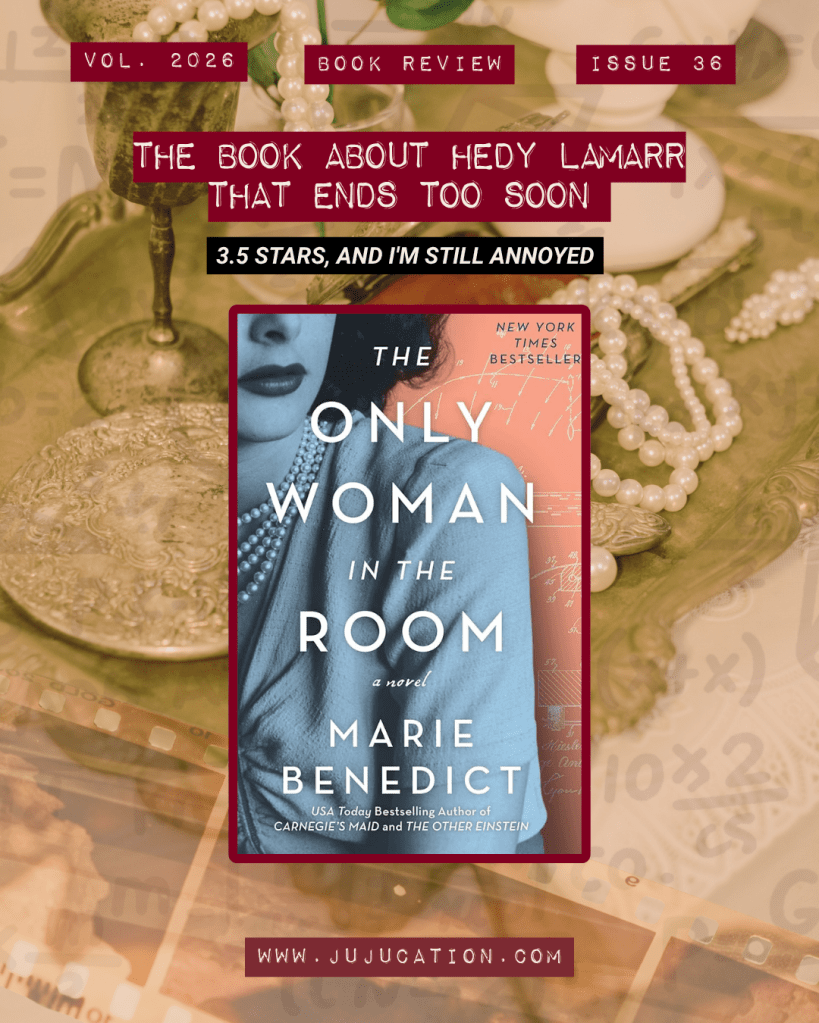
I picked this book up thinking I was being very smart about my reading challenge. Historical fiction about Hedy Lamarr: a woman who was, impossibly, both a 1930s film star and the co-inventor of a frequency-hopping signal technology that eventually became the foundation for modern Wi-Fi. I had questions. I wanted answers. I settled in with very high expectations and what I can only describe as a deeply misplaced confidence that this book was going to give me everything.
It gave me some things. Not everything. But some things are worth paying attention to.
A Quick Word on Marie Benedict
Marie Benedict has made a career out of fictional biographies of real women who have been historically underserved by history — Ada Blackjack, Mileva Einstein, Nessie Carnegie. Her approach is consistent: take a woman who existed in the shadow of something larger (a war, a famous man, a cultural moment), and give her an interior life. The results are readable, accessible, and occasionally frustrating if you come in wanting more than interiority. The Only Woman in the Room fits that pattern exactly.
The Setup
Austria, 1933. Hedy Kiesler is nineteen, already famous for a film that scandalized Europe, and about to marry Friedrich Mandl, without a doubt one of the richest, most dangerous men in the country. He deals in weapons. He controls everything and everyone around him. And he is, inconveniently, charmed by his new wife’s mind.
So Hedy does something quietly extraordinary: she listens. Dinners with Nazi officials and munitions engineers become an education she was never supposed to receive. She absorbs information about military technology, about the weakness of radio-controlled torpedoes, about frequency and interference. She files it away. She waits.
And then she escapes. And eventually, she gets to Hollywood, and eventually, she uses what she heard at those dinners to develop a patent that the U.S. military would ignore for decades and the tech industry would later build a world on.
The novel covers the first part of that arc. The escape. The becoming. The steel.
What Makes This Book Different
- It takes Hedy’s intelligence seriously from page one. There’s no moment where she “discovers” she’s smart. She already knows. The book opens with a woman who is fully formed and competent navigating a world that wants her decorative. That choice to not make the reader wait for the revelation that she’s more than her face matters more than it sounds.
- The marriage is written as a slow suffocation, not a dramatic horror. Mandl is controlling and dangerous, but the novel gets the texture right: the small erasures, the monitored conversations, the disappearing sense of self that happens gradually enough that you almost don’t notice until you’re reading through your teeth. It’s not a thriller. It’s something more unsettling.
- The historical backdrop is handled with restraint. The rise of fascism in Europe is not explained at you; it seeps in through the edges of social scenes and uncomfortable dinner parties. Benedict trusts the reader to understand what it means when certain guests start appearing at Mandl’s table.
- The writing style is functional but unflashy. This is worth naming because it shaped my experience of the book significantly. Benedict writes cleanly. She doesn’t reach. But there’s also not much texture — I never felt the weight of a room or the grain of a fabric or the way a particular evening felt in the body. The story is told. It is not inhabited.
Things I Loved
Her self-possession. At every point where the novel could have let Hedy doubt herself completely, it doesn’t. She goes through abuse. She endures being watched and controlled and diminished. And she never loses her assessment of her own worth. Not performed confidence — a quieter, more durable thing. The knowledge that she is more than this, even when this is all there is.
The escape sequence. I won’t say how, but when she finally gets out, it is genuinely satisfying in the way that only well-earned fictional freedom can be. I may have fist-pumped slightly. There were no witnesses.
The fact that it’s short. I say this sincerely and without irony. 320 pages is the correct length for what this book is trying to do. It knows its scope and it stays inside it.
What This Book Is Really About
It’s about the cost of being seen for the wrong thing.
Hedy Lamarr spent her life being looked at. Men looked at her face and decided they understood her. Audiences looked at her and felt things. Her husband looked at her and saw something to own. And all the while, behind the face that everyone was so busy staring at, she was watching, thinking, calculating, remembering.
The book asks something quiet and uncomfortable: how many women were in rooms like that? How many were listening at the edges of conversations they weren’t meant to understand? How many filed things away because the filing away was the only power they had?
It also, gently but insistently, refuses to judge Hedy for the choices she made to survive. She married badly. She stayed longer than she should have. She made compromises. And the book holds all of that without collapsing into either excuse-making or condemnation, which is harder than it looks.
The thing it left me sitting with: women’s circumstances have changed enormously. And the instinct to surveil and absorb from the margins, because the center wasn’t an option, that one has a longer half-life.
Who Should Read This / Who Can Skip
Read it if:
- You’re interested in Hedy Lamarr and want a way into her story that isn’t a Wikipedia page
- You like your historical fiction character-driven over plot-driven
- You’re in a reading challenge and need something about pioneering women (genuinely: this one delivers on that)
- You’re interested in pre-war Europe filtered through the domestic rather than the political
Skip it if:
- You want the full arc (the Hollywood years, the invention, the patent fight, the erasure and eventual recognition) because this book stops before most of that
- You need rich, sensory prose to stay engaged
- You’re expecting a thriller energy; the pacing is deliberate, not propulsive
- You want Hedy’s story told with more biographical meat on the bones
The Bottom Line
The Only Woman in the Room is a solid, earnest, sometimes frustrating book about an extraordinary woman. Marie Benedict has clearly done her research and clearly cares about giving Hedy Lamarr an interior life. What she hasn’t done — and I wanted this badly enough that I’m still a little annoyed — is give us the full story. The invention gets mentioned. The patent gets gestured at. And then the book ends, and Hedy is still mostly at the beginning of what made her remarkable.
Three stars, meaning: I’m glad I read it, I would recommend it with caveats, and I immediately looked up three other books about Hedy Lamarr the moment I finished.
Rating: 3/5 Earned for the portrait it did draw, docked for the portrait it promised and didn’t quite finish.
Let’s Talk
Here’s what I keep thinking about: Hedy sat at those dinners and absorbed information that men were sharing freely because they didn’t think she was really listening. Have you ever been underestimated in a room in a way that turned out to be accidentally useful?
Drop your answer in the comments. And if you want more of this kind of thing, the subscribe button is right there, and I promise to keep the rambling to a reasonable length.


