
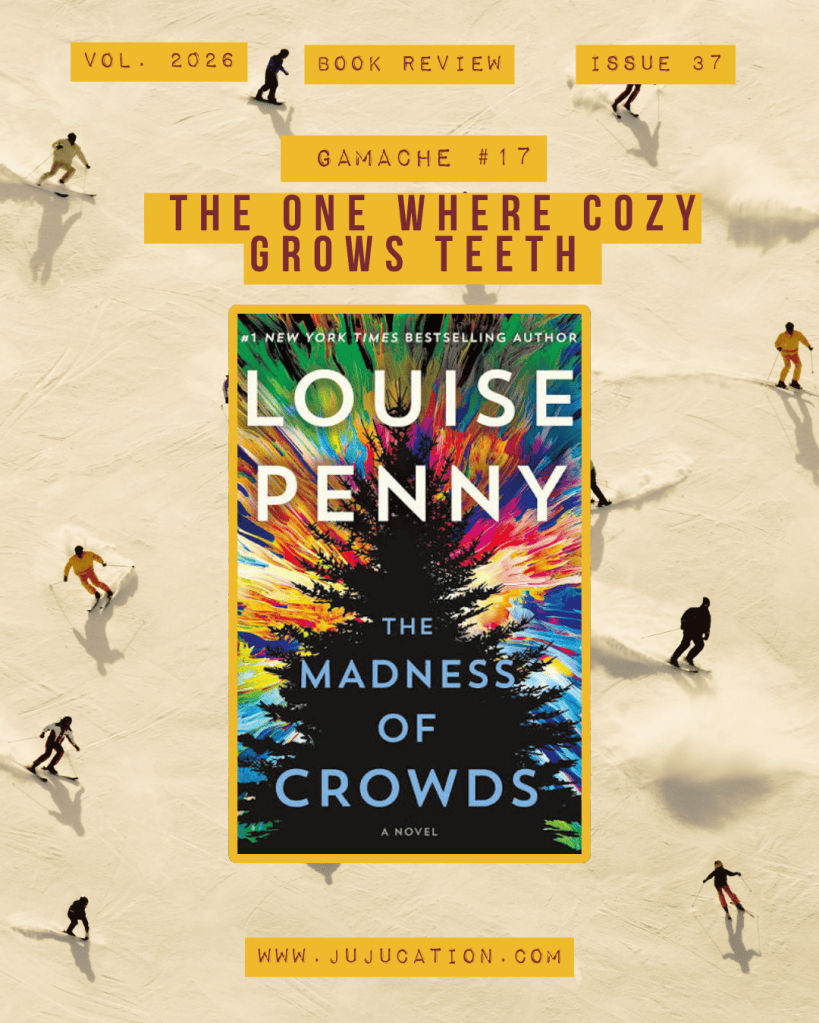
The Book You Thought You Knew
I went into this one the way I go into every Gamache book: bracing for a body in the snow and a lot of Ruth calling everyone an idiot. What I got instead was a statistics professor standing at a podium explaining, very calmly, why some people cost more than they’re worth. No violin music. No monologuing villain. Just a woman with a laser pointer and a room full of people nodding along.
I run risk models for work. I know what it looks like when a person becomes a row in a spreadsheet, how quiet and procedural that process is. I did not expect Louise Penny to make me sit with that on my own couch, on a Tuesday, with tea going cold beside me. But here we are.
Where This One Sits
By book seventeen, most series either coast or swing for something bigger. Penny swings. This is the most overtly political entry in the Gamache catalog, the first to look the pandemic directly in the face instead of writing around it, and it uses the murder mystery scaffolding to hold up a much bigger, much uglier question. If you’ve been reading for the village charm, this is the one where the village has to earn it.
The Setup, No Spoilers
Gamache is asked to provide security for a lecture. That’s it, that’s the ask. Except the lecturer is proposing something that would put someone he loves directly in danger, and the university is treating “academic freedom” like a shield thick enough to cover mass euthanasia. A crowd gathers. Shots get fired. And then someone connected to the whole ugly mess ends up dead, which means Gamache has to investigate a murder inside a debate he can’t stay neutral on, because neutrality here has a body count too.
What Makes This Book Different
- The villain isn’t a person, it’s a spreadsheet. Robinson isn’t cartoonishly evil. She’s careful, credentialed, and convinced. That’s scarier than a monster. Monsters don’t get invited to keynote.
- It refuses to let “the greater good” stay abstract. The book keeps dragging the argument back down to specific people with names and faces, which is exactly the move that makes utilitarian math fall apart in real life.
- Haniya Daoud breaks the hero mold on purpose. She survived horrors most of us can’t picture, and she’s also difficult, abrasive, hard to like. Penny won’t let you require gratitude from someone she made you feel sorry for.
- The middle drags, and I’m not going to pretend it doesn’t. There’s a stretch where the team re-theorizes the same three suspects for what feels like eighty pages. It’s the one real flaw in an otherwise sharp book.
Things I Loved
- The lecture hall scene. Not for the violence, for the calm before it. The way the crowd’s mood turns like weather.
- Gamache’s refusal to treat “well-argued” and “acceptable” as the same thing. He gets that distinction right when a lot of real institutions still don’t.
- One small, unshowy moment where a Three Pines regular says something plain and kind to Haniya, no fanfare, and it lands harder than any of the big speeches.
What This Book Is Really About
It’s about how atrocity doesn’t usually arrive as a monster. It arrives as a policy proposal, footnoted, reasonable-sounding, delivered by someone who believes they’re saving people. It’s about the specific cowardice of letting a number stand in for a face. And underneath all of it, it’s about love as the thing that refuses to do that math, the thing that insists on the specific person even when the aggregate would be easier.
I do this for a living in a smaller, less lethal way. I sort risk. I put people into categories that make decisions faster. This book made me want to be slower.
Who Should Read This / Who Can Skip
Read this if:
- You want your cozy mystery series to occasionally have teeth
- You work in healthcare, policy, tech, or anything that quantifies people, and you want fiction that gets it
- You’re ready for the series to stop being gentle
Skip this if:
- You’re still raw from the pandemic and need distance, not a mirror
- You picked up Gamache specifically for comfort tonight
- Slow, talky investigations wear you out
The Bottom Line
It’s not the tightest mystery in the series, the middle sags, and the resolution asks you to hold more moral complexity than a typical procedural bothers with. But it’s the book where Penny stops being polite about what the pandemic revealed in people, and I respect that more than I enjoyed the sag.
Rating
★★★★☆ — Docking half a star for the mid-book repetition, not for the nerve.
Let’s Talk
Have you ever had to defend a number that used to be a person? Drop it in the comments, I want to know I’m not the only one who brought their day job to a murder mystery. And if you want the full Gamache reading order, that’s linked below.

 jujucation.com