
Three husbands, one Hampstead house, and nobody to root for
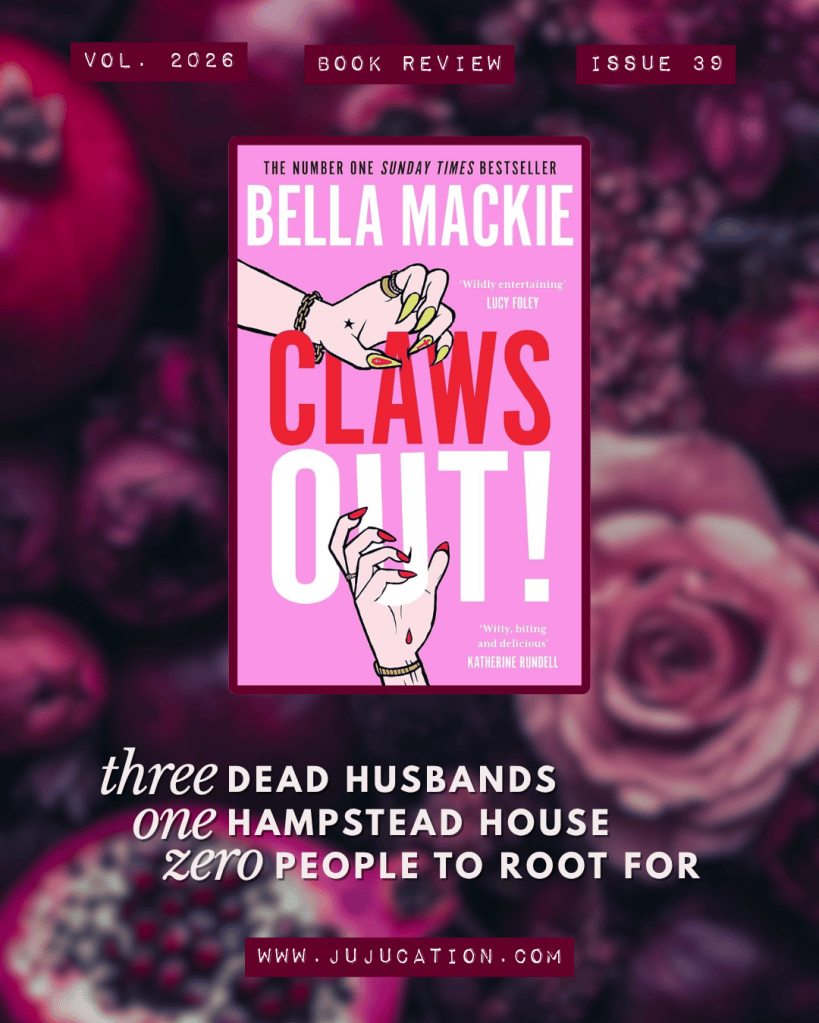
Thank you to Times Reads for sending me a copy of this book. All opinions, including the unflattering ones, are my own.
I thought I was signing up for a knife fight in good shoes. A black widow, a suspicious daughter, a Hampstead house with a garden big enough to bury a grievance in. Think Knives Out, except the deaths are already in the past tense and everyone’s manners are worse.
What I got was a book that kept nudging me in the ribs to say look how clever this is, and I kept saying yes, very, please continue, and then it didn’t so much continue as circle. Like a cat deciding where to sit. For a very long time.
Three stars, hardcover, 368 pages, and a real question about what I need from characters I’m supposed to despise. That’s what this review is about: what happens when a book is very sure you’ll enjoy your own disgust.
Bella Mackie used to be a journalist (The Guardian, Vice, Vogue), and it shows in how she clocks status: the right tote bag, the wrong vowels, the sentence someone uses to excuse themselves before they’ve done anything. She came to fiction with How to Kill Your Family in 2021, followed by What a Way to Go in 2024, and Claws Out! is her third novel and a standalone, published 27 August 2026 by The Borough Press. If you loved her debut, this is familiar territory: wealth, class rage, murder played for deadpan laughs. If you’ve never read her, you need nothing beforehand. Just an appetite for people behaving terribly in good coats, and a slightly higher tolerance for repetition than I turned out to have.
The Spoiler-free Setup
Here’s how I’d tell it on the bus.
Diana Leyland has been widowed three times. Each husband left her a rung higher on the ladder, which is a lot of ladder to climb on grief. Now the money is running low, her grown son Zeb still needs propping up, and she has spotted husband number four: David Farrand, an older, wealthy psychiatrist and author with a Hampstead house and the confidence of a man who has been listened to for fifty years.
The problem is his daughter. Cat Farrand has looked at Diana’s marital history the way you look at a suspicious mole, and she has opinions. She would like her father safe. She would also, less nobly, like her inheritance intact.
What follows is a war fought in two voices, because the book alternates between Diana and Cat, with “Interlude for a Murder” chapters sliding back to the late husbands. Both women are terrified of the same thing: being pushed out of the life they believe they’ve earned. Neither is entirely wrong. Neither is remotely nice about it.
What Makes This Book Different
1. Class here is about belonging, not bank balance. Diana can acquire money. What she can’t buy is effortless membership in the liberal North London set that Cat and David wear like a good coat they’ve never had to pay for. Mackie is at her best on that gap: the fluent language of concern sitting on top of very undisturbed comforts.
2. There’s no clean villain and no clean heroine. The black-widow shape promises a wicked stepmother and an endangered daughter. Mackie gives you two rivals whose best arguments are contaminated by their worst motives. That’s sharper than the premise suggests, and it’s the book’s most interesting choice.
3. The book keeps telling you it’s playing with your expectations. Between the interludes, the planted clues, and an authorial voice that occasionally steps out from behind the curtain to address you directly, Claws Out! is very invested in being seen to be smart. Some readers find that arch tone delicious. For me, the winking got louder as the game got thinner. A book can be pleased with itself and still be good, but it helps to have earned the smirk.
4. The Zeb thing. No spoilers, but Zeb has an unusually strong affinity with animals, and the book mentions it so often that it stops being a clue and becomes a billboard. I genuinely couldn’t tell whether it was meant to charm me, mislead me, or both, and I say that as someone who very much wanted to be charmed.
Things I Loved
- The opening. It made a promise of bite, and for a good stretch I believed it. I was intrigued, I was in, I was doing that thing where you read “just one more chapter” with one shoe already off.
- Diana as a lens. She’s outside the world she wants to join, which makes her weirdly perceptive about how its cruelties work. She can read every code in the room while being denied the password.
- The mirror structure. Watching two women narrate themselves as the reasonable one is the real engine of the book. Everybody has a flattering internal monologue. Mackie lets you hear all of them and then declines to clap.
- The satire of performative progressivism. Wealthy people fluent in the language of social conscience while guarding every one of their comforts. It’s specific, it’s mean, and it’s funny where it lands.
- The readability. Mackie writes clean, quick sentences. Even when I was restless, I was never slogging.
What This Book Is Really About
Under the murders, this is a book about fear wearing a nice outfit.
Diana wants never to be powerless again. Cat wants never to be displaced. Both dress that fear up as principle: protection, vigilance, standards, doing what’s best for everyone. The book’s quiet joke is how convincing that costume is, and how little anyone in it can see their own hands.
The question I carried out of it: how often do I call my fear of losing something “having standards”? And the uglier cousin: what is love worth when it arrives attached to a house? Wealth in this book turns care, loyalty, and family into forms of ownership, and it does it so smoothly that nobody notices the paperwork.
Next time you’re absolutely certain you’re the reasonable one in a family argument, it might be worth checking what you’re guarding.
Who Should Read This / Who Can Skip
Read it if:
- You already enjoy Bella Mackie’s dry, caustic voice
- You like wealthy Londoners behaving terribly and don’t need them redeemed
- You’d rather have social satire and vicious family dynamics than a tightly built puzzle
- You want a breezy, sharp-edged holiday read full of people to judge
Skip it if:
- You need at least one character you can root for
- You want a twisty, fair-play mystery with a big, clean payoff
- Heavily signposted clues, authorial winks, or an almost Doctor Dolittle animal thread will irritate you
- You’re hoping it matches the velocity of How to Kill Your Family, because many readers felt it doesn’t quite
The Bottom Line
Claws Out! is a good idea with a great cast of awful people, and it can’t quite decide whether it’s a satire with a mystery in it or a mystery with a satire on top. The middle repeats itself. The animal thread is heavy-handed. The ending lands softer than the build-up earned. And the central problem is one I can name precisely: Mackie clearly intends her characters to be appalling, but the book didn’t consistently give me the extra ingredient that makes appalling characters compelling, which is a stake in who wins, loses, or gets exposed.
So, is it worth reading if you loved How to Kill Your Family? If you want more of that voice and that venom, yes. If you want that book’s momentum and payoff, temper your expectations. It will reward the reader who enjoys judging people more than the reader who wants to be surprised by them.
Thank you again to Times Reads for the copy. A free book doesn’t change the star rating, but it does make the honesty a little more awkward to type.
Rating
★★★☆☆
Three stars, because I admired the machinery and never once cared who it ran over.
Let’s Talk
What’s the last truly awful character you couldn’t stop watching, and what did the author give them that kept you turning pages? Tell me in the comments, and if you’d like more reviews that are honest about the flaws (and occasionally unhinged about the rest), subscribe and I’ll see you in the next one.

 jujucation.com