
Miss Marple Gets Top Billing and a Supporting Role
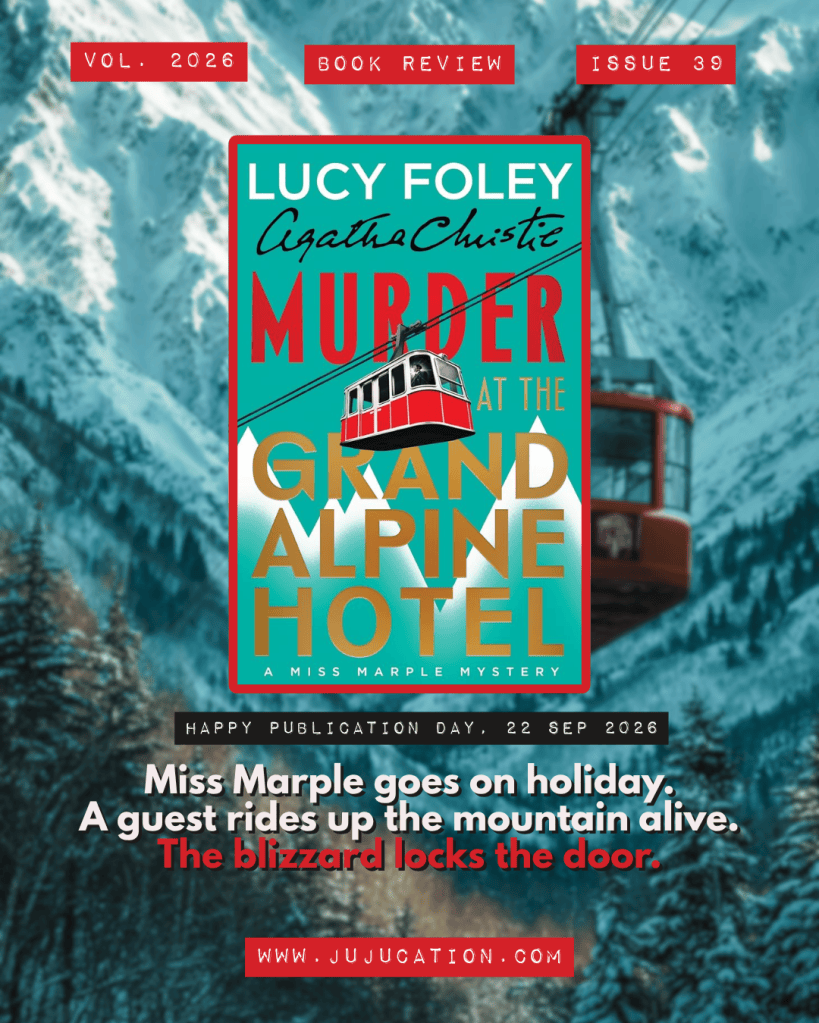
Happy publication day to this book, out today, 22 September 2026. Thank you to Times Reads for sending me a copy. All opinions are mine, and several of them are petty.
A Cozy Mystery Walked Into a Thriller
I picked up Murder at the Grand Alpine Hotel expecting a warm bath in book form. Miss Marple, a cardigan, a body in a tasteful location, and by page forty a quiet suspicion that someone’s second cousin was lying about a will. I was going to be tucked in.
What I got was closer to Murder on the Orient Express after it got a therapist, a phone, and the urge to narrate in first person. Four narrators. A hotel in the Swiss Alps. A gondola. A blizzard doing what blizzards do in these books, which is lock the door and then stand outside with its arms folded.
I had ordered a Christie and been sent a Lucy Foley in a Christie costume. I still finished it, and quickly, which tells you something. But my feelings are tangled, and my tea went cold while I sorted through them.
So this review is about what happens when a beloved old detective gets handed to a new author, and what it feels like to keep checking the room for her.
First Full Marple Novel in 50 Years, No Pressure
Lucy Foley is a British novelist and former fiction editor who built her name on the closed-circle thriller: The Hunting Party, The Guest List, The Paris Apartment, The Midnight Feast. Remote place, wealthy people, rotating narrators, one very bad weekend. She had already been allowed near Miss Marple once, with the short story “Evil in Small Places” in the 2022 anthology Marple: Twelve New Mysteries. This is her first full-length Marple novel, and the first full-length Marple novel in about fifty years, since Sleeping Murder in 1976. It is an authorized continuation, not a lost Christie, and the book is much happier if you walk in knowing that.
What This Book Is About
It’s 1950 and Miss Marple has left St. Mary Mead, which is roughly like watching a houseplant board a plane. She’s on a winter holiday at the Grand Alpine Hotel in Switzerland with her recently widowed friend Dolly Bantry and Dolly’s companion, Diana Glass. The hotel is the kind of beautiful that makes you sit up straighter: a winding railway to reach it, snow on everything, gondolas, champagne at what feels like all hours.
It is also full of people performing themselves. An ambitious politician and his much younger wife. A fading Hollywood actress. A wartime friend who has turned up like an unpaid bill. Everyone is polite. Everyone is well lit. Everyone is hiding something behind a very good coat.
Then a guest rides the gondola up the mountain alive and is found dead at the top, and a blizzard closes the exits. Now the question is who did it, and who might be next.
Underneath the puzzle, this is less about how and more about what happens when people who have survived a war, a scandal, a lopsided marriage or the wrong kind of fame are made to share a lobby. Turns out luxury is a terrible place to hide.
What Makes This Book Different
1. It’s a Lucy Foley book with Miss Marple as a guest. The story is told by four first-person narrators: Catherine Narracott (the politician’s much younger wife), Bruno Crane (his wartime comrade), Sylvia Sinclair (the actress), and Diana Glass. Marple is not one of them. The upside is that the suspects get real inner lives, so the mystery feels like it’s happening to people instead of just being solved at them. The cost is that the detective is often reported on rather than watched. That’s the trade, and I felt every ounce of it.
2. The setting is a lock, not wallpaper. The railway, the altitude, the cold, the gondola and the blizzard all shape what can happen and who can get away. The snow is not scenery. It’s the reason nobody can leave. Classic Christie understood that physical limits create moral pressure, and Foley knows it too.
3. The war is still in the room. It’s 1950, five years after, and the past has not left the building. Old loyalties, war stories that might be self-serving, heroism that may have been more useful than true. This is the richest material in the book, and it gives the puzzle a weight that a plain whodunit wouldn’t have.
4. Marple’s method is quiet, and the structure keeps her quiet. Her gift is noticing small repeated behaviors and the ways people lie to themselves. That is a quiet skill, and a four-narrator design gives quiet skills very little room to breathe. I kept feeling the book spent more time on the dying than on Marple investigating, and my attention span, which is currently on a payment plan, noticed.
Things I Loved
The atmosphere. The winding railway, the snow, the glamour, the sense that luxury turns menacing when nobody can leave. I was cold in a warm room. That’s a compliment.
The gondola. A person goes up the mountain alive. A person is found dead at the top. I have thought about that image more this week than about most of my errands. It’s clean, visual and slightly cruel, which is the best kind.
The rotating suspects. Everyone is carrying a story they’ve edited for public use. Watching those edits crack from the inside is a pleasure, and it’s where Foley’s training as an editor shows.
The clueing, once it gets going. When the investigation properly commits, the secrets and shifting suspicion do real work. The puzzle is well built, and I always respect a puzzle that earns its solution.
What This Book Is Really About
On the surface it’s a snowbound murder. Underneath, it’s about how quickly we mistake polish for goodness. The politician has a public voice. The actress has a public face. The war hero has a war story that may be doing a lot of heavy lifting. Miss Marple’s real talent isn’t supernatural insight. It’s a refusal to confuse nice manners with a clear conscience.
Carry that into your actual life and it gets uncomfortable in a useful way. Who do you trust because they present well? Whose account of themselves have you never once checked? Whose polish is protecting something?
The book also asks a quieter question, which I did not expect to be chewing on: what do we want from continuation fiction? Preservation, imitation, or a new author taking a beloved character somewhere unfamiliar and risking our disapproval? I don’t have a tidy answer. I have a feeling, and the feeling is: I wanted her more.
Who Should Read This / Who Can Skip
Read it if you:
- Like Agatha Christie and are open to authorized continuations
- Are a Lucy Foley fan who wants a snowbound, closed-circle mystery
- Want a glamorous postwar setting with a proper suspect ensemble
- Enjoy shifting perspectives and a traditional reveal
- Liked The Hunting Party, Ruth Ware’s One by One, or Sophie Hannah’s Poirot novels
Skip it if you:
- Want Marple front and center, page after page
- Dislike multiple first-person narrators
- Need the murder to happen immediately
- Are looking for a village Marple, not a glamorous resort Marple
- Find continuation fiction unwelcome on principle (the book can’t win that argument for you)
The Bottom Line
This is a well-built puzzle in a beautiful setting, told in a style that keeps taking the spotlight off its own detective. The set-up is patient, the middle is busy, and the ending feels like it’s late for a train, which is funny because there is an entire railway in the book. I liked it. I did not love it. Christie purists will bristle, and Foley fans will likely have a very good time. Nothing here is perfect, but plenty of it is fun, and a few things are clever.
Rating
★★★½
Three and a half stars, because I liked the puzzle more than I liked being made to wait for the detective.
Let’s Talk
Do you want your favorite detectives preserved exactly as they were, or is a new author allowed to take them on holiday? Tell me in the comments, and if you’d like more reviews written by someone whose attention span is doing its best, subscribe. I’ll be here with tea, opinions and a mildly suspicious eye on your guest list.

 jujucation.com